





























































South Korea's Education Minister Resigns After Last-Minute AI Cheating Rules Shook the College Entrance Exam
South Korea's Education Minister Choi Kyo-jin resigned on Sunday, 22 November, taking responsibility for the confusion caused by last-minute anti-AI-cheating rule changes before the country's high-stakes college entrance exam. President Lee Jae Myung accepted the resignation within an hour and ordered a full review of how national exams are managed.

South Korea's Education Minister Resigns After Last-Minute AI Cheating Rules Shook the College Entrance Exam
South Korea's education minister has stepped down after a week of chaotic, last-minute rule changes meant to stop artificial intelligence-assisted cheating in the country's most important exam. Education Minister Choi Kyo-jin offered his resignation on Sunday, 22 November, and President Lee Jae Myung accepted it within the hour, in a fallout that has put the entire system for running national exams under review.
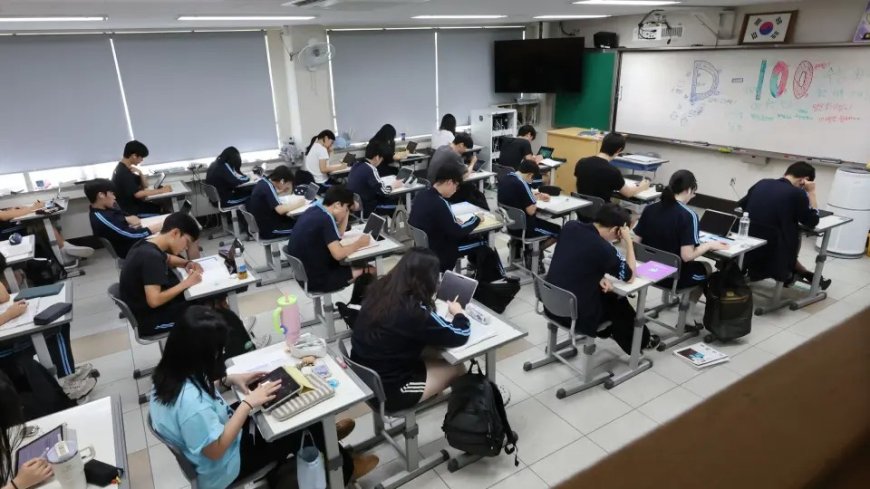
The exam at the centre of the storm is the College Scholastic Ability Test, known in Korea as the Suneung. Held on Thursday, 19 November, it is the single test that largely decides which university more than 550,000 students can attend, and in a country where a university place can shape a career, it is treated as a national event. This year, it became a test of the government's ability to keep up with cheating technology.
A resignation three days after the exam
Choi announced his decision in a statement released through the education ministry, acknowledging that the ministry had failed to prepare in time. "As the minister in charge, I believe I cannot escape criticism that we failed to prepare in advance," he said, according to Yonhap News Agency. "Now that the exam has concluded, I feel a deep sense of responsibility and am offering my resignation."
President Lee moved quickly. His spokesperson, Kang Yu-jung, told reporters that Lee accepted the resignation about an hour after Choi announced his intention to step down, and later formally approved it. Lee also ordered a comprehensive review of national exam management and the laws behind it, and instructed Prime Minister Han Seong-sook to take full responsibility for the follow-up, including measures to be taken after the exam. The process of nominating Choi's successor will now proceed through the usual procedures, and Vice Minister Choi Eun-ok is expected to serve as acting minister until a replacement is appointed, the Maeil Business Newspaper reported.
The rule changes that came too late
The ministry's troubles began with a scandal in an entirely different exam. On 15 November, four days before the Suneung, the top scorer in this year's national certified tax accountant exam admitted he had cheated using a miniature camera, a smartphone and generative AI. The admission exposed how easily modern technology could be smuggled into an exam hall, and it forced the education ministry into a scramble it never recovered from.
Until then, the ministry's anti-cheating preparations had focused mainly on smart glasses. After the tax accountant's confession, officials widened the net in a series of announcements that kept changing right up to the eve of the test. On 17 November, two days before the exam, the government said it would deploy 8,400 extra staff, including 1,800 people assigned to watch for smart devices and 6,600 corridor supervisors. Test takers were told stickers would be placed over the buttons on their clothing to block miniature cameras.
Then, on 18 November, the day before the test, the rules on writing instruments changed again: only black pencils would be allowed into exam rooms, with sign pens, correction tape, erasers and mechanical pencils all banned. During the eight-hour exam itself, authorities restricted Wi-Fi, checked glasses and clothing buttons for hidden devices, and sent three emergency disaster alerts to mobile phones nationwide to help identify students who had failed to hand in their phones.
Students and teachers complained that the shifting instructions only added to the anxiety around an already high-pressure day. The ministry said on Friday that 111 suspected cheating cases involving electronic devices had been detected during the exam, though it was not clear how many involved an actual attempt to cheat.
A remark in parliament that sealed it
Choi had already been under fire before the exam was even held. At a meeting of the National Assembly's Education Committee on Monday, 16 November, a lawmaker asked the 72-year-old minister whether he was fully confident that AI-assisted cheating could be detected. "I don't think I could, because of my age," he replied, a remark that drew sharp criticism and was widely seen as an admission that the ministry was not ready.
The week also brought a darker episode. A man who earned a perfect score on this year's Legal Education Eligibility Test, the national law school entrance exam, was found dead on Thursday after facing allegations of cheating, Yonhap reported. Police said they would continue investigating the allegations.
What happens next
The resignation, coming just three days after the exam and about 14 months after Choi took office, leaves the ministry with two immediate tasks: restoring confidence in the exam system and deciding how to police cheating in an era when AI tools keep getting smaller and harder to detect. President Lee's order for a comprehensive review points to new legislation, with the government expected to push for a legal basis to ban filming exam papers and to block the transmission of questions from inside exam rooms.
For the students who sat the test, the results will matter far more than the politics. But the episode has made one thing clear: in South Korea's most high-stakes exam, the rules for keeping it fair will have to be settled long before exam week, not rewritten during it.
Related reading: South Korea's Chip Boom Leaves Retail Investors Behind as AI Stock Rout Deepens
Sources
- Yonhap News Agency — "(2nd LD) Education minister resigns over college exam chaos amid AI cheating fears", 22 November 2026
- Reuters — "South Korea's education minister quits over exam cheating chaos", 23 November 2026
- The Korea Times — "Education minister resigns amid backlash over CSAT anti-cheating measures", 22 November 2026
- Maeil Business Newspaper — reporting on the resignation, the acting minister and successor candidates, 22 November 2026
What's Your Reaction?
 Like
0
 Dislike
0
 Love
0
 Funny
0
 Angry
0
 Sad
0
 Wow
0