


























































Samsung Galaxy S26 Review: A Cautious Compact Flagship That Plays It Too Safe
GSMArena's full review of the base Galaxy S26 awards it 4.3 out of 5: a compact flagship with a bigger battery, a new Exynos 2600 chip and seven years of updates, but only a modest step up from the Galaxy S25 — and one that falls behind the iPhone 17 Pro, Pixel 10 Pro, Xiaomi 17 and vivo X300 on camera, charging and value. Read the full verdict, lab results and pros and cons.

Samsung Galaxy S26 Review: A Cautious Compact Flagship That Plays It Too Safe
There are not many compact flagships left, and the Galaxy S26 is one of the few still standing. After weeks of lab testing, GSMArena's full review awards Samsung's smallest S26 a score of 4.3 out of 5 — a solid mark for a phone the reviewers describe as a modest upgrade that does a lot of things well, yet never quite escapes the shadow of its bigger siblings or its rivals.
The headline changes are real enough. The battery grows to 4,300mAh, the chipset is the new 2nm Exynos 2600 in most of the world, and the screen is a touch larger at 6.3 inches. But the cameras are unchanged from last year, charging is still capped at 25W, and the design's one visible change — a new unified camera island — is more of a nuisance than an improvement. Here is what the review found, section by section.
Design: familiar, compact, and a camera bump that wobbles
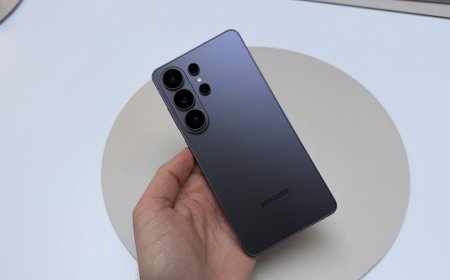
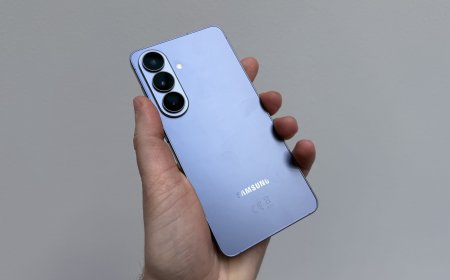
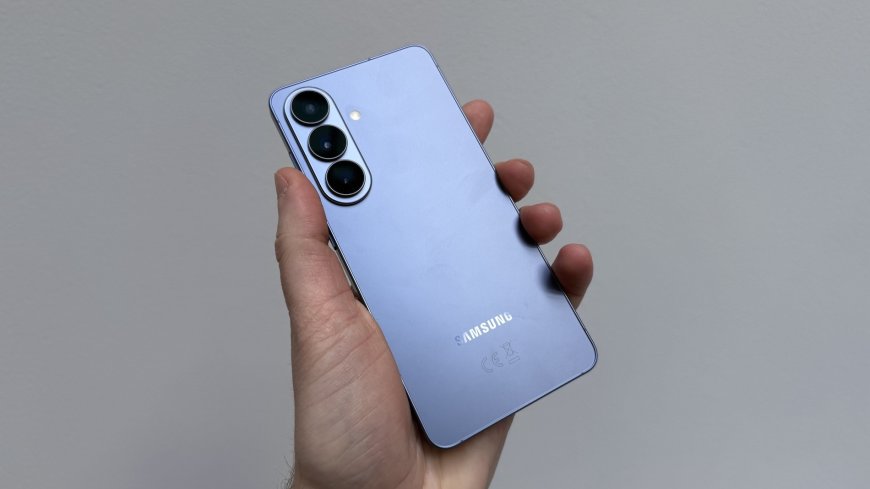
The Galaxy S26 looks much like its last couple of predecessors: a flat front panel, a flat back and a flat side frame. The one change is the camera island. Instead of three separate camera lenses sitting on the back, Samsung has joined them in a single raised bump that sticks out further than before — enough that the phone wobbles when you tap it on a flat surface, which the reviewers call annoying.
At 149.6 x 71.7 x 7.2mm and 167g, the S26 is slightly taller and wider than the S25 thanks to the 0.1-inch larger screen, but no thinner. Materials are unchanged: Gorilla Glass Victus 2 on the front and back, an Armor Aluminum 2 frame and IP68 water and dust resistance. The ultrasonic under-display fingerprint reader is snappy and reliable, working well even with wet or dirty fingers. Colours are Cobalt Violet, Sky Blue, Black, White, Silver Shadow and Pink Gold. The verdict on the design is simple and elegant as ever — small and light enough for easy one-handed use — but the new camera bump looks and feels unnecessary.
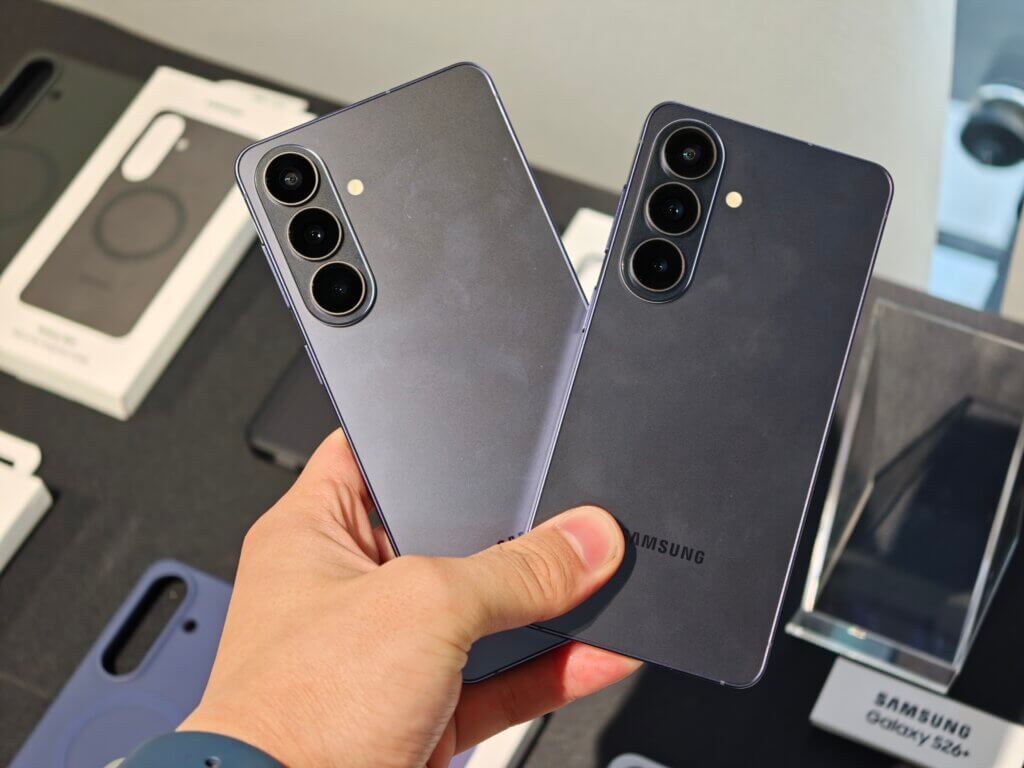
Galaxy S26 series phones on display at a showcase in Japan. Image: Ringo News.
Display: bright and smooth, but no Ultra extras
The 6.3-inch Dynamic LTPO AMOLED 2X panel is almost identical to the Galaxy S25's: FHD+ resolution (1080 x 2340), 120Hz refresh rate and HDR10+ support. There is no Dolby Vision, no high-frequency PWM dimming for sensitive eyes, and no Privacy Display — that stays exclusive to the Ultra, as does the anti-reflective DX coating. You can read our Galaxy S26 Ultra review for how that feature works.
What the screen does offer is strong. GSMArena measured 751 nits in manual mode and almost 1,400 nits in auto mode on a 75% white patch, rising to 2,552 nits on a 10% patch — comfortably bright outdoors and for HDR content. Minimum brightness is just 0.9 nits, a treat for late-night reading. Two new tricks arrive with the Exynos 2600: ProScaler, which sharpens lower-resolution images and text, and mDNIe, which smooths colour gradients. Both modes of the 120Hz refresh rate are adaptive, dropping to 1Hz when the screen is idle, and the phone supports Android Ultra HDR photos in Samsung Gallery, Google Photos and Chrome.
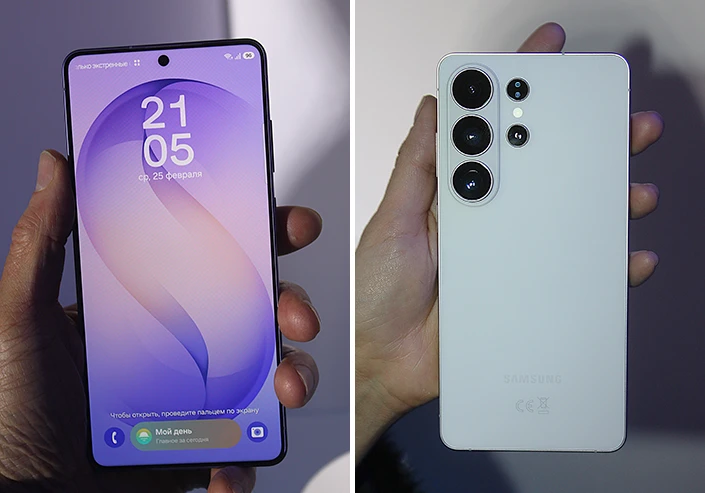
The Galaxy S26 from the front and back. Image: ICT-Online.
Battery and charging: a genuine improvement, still behind rivals
The base S26 is the only member of the family to get a bigger battery this year, and it shows. The 4,300mAh cell — up from 4,000mAh in the S25 — earned a 15:20h Active Use Score in GSMArena's tests, a significant jump over its predecessor. The reviewers credit software optimisation as much as the extra capacity, noting similar gains on the S26+ and S26 Ultra without any battery change. Even so, the S26 trails the Xiaomi 17 and vivo X300, both of which carry larger batteries, while matching the iPhone 17 Pro and beating the Google Pixel 10 Pro.
Charging is where the progress stops. Wired charging stays at 25W over USB Power Delivery, wireless at 15W with Qi2 Ready support — though there are no magnets built in, so a magnetic case is needed for the full Qi2 experience — and reverse wireless at 4.5W. The charging curve is more aggressive than last year's: the S26 reached 62% in 30 minutes and a full charge 13 minutes faster than the S25. Even so, the reviewers note it is still not enough to compete with most phones in this price segment, and even the iPhone 17 Pro is faster in some cases. Speakers earn a "Good" -26.7 LUFS loudness score: a touch quieter than before, but warmer and better balanced, among the best in the class behind only the iPhone 17 Pro.
Performance: the Exynos 2600 is fast, but the gap returns
Samsung is back to its two-chip strategy after pausing it for the S25 family. The US, China and Japan get the Snapdragon 8 Elite Gen 5, while the rest of the world — including the review unit — gets the Exynos 2600, a 2nm chip with a 10-core CPU and the Xclipse 960 GPU. Samsung claims up to 39% more computing performance and up to 113% more AI performance from the upgraded NPU, plus as much as 50% better ray tracing.
In the lab, the picture is mixed. Multi-core Geekbench scores match the Snapdragon 8 Elite Gen 5 inside the S26 Ultra and improve about 10% over last year's Snapdragon 8 Elite, but single-core performance barely reaches last year's level. AnTuTu 11 scored about the same as last year's chips, with the Ultra pulling well ahead in graphics and user-experience sub-scores, and 3DMark showed improvement over the S25 but a clear gap to the Ultra. Sustained performance is the weak spot: about 40% performance loss in the CPU stress test and more than 50% in the GPU test, similar to last year's S25 and a bit worse than the S26+.
The reviewers are blunt about what that means: the dual-chip divide is back, and buyers in Europe and Asia are once again on the wrong side of it. In fairness, the Exynos 2600 will still handle pretty much everything a user throws at it — the disappointment is that Samsung's newest 2nm chip was expected to do more.
Software: One UI 8.5 and seven years of updates
The Galaxy S26 runs Android 16 with One UI 8.5, and Samsung promises seven major OS updates alongside seven years of security patches — one of the longest support commitments in the industry. There are no major changes to the interface itself; the upgrades sit in the Galaxy AI realm, and every Galaxy AI feature from the S26 Ultra trickles down to the standard S26. The reviewers covered One UI 8.5 in depth in their S26 Ultra review, and everything described there is present here.
Cameras: great daylight, excellent selfies, frustrating nights
The camera hardware is unchanged from the S25: a 50MP main camera (f/1.8, OIS), a 10MP 3x telephoto (f/2.4, OIS) and a 12MP ultrawide (f/2.2, fixed focus), plus a 12MP selfie camera with a wider 23mm lens. The headline on the camera page says it plainly — midrange cameras at a flagship price, with standout selfies.
In daylight, the main camera delivers great photos with very good detail, reliable white balance, pleasing colours and excellent dynamic range. The 2x zoom mode works well in good light, the telephoto produces okay results with pleasing colours, and the ultrawide is solid outdoors — though its fixed focus means nearby subjects end up blurry, and indoor shots can go soft. Portrait mode handles subject detection well, and the 3x telephoto can focus as close as 17cm, slightly better than the Plus and Ultra.
Selfies are the clear camera win. The wider lens, autofocus and the same proven sensor produce great sharpness, wide dynamic range and excellent colours, with low-light results that are not half bad. The reviewers call it a standout.
After dark, the story changes. The main camera's full-auto photos look soft and noisy, and the S26 is noisier still than the S26+. The new Night mode is the frustration: there is no dedicated mode in the carousel, the automatic version does not kick in often, and when it does not, there is no way to force it on. Maxing it out cleans things up, but the results stay softer than the Plus. A workaround exists — Samsung's Camera Assistant app can restore a dedicated Night mode — but as the reviewers put it, that is not the point-and-shoot experience expected from a smartphone in 2026. Their photo verdict is measured: not too bad, just not particularly good for its class.
Video is a stronger suit. The S26 records 4K60 on every camera and 8K30 on the main, with 10-bit HDR10+, a Log option, pre-loaded LUTs and a Horizon Lock mode that keeps footage level up to 1440p. Pro video adds a 24fps setting, though there is no 4K120 and no pro-grade APV codec as on the Ultra. Video quality is very good from the main camera and the ultrawide in both daylight and low light, the telephoto is decent in good light and much less so at night, and stabilisation is excellent — a little better than the Plus.
Competition and verdict: better than the S25, but the value is elsewhere
At $900 for the 12GB/256GB base model in the US, the Galaxy S26 sits head-to-head with the iPhone 17 Pro and the Google Pixel 10 Pro, and in Europe and India it faces the Xiaomi 17 and vivo X300 in the €900–1,000 bracket. Against the iPhone and the Pixel it matches them on display, charging and battery life, and the decision comes down to cameras — where the S26 is a bit behind. Against the Xiaomi 17 and vivo X300, it is harder still: both match the price while offering more in return, excelling in cameras and doing better in battery life and charging tests.
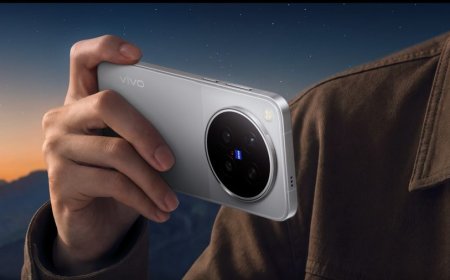
GSMArena's verdict gives Samsung credit for optimising the existing hardware — notably better battery life, somewhat faster charging, and new AI and video features — but says it is increasingly hard to sugar-coat how minor the upgrades are. The S26 still feels like the flagship underdog next to the Plus and Ultra, and it is more than a few laps behind the competition in camera hardware, battery technology and charging. The conclusion is blunt: there are better value smartphones at the same price, so unless you are a die-hard fan of Samsung's otherwise excellent One UI and its promise of long support and AI features, your money will be better spent elsewhere.
Pros
Premium build quality. Bright LTPO OLED panel. Better battery life and faster charging times than the Galaxy S25. Seven years of Android updates and security patches. Excellent selfie camera with autofocus. Versatile video recording features with LUTs and Horizon Lock.
Cons
Very minor upgrade over the Galaxy S25 overall. Base level IP68 rating — other Androids get IP69. Display is missing 10-bit depth, high-frequency PWM and Dolby Vision support. Video recording lacks 4K120 and APV codec support found on the S26 Ultra. Unintuitive Night mode implementation. Charging speeds still lag behind many competitors, even the other S26 models.
Sources
GSMArena — Samsung Galaxy S26 review (full review, all six pages): https://www.gsmarena.com/samsung_galaxy_s26-review-2942.php — score 4.3 out of 5, Active Use Score 15:20h, US price $900 (12GB/256GB).
Featured image: Samsung Magazine hands-on photo of the Galaxy S26: https://samsungmagazine.eu/wp-content/uploads/2026/02/Galaxy-S26-3.jpg
What's Your Reaction?
 Like
0
 Dislike
0
 Love
0
 Funny
0
 Angry
0
 Sad
0
 Wow
0