






























































Alibaba Trains Next Qwen Model on Homegrown T-Head Chips as US Curbs Tighten
Alibaba CEO Eddie Wu said on the company's earnings call on 19 November that the next generation of its Qwen AI models is already being trained on chips from its own semiconductor unit T-Head, with domestic chips set to underpin all of its training work by 2027. The disclosure comes days after Washington tightened rules on China's access to advanced AI chips.

Alibaba Trains Next Qwen Model on Homegrown T-Head Chips as US Curbs Tighten
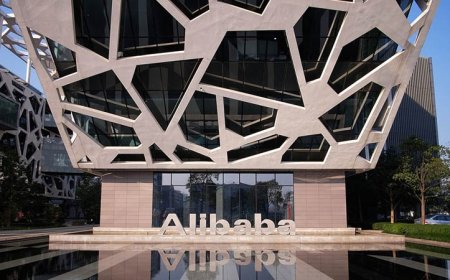
Alibaba is already training its next-generation Qwen artificial intelligence model on chips designed by its own semiconductor unit, T-Head, chief executive Eddie Wu told analysts on Thursday, in the clearest sign yet that the Chinese technology group is moving its AI work onto domestic hardware as Washington tightens access to advanced American chips.
The disclosure came on Alibaba's earnings call for the July-September quarter, held on 19 November. Wu said the company's Bailian platform, known internationally as Model Studio, is already serving customers with inference work running on domestically produced chips as well.
"Progress in developing domestic computing power has exceeded our expectations," Wu said on the call, adding that T-Head is accelerating its three-generation roadmap for graphics processing units. He said that by 2027, domestic chips would "certainly underpin all our training workloads, including both pre-training and post-training."
A three-generation chip roadmap
Wu laid out the timetable for T-Head's Zhenwu line of AI accelerators. The current chip, the Zhenwu M890, entered service in August and its supernode systems have moved into large-scale commercial use, with shipments continuing to ramp up. Mass production of the next chip, the Zhenwu V900, is due to begin in the first quarter of 2027, with supernode clusters built on it reaching commercial scale in the second quarter of that year. A third generation, the J900, is scheduled for 2028.
The company also said most of the new AI chip capacity it adds after 2027 will come from domestic suppliers, with T-Head's own flagship chips given first priority for training its foundation models and those of close partners. Other Chinese suppliers will help cover inference workloads, where Wu said capacity constraints could bite in the short term.
T-Head, which Alibaba set up in 2018, was recently approved for a listing in Hong Kong, giving the chip unit its own route to raise capital as it scales up production. Wu said Alibaba plans to "significantly ramp up production capacity" for T-Head chips over the next two years.
Why the timing matters
The announcement landed days after the US Commerce Department's Bureau of Industry and Security issued a new rule on Monday restricting China's access to advanced AI chips through overseas data centres. Investors had questioned whether Alibaba could keep training and running its next-generation models under the tighter regime, and its shares have fallen 43 percent since the start of the year, hitting a new low as the Hong Kong market closed on Thursday.
Wu sought to reassure them, saying there would be "some short-term effects" from the new restrictions but that the company expects to manage the transition. Alibaba is still assessing how the rules could affect its overseas cloud business, he added, while international expansion remains a long-term priority.
The shift also has a commercial logic. Wu argued that the close integration of Alibaba's own chips and its own models would cut computing costs per unit of work and speed up application development, and that infrastructure built on domestic chips is becoming the foundation of the group's full-stack AI capabilities, supporting training, inference and agent-based workloads for Alibaba and its cloud customers alike.
A strong quarter behind the announcement
Alibaba reported better-than-expected results for the quarter alongside the chip disclosure. Profit rose 213 percent from a year earlier to 64.4 billion yuan (about $9.7 billion), while revenue reached 271.5 billion yuan, ahead of the 270.3 billion yuan average estimate from analysts surveyed by LSEG. AI cloud revenue grew 53 percent, and annual revenue from AI-related products has now passed $10 billion.
The new model being trained on T-Head hardware follows last week's launch of Qwen4-Max, Alibaba's flagship foundation model, which the company says has 2.4 trillion backbone parameters. Coverage of the call also indicated Alibaba may trim its 20-gigawatt data-centre build-out target as it reassesses demand under the new export rules.
For Alibaba, the message of the call was that its AI ambitions no longer depend on a steady supply of foreign chips. Whether its domestic hardware can keep pace with the largest models remains the open question, and the first real test will be the V900's mass production early next year.
Sources
- Nikkei Asia — Alibaba trains next-gen AI model on own chips amid tighter US curbs
- TechNode — Alibaba uses its own chips to train next-generation Qwen model
- Yicai Global — Alibaba to Use More Chinese Computing Power as Its AI Chip Output Ramps Up, CEO Says
- Alibaba Group September Quarter 2026 earnings call transcript (Roic AI)
Related Innopark IT coverage: Alibaba's AI Cloud Revenue Jumps 53% as September-Quarter Sales Beat Estimates; Alibaba Plans Hong Kong Listing for Its T-Head Chip Unit; Alibaba Unveils Qwen4-Max, Its New Flagship AI Model.
What's Your Reaction?
 Like
0
 Dislike
0
 Love
0
 Funny
0
 Angry
0
 Sad
0
 Wow
0