





















































Trump–Xi Summit in Shenzhen Faces AI Chip Curbs Test as Safety Talks Move Forward
Donald Trump and Xi Jinping meet in Shenzhen on Thursday, November 19, with tighter US curbs on China's access to advanced AI chips set to dominate the talks — even as both sides work on AI safety cooperation, including an incident-notification mechanism that is still not operational.
Trump–Xi Summit in Shenzhen Faces AI Chip Curbs Test as Safety Talks Move Forward
Donald Trump and Xi Jinping will meet in Shenzhen on Thursday, November 19, for a summit where the question of advanced AI chips is expected to weigh over almost everything else. The prospect of tighter American curbs on China's access to the most powerful chips is likely to overshadow the talks, analysts told Reuters, even as the two sides try to make headway on cooperation over the safety risks of increasingly powerful AI systems.
The meeting comes only days after the resignation of Nvidia co-founder Jensen Huang, who had been a prominent voice in favour of selling chips to China and who featured heavily at the US-China summit in Busan a year ago. Huang stepped down after reports of an affair with a suspected Chinese spy, and the scandal has since fuelled a push in Washington to tighten China's access to advanced AI chips — a move Beijing will be bracing for when the two leaders sit down.
"President Xi may not name or mention Jensen Huang, but I'm pretty sure export controls will be high on the agenda when he meets Trump," George Chen, chair of digital practice at consultancy The Asia Group, told Reuters.
The chip question at the centre of the summit
For Beijing, the concern goes beyond any single rule. Chen said the Chinese government's key worry was not just technology controls, but whether Washington is moving to contain China's broader technological and economic rise. "If we are moving from strategic stability to strategic containment, that's a big shift and that's what Beijing is watching," he said.
That tension was sharpened on Monday, November 16, when the US Commerce Department's Bureau of Industry and Security issued an interim final rule aimed at stopping Chinese companies from reaching advanced American AI computing through data centres in other countries. The rule requires a licence to export, re-export or transfer advanced chips and servers to any data centre anywhere in the world that provides more than 12 million total processing performance (TPP) of computing power to companies headquartered in China, Macau or other restricted countries.
The same rule adds licence requirements for shipments of advanced semiconductors to Indonesia, Malaysia, Singapore, Thailand and Brazil, which the Commerce Department described as presenting a higher-than-normal risk of diversion. It also formally rescinds the Biden-era AI Diffusion Rule, which was never enforced. Existing data centre operators covered by the new rule have 90 days from its effective date to obtain licences.
The timing is hard to miss. The rule landed the same day Trump departed for Asia, and days after Huang's resignation put semiconductor exports under fresh scrutiny in Washington. It follows months of reporting on how banned Nvidia chips reached Chinese AI projects — reporting that has already shaped the regional fallout across Southeast Asia and the Reuters exclusive on Huang misleading Nvidia's top lawyer. For more on the resignation itself, see our report on Huang stepping down as Nvidia CEO.
A safety channel that still is not working
Despite the rivalry, Washington and Beijing have been exploring cooperation on the risks posed by powerful AI systems. Three people briefed on preparations for the talks told Reuters that the two sides had planned further AI discussions around the Shenzhen summit, covering safeguards against misuse of the technology.
One idea under discussion is an emergency mechanism for the two countries to notify each other of serious AI incidents. The proposal was discussed by US Treasury Secretary Scott Bessent and Chinese Vice Premier He Lifeng in September, but it has yet to become operational, according to several people familiar with the discussions, who did not say what was delaying it.
The mechanism is meant to stop AI-related incidents or misunderstandings from escalating into national security crises. For now, communication has relied largely on direct contacts between senior officials. Bessent said in New York last week that both sides would discuss communication protocols for AI safety incidents at the APEC AI talks and expected to exchange best practices for testing advanced models.
Neither side, analysts say, wants the chip dispute to wreck the summit itself. "Right now, I don't think it's in the interest of either side to let the potential export control squeeze sour the leaders' summit," Bo Zhengyuan, a Shanghai-based partner at research consultancy Plenum, told Reuters.
What else is on the table
The summit will not produce movement on trade. The US and China will not announce any further progress on the Board of Trade initiative, agreed at their September summit in Washington, to lower reciprocal tariffs on $30 billion worth of goods, a senior US administration official told Reuters.
China has identified AI and the digital economy as priorities for the Asia-Pacific Economic Cooperation (APEC) forum in Shenzhen, with Foreign Ministry spokesperson Mao Ning saying Beijing hoped leaders would reach practical agreements in both areas. More than 2,000 political and business leaders are expected at the APEC CEO Summit on November 17–18, including representatives from 115 Fortune Global 500 companies.
Trump is not bringing a formal business delegation, according to the administration official. Elon Musk is the main chief executive travelling with him, while other corporate leaders are attending at China's invitation. Musk, Mastercard CEO Michael Miebach and FedEx CEO Raj Subramaniam are expected to attend the summit dinner.
Thursday's meeting in Shenzhen will also be the setting for a separate trilateral meeting between Xi, Trump and Russian President Vladimir Putin — the first face-to-face meeting of the three leaders, according to China's Foreign Ministry, which described it as having "groundbreaking significance" for safeguarding world peace and promoting strategic stability among major powers.
Why it matters
The Shenzhen summit captures the contradiction at the heart of the US-China relationship: two governments racing to control the most powerful technology of the decade while trying to build guardrails so that same technology does not trigger a crisis between them. The chip curbs, the stalled safety mechanism and the trade freeze all point in the same direction — competition is hardening, but neither side is ready to walk away from the table. What the leaders agree, or fail to agree, on Thursday will set the terms for that competition into 2027.
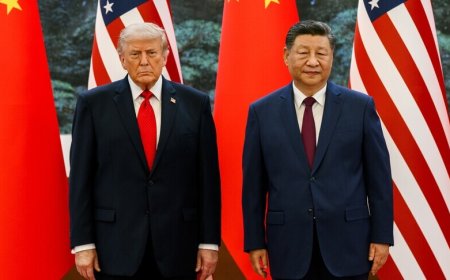
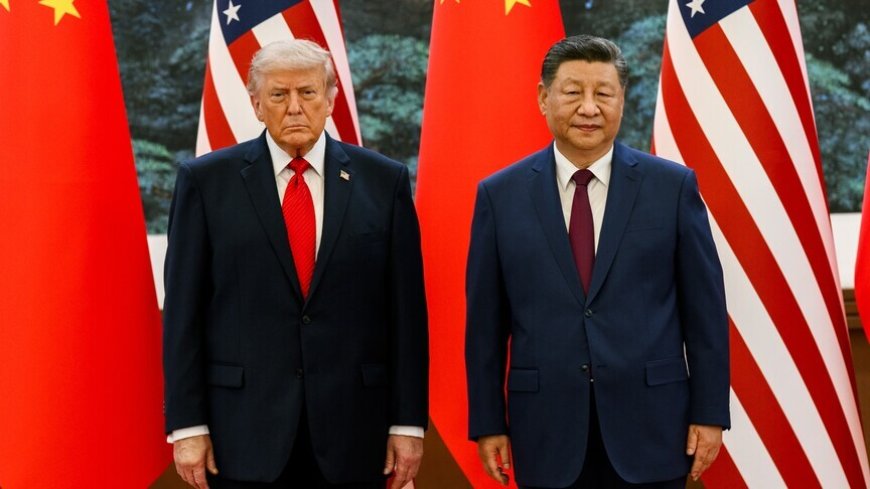
The photograph above shows Presidents Trump and Xi at an earlier summit meeting.
Sources
- Reuters — "Chip tensions loom over Trump-Xi summit, as US and China push AI safety steps", November 16, 2026 — https://www.reuters.com/business/media-telecom/chip-tensions-loom-over-trump-xi-summit-us-china-push-ai-safety-steps-2026-11-16/
- Reuters — "US issues rule to protect advanced AI chips from being accessed remotely", November 16, 2026 — https://www.reuters.com/legal/litigation/us-issues-rule-protect-advanced-ai-chips-being-accessed-remotely-2026-11-16/
- TechCrunch — "US tightens AI chip export controls to deter Chinese companies from accessing compute remotely", November 16, 2026 — https://techcrunch.com/2026/11/16/us-tightens-ai-chip-export-controls-to-deter-chinese-companies-from-accessing-compute-remotely/
- Reuters — "China says Xi-Putin-Trump meeting has 'groundbreaking significance'", November 16, 2026 — https://www.reuters.com/world/china/china-says-xi-putin-trump-meeting-has-groundbreaking-significance-2026-11-16/
What's Your Reaction?
 Like
0
 Dislike
0
 Love
0
 Funny
0
 Angry
0
 Sad
0
 Wow
0