

























































India Stocks Stage a Comeback as Global Funds Rotate Out of the AI Trade
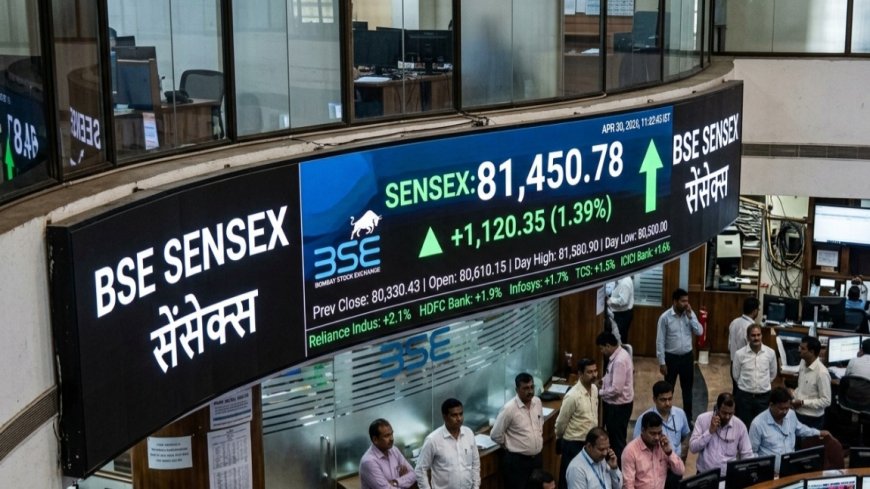
India's stock market has rebounded sharply as global investors rotate out of crowded artificial intelligence stocks. The MSCI India gauge has climbed 11 per cent from its October low, adding more than $400 billion in value, while foreign buyers have poured a net $8.5 billion into Indian shares in November.
India Stocks Stage a Comeback as Global Funds Rotate Out of the AI Trade
Indian stocks have staged a sharp recovery in November, turning one of Asia's weakest markets of 2026 into one of its brightest in a matter of weeks. The trigger was not something that happened in Mumbai. It was the unwinding of the year's most crowded trade: artificial intelligence.
For the first nine months of the year, Indian shares suffered bruising losses as the AI trade hoovered up global investor capital. Money poured into chipmakers, data-centre builders and the handful of markets that supply them, while India — with little exposure to the AI hardware supply chain — was left behind. Now that the AI trade is cooling, the same lack of exposure has become India's advantage.
MSCI India rebounds 11 per cent from its October low
The MSCI India gauge has rebounded 11 per cent from a six-month low set in October, adding more than $400 billion in value and almost erasing this year's losses, according to data compiled by Bloomberg. India's equity market is now worth roughly $5.4 trillion.
The bounce has been driven by a broad rotation by global funds away from crowded technology bets and toward markets backed by strong earnings. India, with its deep domestic market and limited AI hardware footprint, has been one of the main beneficiaries.
"We've become more positive on India and have added back to our exposure in recent weeks," Tan Altundag, an investment manager for emerging equities at Pictet Asset Management in Hong Kong, told Bloomberg.
Foreign buyers return with $8.5 billion in November
A return of overseas investors has underpinned the rebound, and the process may still have room to run. Overseas buyers have snapped up a net $8.5 billion of Indian shares in November, heading for the biggest monthly inflow in six years, according to data compiled by Bloomberg. That has reduced the total outflow for 2026 to about $22 billion.
Domestic data point the same way. Foreign portfolio investors pumped about Rs 54,000 crore into Indian equities in the first six trading sessions of November, a sharp reversal after outflows of nearly Rs 35,000 crore in each of September and October, Moneycontrol reported.
Even so, global funds remain far from fully invested in India. Active long-only funds globally remain $74 billion underweight on Indian shares relative to the benchmark, Bank of America data show — close to their lightest positioning since the bank began compiling the figures in 2015. That gap is one reason some managers see further upside if the rotation continues.
Cheaper oil and faster earnings are helping too
The AI unwind is not the only force behind the rally. Two domestic supports are lining up at the same time: falling oil prices and accelerating earnings growth.
Brent crude has fallen by more than 18 per cent since its peak on October 30, easing pressure on India's import bill and the rupee. India imports nearly 90 per cent of its energy needs, so cheaper oil is a direct tailwind for both the economy and the market.
Earnings are also improving. Earnings for Nifty 50 companies may rise around 18 per cent year-on-year in the September quarter, accelerating from 13 per cent growth in the prior three months, Bank of America data show. Of the 47 Nifty 50 companies that had reported by November 10, 27 beat analysts' estimates, 17 were broadly in line and only three missed, according to Moneycontrol.
The improving outlook is already showing up in broker calls. Citi raised its Nifty target to 28,000, implying about 12 per cent upside, citing resilient earnings, softer crude prices and capital rotating away from crowded AI trades. HSBC has also upgraded India to overweight from neutral, pointing to improved valuations, corporate earnings and strong credit growth.
Valuations, too, look more forgiving than they did a year ago. The MSCI India gauge trades at a price-to-earnings ratio of about 20 times one-year-ahead profits, a discount to its five-year average, data compiled by Bloomberg show.
What triggered the AI sell-off
The rotation began with a reassessment of the AI boom itself. The Democratic Party's sweep of the United States midterm elections raised the prospect of tighter regulation of the artificial intelligence industry, and investors began to question whether the heavy spending on data centres would pay off. The Nasdaq Composite fell sharply on November 5, and the sell-off spread from Tokyo to Seoul.
AI infrastructure providers were hit hardest. Iren, Nebius and CoreWeave had each fallen at least 40 per cent from the Nasdaq's October 6 peak, while Nvidia fell 6.5 per cent on November 10 alone. Capital rotated toward Chinese and Indian stocks, which carry far less exposure to AI hardware.
For India, the shift is a reminder that being left out of a rally can become an advantage when that rally reverses. The country was largely bypassed by the AI-led surge; now it is attracting capital looking for exposure beyond an increasingly concentrated technology trade.
The rebound still has something to prove
Despite the recent advance, the durability of India's rebound still needs to be tested. The MSCI India gauge has still dropped 2.2 per cent in 2026, whereas the index provider's regional benchmark has jumped about 12 per cent. The Indian measure is on track for back-to-back years of underperformance against its regional peer for the first time since 2020, according to data compiled by Bloomberg.
The question for investors now is whether the rotation has further to run. Foreign positioning remains light, earnings are accelerating and valuations sit below their recent averages — but the market's gains still depend on global funds continuing to move money out of AI stocks and into markets like India. For now, though, the great rotation has given Indian equities their best month of the year.
Related coverage: Neocloud and AI stocks slide again as Nvidia turmoil rattles the sector; Nvidia fallout throws spotlight on Southeast Asia's AI boom; US stock market: S&P 500 and Nasdaq slip on Friday but hold weekly gains.
Sources
- The Straits Times — "AI retreat fuels India stock comeback in great rotation trade" (Bloomberg), November 15, 2026
- The Business Times — "AI retreat fuels India stock comeback in great rotation trade" (Bloomberg), November 15, 2026
- The Economic Times — "AI retreat fuels India stock comeback in great rotation trade" (Bloomberg), November 15, 2026
- Forbes India — "Indian Equities Stage Sharp Recovery as Capital Rotates Away From AI"
- Moneycontrol — "Three forces behind November's market turnaround: AI correction, Rs 54,000-crore FII comeback and earnings resilience"
What's Your Reaction?
 Like
0
 Dislike
0
 Love
0
 Funny
0
 Angry
0
 Sad
0
 Wow
0