



































































Riemann Hypothesis Proof Claimed Twice in One Day — by AI and by a Human Mathematician
On 20 November 2026, Anthropic mathematician Levent Alpöge said he had found a proof of the 167-year-old Riemann Hypothesis working with the AI model Claude — and hours later a rival human-written proof by Alessandro Masullo was posted by Stanford's Ravi Vakil. Neither claim is peer-reviewed or confirmed yet, but independent mathematicians have verified that Alpöge's machine-checkable Lean code compiles without errors.
Riemann Hypothesis Proof Claimed Twice in One Day — by AI and by a Human Mathematician
Mathematics may have just had its most extraordinary day in living memory — or it may be looking at two claims that still have a long way to go before anyone can call them proofs. On 20 November 2026, Levent Alpöge, a mathematician at the AI company Anthropic, announced that he believed he had found a proof of the Riemann Hypothesis, one of the most famous unsolved problems in mathematics, working together with Anthropic's AI model Claude. Hours later, a second, entirely human-written claim to the same prize appeared online.
Both announcements are claims, not confirmed results. Neither has been peer-reviewed, and no human has yet read and understood either argument in full. But the reaction from leading mathematicians has been striking: many of them think Alpöge's claim, at least, may well turn out to be right.
What Alpöge says he found
Alpöge, a number theorist on leave from Harvard University who now works at Anthropic in San Francisco, posted a four-page note on his personal website on 20 November. In it he wrote: "I believe I have, working with Claude, discovered a proof of the Riemann Hypothesis."
There is no conventional paper to go with the announcement. The argument exists as computer code written in Lean, a programming language designed so that software can check a mathematical proof line by line. Alpöge released 17 million lines of that code, which he says formally verifies a broader version of the conjecture known as the Generalized Riemann Hypothesis. Written out in ordinary mathematical prose, he says, the argument would run to more than 250,000 pages.
That code has already passed its first real test. Independent mathematicians, including Andrew Sutherland of the Massachusetts Institute of Technology, downloaded Alpöge's Lean code and reported that it compiles successfully, meaning the machine checker found no errors in it. That is a strong signal, but it is not the same as a human understanding of why the proof works — and that understanding could take a very long time to build.
"I suspect that the proof will turn out to be correct," James Maynard, a Fields Medal winner and number theorist at the University of Oxford, told Nature. "If this fully checks out, it is clearly a historic milestone in mathematics."
Alpöge has been working with Claude on the hardest problems in mathematics for months, and the decisive stretch lasted 41 days, from 6 October to 16 November. It is not his first breakthrough with the model: he previously used Claude to produce a counterexample to the 87-year-old Jacobian conjecture, and in August he and Ralph Furman published a Claude-assisted result showing that at least two-thirds of the zeta function's zeros lie on the critical line, up from the previous record of 41.6 percent.
Alongside the Riemann claim, Alpöge and Tristan Buckmaster, a mathematician at New York University, also released advances on problems related to the Euler and Navier-Stokes equations, which describe how fluids such as air and water flow.
The human rival, twelve years in the making
Hours after Alpöge's note went up, a rival proof appeared. Ravi Vakil, a mathematician at Stanford University, posted a preprint written by Alessandro Maria Masullo, who earned his PhD at Stanford in 2020 under the supervision of number theorist Brian Conrad. The proof is entirely human, with no AI involved, and it is the result of about twelve years of work.
Masullo's manuscript runs to around 940 pages, and it was not meant to be public yet. The plan had been to spend another year polishing the writing and circulating it among experts before announcing it. The AI announcement forced their hand.
"The hope was to have Brian work with Alessandro for a year to polish the writing and then announce it after running it by enough people," Vakil wrote. "Now it seems best to put out the current draft."
Unlike Alpöge's claim, Masullo's proof has not been expressed in Lean, so there is no machine check to lean on yet. It is too early to say whether the argument holds up, let alone whether anyone fully understands it. In a brief introduction to the draft, Masullo addressed mathematicians unsettled by the pace of AI progress: "If any message at all this work is meant to send to the mathematician who feels discouraged by the pace and tone of the current climate, it is this: we are still here. We are very much alive. We are not going anywhere."
What the Riemann Hypothesis actually says
The problem dates back to 1859, when the German mathematician Bernhard Riemann published a short paper on the distribution of prime numbers — the numbers divisible only by one and themselves: 2, 3, 5, 7, 11 and so on. Riemann discovered that the pattern of the primes is encoded in a mathematical object called the Riemann zeta function, and he conjectured that, apart from some obvious cases, all of the function's nontrivial zeros lie on a single vertical line in the complex plane, the line where the real part equals one half.
If true, that would mean the primes are scattered among the whole numbers in about as random a way as they possibly could be. The hypothesis is one of the seven Millennium Prize Problems chosen by the Clay Mathematics Institute, which offers a one-million-dollar prize for a solution to each. The timing of the claims adds a touch of symmetry: Riemann was born 200 years ago this September.
AI has been closing in on the problem all year. Just last month, researchers at OpenAI used an advanced version of ChatGPT to prove what is known as the quasi-Riemann hypothesis, ruling out zeros in a strip of the plane between seven-eighths and one. Alpöge's claim, if it holds, would go all the way.
Not everyone is cheering
The announcement has also drawn criticism. Andrew Granville, a number theorist at the University of Montreal, said Alpöge should have taken the time to prepare a clearer write-up before going public, calling the four-page document "garbled". Granville also questioned the timing: the claim arrived just days after Anthropic's stock market debut, an initial public offering that initially valued the company at 1.5 trillion dollars before its valuation fell on 19 November.
Alpöge addressed that suspicion directly in his document, writing: "There is an obvious cynical view, to do with the timing, but it is false." Anthropic did not immediately respond to Nature's request for comment.
For now, the Clay Mathematics Institute still lists the Riemann Hypothesis as unsolved, and that will not change until the mathematics community has checked and understood what has been claimed. If either proof survives that scrutiny, it would be one of the great results in the history of mathematics. If both fail, the problem will go back to waiting — as it has for 167 years.
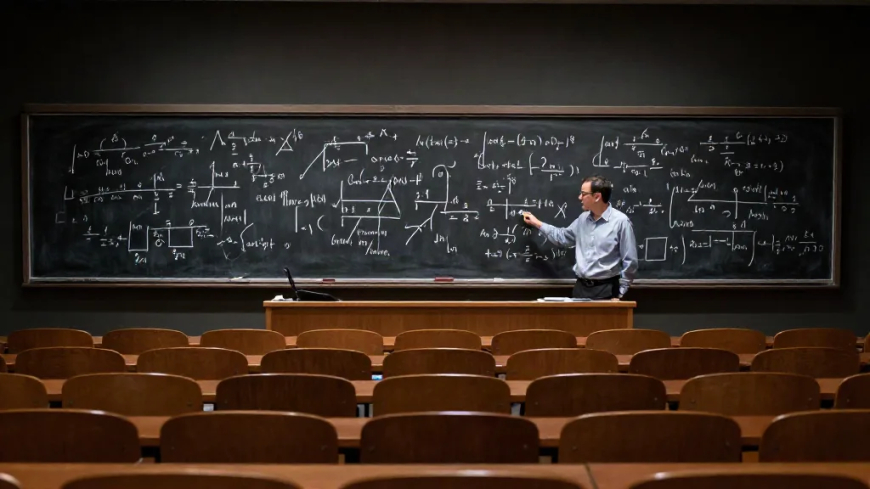
The featured image shows a mathematics lecture scene and is illustrative; it does not depict Alpöge or Masullo.
Sources
- TechCrunch — AI claimed a solution to the 167-year-old Riemann hypothesis — and a human did, too
- Nature — Mathematicians astounded by AI and human-written proofs of iconic Riemann hypothesis
- Science — AI may have solved math's greatest mystery. Can humans understand the answer?
Related on Innopark IT: Anthropic's record stock market debut.
What's Your Reaction?
 Like
0
 Dislike
0
 Love
0
 Funny
0
 Angry
0
 Sad
0
 Wow
0