



























































Daniel Ek Backs Europa Fusion: Spotify Founder Funds AI Researcher's Stealth Fusion Power Startup
Spotify founder Daniel Ek is backing Europa Fusion, a stealthy UK fusion power startup founded by former DeepMind AI researcher Nantas Nardelli, which plans a simulation-first take on pulsed-power fusion.
Daniel Ek Backs Europa Fusion: Spotify Founder Funds AI Researcher's Stealth Fusion Power Startup
Spotify founder Daniel Ek is backing Europa Fusion, a stealthy fusion power startup in the United Kingdom founded by an artificial intelligence researcher who wants to build a fusion power plant differently. The company, founded in February 2026, is pursuing pulsed-power fusion — but with a heavier bet on simulation and data than on building physical test hardware first.
Bloomberg first reported Ek's backing of the startup on November 18, and TechCrunch reported further details on November 20. The size of Ek's investment has not been disclosed, and it is unclear whether his investment firm Prima Materia is involved. Ek's spokesperson declined to comment, and Nardelli did not respond to requests for comment, according to Bloomberg.
A stealth startup with an AI pedigree
Europa Fusion was founded by Nantas Nardelli, a veteran AI researcher whose career has run through some of the most prominent machine learning labs in the world. He previously worked at Google DeepMind, Facebook AI Research and Microsoft Research Cambridge, and most recently served as head of machine learning at Pacific Fusion, a fusion power startup based in Fremont, California.
UK company records list Europa Fusion Industries Ltd as incorporated in London on February 9, 2026, with Nardelli as its sole director. Sources told TechCrunch that Nardelli had been working on the idea for longer before formally setting up the company, and that he met London venture investors earlier this year to raise initial funding.
The move from AI research to fusion energy was driven by climate change, according to Nardelli's own writing. On his personal website he describes his background in electronics and control engineering and says he used to build robots for a living, adding: "One day I'll be back to that, but it's time to fix climate change for good."
Pulsed power, with a simulation-first twist
Like Pacific Fusion, Europa Fusion will pursue a pulsed-power approach to fusion. Pulsed-power reactors use massive, precisely timed surges of electrical current to compress fuel targets until the atoms inside fuse and release energy.
Where Nardelli parts company with much of the fusion industry is in how to get there. Pacific Fusion, which recently broke ground on a demonstration facility in New Mexico, leans heavily on physical devices to test its theories and improve its simulations — an approach shared by most fusion startups of its size. Nardelli apparently did not agree with that hardware-first focus, a source familiar with his thinking told TechCrunch. Instead, he believes fusion startups should invest more in a simulation- and data-heavy approach, using computing to explore designs before committing to expensive hardware.
That is a bet that plays to Nardelli's strengths: his career has been built on machine learning, and modern fusion research increasingly depends on simulations that can model the extreme physics inside a reactor. Whether a simulation-first strategy can shorten the path to a working power plant remains an open question — the company has released no public technical details, and its work is still in stealth.
Why Ek is betting on fusion
For Ek, Europa Fusion is another step into European deep tech, beyond the music streaming business that made his name. He is co-chair of Helsing, the defence AI company, where his firm Prima Materia led a 600 million euro funding round in 2025. He has also backed Neko Health, a health-scanning startup.
Fusion power has the potential to become a significant energy source in the coming decades, drawing on nearly limitless fuel supplies to generate carbon-free electricity. It also has a direct link to the AI boom: data centres are consuming ever more power, and fusion is one of the few technologies that could, in principle, meet that demand without adding to climate change. That connection — an AI researcher building the power source AI itself may one day need — is part of what makes this particular bet stand out.
Fusion's long road to the grid
The enthusiasm comes with a necessary reality check. No one has yet built a fusion power plant capable of supplying electricity to the grid, and the technology has a long history of timelines slipping. Europa Fusion is an early-stage, stealth-mode company, and its approach is unproven at commercial scale.
Even so, the flow of tech founders and AI talent into fusion is becoming a pattern in its own right. Private fusion companies are now raising serious money and breaking ground on demonstration plants, and investors who made their fortunes in software are increasingly willing to fund the long, capital-heavy road to commercial fusion. Ek's backing of a small UK startup led by a former DeepMind researcher is the latest sign of that shift — and one to watch as Europa Fusion moves out of stealth.
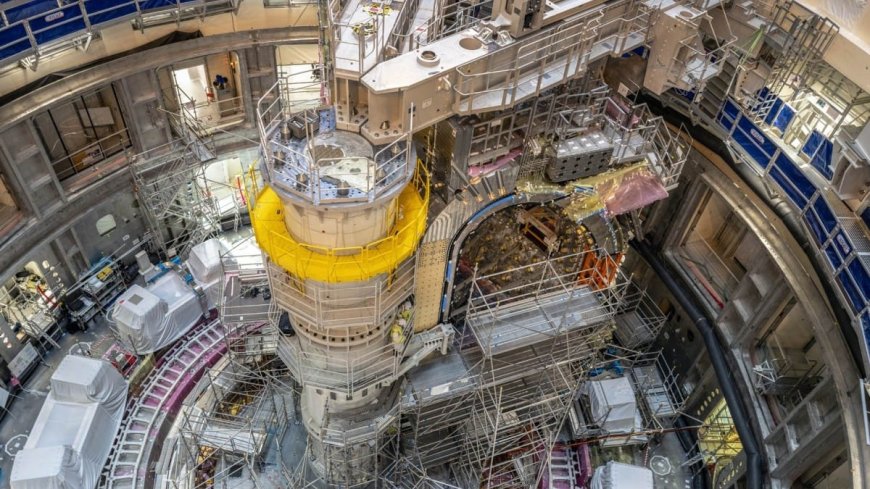
The featured image shows the ITER tokamak under construction. Europa Fusion is in stealth and has released no images of its own, so the photo shows a closely related fusion project rather than the startup itself.
Sources
What's Your Reaction?
 Like
0
 Dislike
0
 Love
0
 Funny
0
 Angry
0
 Sad
0
 Wow
0