























































Fervo's Geothermal Order Book Hits $11.9 Billion as Google Signs 396 MW Deal
Fervo Energy's contracted revenue jumped to $11.9 billion after a 396-megawatt Google power deal, with its first Cape Station geothermal unit already selling power and 1,054 megawatts now under binding agreements.
Fervo's Geothermal Order Book Hits $11.9 Billion as Google Signs 396 MW Deal
Geothermal developer Fervo Energy now holds $11.9 billion in contracted revenue, after a major power deal with Google lifted its order book by roughly two-thirds in a single quarter. The Houston-based company disclosed the figure in its third-quarter earnings report on Monday, November 9, 2026, as the race to power artificial intelligence data centres pushes hyperscalers toward round-the-clock clean energy.
The jump came almost entirely from one customer. Fervo said it now has 1,054 megawatts of capacity under binding power purchase agreements, up from 658 megawatts and about $7.2 billion in contracted revenue at the end of the second quarter. The new Google agreement accounts for 396 megawatts of that total.
The Google deal: 396 MW over 15 years
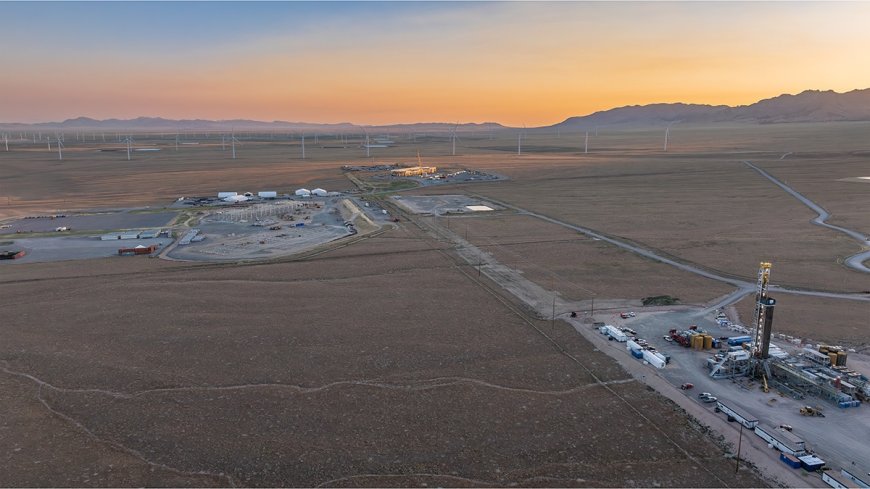
Fervo describes the Google contract as the largest enhanced geothermal power purchase agreement signed to date. It is a 15-year, take-or-pay deal covering about 396 megawatts delivered from eight GeoBlocks at the company's Cape Station project in Utah, with fixed terms for the life of the contract.
First power from the Google units is expected in mid-2028, with the full set online before the end of that year. The project, now called Cape Google 400, will be grid-connected. That structure matters: Google can draw power from the deal and sell it to other customers if it is not ready to use it, while Fervo builds on its own schedule.
"We built Cape Station on our schedule. Google can develop a potential data center on their schedule, and neither party is waiting on the other," co-founder and chief executive Tim Latimer said on the earnings call.
Fervo has also committed to offer Google an option to expand by about 600 megawatts, which would bring the partnership to nearly one gigawatt. That expansion would serve a potential Google data centre in Beaver County, Utah, through direct-to-load delivery under Utah's SB132 framework, subject to regulatory progress.
Cape Station is already generating power
Unlike many clean-energy announcements, this one comes with a working plant. Fervo declared commercial operation at the first 33-megawatt GeoBlock at Cape Station on September 30, ahead of its contractual deadline, and the unit is already generating revenue under a power purchase agreement.
The second GeoBlock has achieved grid synchronisation and is exporting test electricity, while the third remains in cold commissioning. Both are expected to reach commercial operation by January 1, 2027, completing a roughly 100-megawatt first phase. Capacity in operation reached 36 megawatts at the end of the quarter, up from 3 megawatts at the end of the second quarter.
An independent study by DeGolyer and MacNaughton now supports about 8.4 gigawatts of capacity potential at Cape Station, nearly double the prior estimate of 4.3 gigawatts, based on deeper drilling results.
Costs are falling, but still high
Whether geothermal can compete on price will decide how far this boom goes. Fervo's newer wells are deeper and hotter, each capable of generating 15 megawatts of gross power, and several are linked together into what the company calls a GeoBlock. The first completed GeoBlock generated 33 megawatts, while recent ones have reached 50 megawatts, sized to match the demand of a typical data centre hall so hyperscalers can bring them online as they are completed.
The first phase of Cape Station cost about $7,000 per kilowatt of capacity. The Google project is expected to cost $5,500 per kilowatt, a significant drop that suggests Fervo is on the right path. With subsidies, that is roughly equivalent to a new natural gas power plant running on fuel that costs $6 per million BTUs — still about twice what natural gas costs today, but trending closer to where it needs to be.
Fervo's long-term target is $3,000 per kilowatt. If it gets there, geothermal could significantly undercut natural gas power, even at today's prices. The company is also targeting a total investment of about $2.2 billion in the Cape Google 400 project through 2028, with construction of the next eight GeoBlocks already under way.
A young business with cash to spend
As a business, Fervo is still in the early stages. It reported third-quarter net income of $11.7 million despite an operating loss of $43.7 million, and ended the quarter with cash and cash equivalents of $1.9 billion and long-term debt of $301.6 million, which should give it plenty of runway. Fervo will host an investor open house at Cape Station on November 19.
Why it matters for AI
The timing is no accident. Hyperscalers are scouring the earth for electricity to power AI data centres, and geothermal has an edge over large nuclear or natural gas plants: it is built in phases, so capacity can come online in step with demand rather than all at once after years of construction. Google is not the only buyer betting on new power sources for AI — the same week saw Google unveil new TPU variants for surging cloud demand, while startups like Drogue chase ocean heat for floating data centres. For Fervo, the Google deal turns a promising technology into a booked, revenue-backed pipeline — and the next test is delivering the first Google power on schedule in 2028.
Sources
- TechCrunch — Fervo now has $12B in orders for its geothermal power tech
- The Motley Fool — Fervo Energy (FRVO) Q3 2026 Earnings Call Transcript
- Zacks — FRVO Q3 Earnings Call Highlights: Google Deal and Geothermal Expansion
- 1nfluenc3 — Fervo's Google deal lifts its geothermal order book to $11.9 billion
What's Your Reaction?
 Like
0
 Dislike
0
 Love
0
 Funny
0
 Angry
0
 Sad
0
 Wow
0