











































10,000 Home Robots in 49 Days: China's Qiyuan Just Proved the Personal Robot Has Arrived
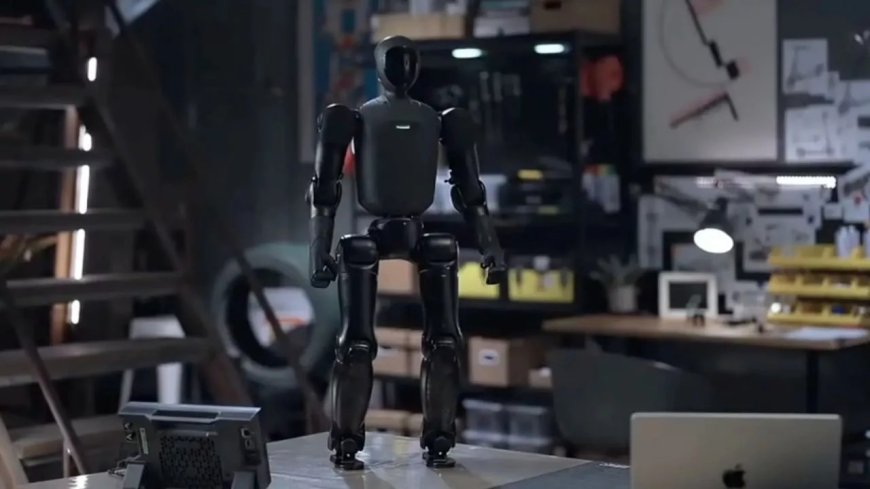
Zhiyuan Robot's consumer brand Qiyuan rolled its 10,000th personal robot off the line on November 8, doubling production in just 14 days — the first time any company has reached 10,000-unit mass production of robots built for the home, and a moment the company calls the commercial inflection point for humanoids moving into living rooms.
10,000 Home Robots in 49 Days: China's Qiyuan Just Proved the Personal Robot Has Arrived
At 10:42 on the morning of November 8, a number on a big screen inside a factory in Kunshan, Jiangsu, ticked from 9,999 to 10,000. In front of it stood financial writer Wu Xiaobo, Qiyuan Robot co-president Liu Dongfang and Lens Technology China president Jiang Nan, all in white dust-proof suits, applauding as the 10,000th Qiyuan personal robot rolled off the line.
It was a milestone with a speed that surprised even people inside the industry. Qiyuan — the consumer brand of Zhiyuan Robot (Agibot), backed by listed company Shangwei New Materials — had only put its Q1 personal robot on sale on September 20. It took about a month to reach 5,000 units on October 25. The next 5,000 took just 14 days.
That makes Qiyuan the first company in the industry to reach 10,000-unit mass production of a personal robot, according to Chinese financial press covering the event. The company itself frames it as the end of the validation phase: personal robots, it says, have now entered scaled deployment, opening new space for the commercialisation of consumer-grade embodied intelligence.
A factory that learned to build robots fast
The numbers behind the milestone are a story of manufacturing as much as robotics. Qiyuan's complete-machine contract factory only began mass production in October. In 37 days, its daily output climbed from 10 units to 240, with a first-pass yield of 89%. The joint-module factory moved even faster: in 10 days, daily capacity rose from 400 units to 4,000, while yields improved from 81% to 97%.
That ramp was built on a manufacturing system Qiyuan describes as combining automotive-grade standards with 3C-level precision manufacturing — car-industry quality control applied to consumer-electronics-scale production. Product definition, algorithms and software are developed in-house by Qiyuan, while whole-machine manufacturing is done together with Lens Technology, whose engineering teams worked jointly on production-line debugging, reliability standards and yield optimisation.
For a consumer product, the hardest part of mass production is not building one good robot but building ten thousand identical ones. Qiyuan's claim is that its supply chain, quality control and production rhythm have now been proven together — and that this, rather than any single technical trick, is what puts its capability at the front of the industry.
What 10,000 robots in homes actually do
The milestone matters only if people actually use the robots, and Qiyuan's early user data suggests they do. Among Q1 users, monthly activity exceeds 98%, the daily online peak is above 40%, average daily online time is 3 hours, and each user interacts with their robot more than 100 times a day.
Those are unusually sticky numbers for a new consumer device, and they are the basis for Liu Dongfang's argument that 10,000 units is the commercial inflection point — the point at which personal robots genuinely begin moving into domestic life. Two days before the 10,000th unit rolled off the line, Qiyuan pushed the first over-the-air update since the Q1 and T1 went on sale, adding six one-tap persona switches, long-term memory, a head-pat wake-up gesture and task reminders to the Q1, plus stair-following recognition, shape-shifting passage, remote audio-video control and voice-triggered local photography to the T1.
The open platform is already producing uses the company did not design itself. Some parents use the robot to keep children company and cut down on screen time. One developer connected a virtual companion character, "cyber daughter Taibai", to a Q1, turning it into a physical AI companion. Other users have built custom personas of their own. Qiyuan's founder Peng Zhihui has described the brand's positioning for personal robots in six Chinese characters — fun, useful and loving — and the early evidence suggests users are taking the "loving" part seriously.
Not the same 10,000 as March
Readers who follow Chinese robotics may remember that Zhiyuan Robot already announced a 10,000th unit back in March 2026. That was a different milestone: the 10,000th general-purpose embodied robot, an Expedition A3 built for industrial and commercial use. By September, the company had delivered its 20,000th general robot to the Chimelong theme park group, reported close to 2 billion yuan in first-half revenue, and claimed roughly 43% of the global humanoid market — figures the company itself reported and which have not been independently audited.
The November 8 milestone is narrower and, in commercial terms, harder: 10,000 units of a single consumer product line, built for homes rather than factories and theme parks, in 49 days from the start of sales. Whether that pace holds — and whether the robots keep getting used once the novelty fades — is the question that will decide if this really is the inflection point Liu Dongfang describes. For now, the factory in Kunshan has shown that building home robots at scale is possible. The next test is what ten thousand of them do once they are living with people.
Sources
- Kimkj — China AI, Robotics, Semiconductor & Telecom In-Depth Briefing, November 9, 2026
- Sina Finance — The Chinese speed of personal robots (November 8, 2026)
- DoNews — 49 days to build 10,000 personal robots (November 2026)
- RobotiChina — China's AgiBot Built 20,000 Humanoid Robots (September 24, 2026)
- RobotiChina — AgiBot's Innovation Day 2026: 20,000 Robots, ¥2B Half-Year Revenue (October 29, 2026)
What's Your Reaction?
 Like
0
 Dislike
0
 Love
0
 Funny
0
 Angry
0
 Sad
0
 Wow
0