























China’s Robot Race Is Entering a New Phase as AI Brains Could Get Their ChatGPT Moment in 2027
Chinese robotics startup Spirit AI believes humanoid robots could experience a ChatGPT-style breakthrough as soon as mid-2027, allowing robots to understand natural-language instructions and perform sequences of physical tasks. The prediction highlights a major shift in the robotics industry: the biggest challenge may no longer be building robots that can walk, run or dance, but giving them the intelligence to understand the physical world.

The Next Big AI Breakthrough May Not Live Inside a Chatbot
The next “ChatGPT moment” in artificial intelligence may happen somewhere very different from a computer screen. It could happen inside a humanoid robot. Chinese embodied-AI startup Spirit AI believes robot intelligence could reach a major turning point by mid-2027, when robots may be able to understand ordinary spoken instructions and then carry out a sequence of physical actions in the real world. Gao Yang, Spirit AI’s co-founder and chief scientist, told Reuters that the company expects to reach what he called a “GPT-3.0 milestone” by then.
That does not mean robots will suddenly become human-like or start doing everything a person can do. The idea is much more practical — and potentially more important. Imagine telling a robot, “Clean the kitchen, put the food in the refrigerator and bring me a glass of water,” and having it understand the request, work out the steps and physically attempt them without every movement being individually programmed. That is the kind of transition robotics companies are chasing.
The Hardware Has Already Become Surprisingly Good
For years, humanoid robots were mostly impressive demonstrations. They could walk awkwardly, balance themselves or perform carefully prepared routines. Now Chinese companies have pushed the hardware much further, with robots capable of running, dancing and even performing backflips. But impressive movement does not automatically equal intelligence.
According to Gao, the “brain” is now the weakest link in the robotics stack. A robot can have powerful motors, cameras and sophisticated mechanical systems, but those abilities mean little if it cannot understand an unfamiliar environment and decide what to do next. That is why the industry is increasingly concentrating on “embodied AI” — AI models designed to connect perception, reasoning and physical action.
This is where the comparison with ChatGPT becomes interesting. ChatGPT did not invent language, but it made interacting with AI dramatically easier for ordinary people. A similar breakthrough in robotics could make physical machines far more useful by allowing people to communicate with them naturally rather than programming every individual task.
Spirit AI Is Betting on the Robot Brain
Spirit AI is one of China's growing group of companies focused specifically on this problem. Founded in 2024, the startup has already raised more than $670 million and is valued at around 20 billion yuan, or $2.9 billion, according to Reuters. The company has around 300 employees and contractors working across China on data collection and robot training.
That data may be one of the most important pieces of the puzzle. Training a chatbot requires enormous amounts of digital information, but teaching a robot to operate in the physical world requires something different: examples of how humans actually interact with objects and environments.
Spirit AI employs roughly 1,000 contractors who collect movement data in homes and factories. At a Beijing training center visited by Reuters, workers wearing sensors repeatedly performed everyday actions such as opening refrigerators, unlocking safes and cutting vegetables. The goal is to turn these real-world movements into training data that can help robots learn how humans interact with physical environments.
A Robot That Works in a Factory Is One Thing. Your Home Is Another.
There is a huge difference between making a robot useful in a controlled factory and making one useful inside someone's house.
Factories are predictable. Objects have known locations, tasks are repeated and the environment can be designed around the robot. A home is the opposite. Furniture moves, children leave toys on the floor, objects appear in unexpected places and people constantly change what they are doing.
Spirit AI says its robots have achieved about a 90% success rate on simple tasks in structured living-room environments. But Gao estimates that genuinely useful household robots could still be at least eight years away. The company expects the next one or two years to be an early window for industrial applications, with simpler commercial service deployments potentially becoming more common around two years later.
That timeline is important because it cuts through some of the excitement surrounding humanoid robots. A robot performing a backflip on stage is visually impressive. A robot reliably unloading a dishwasher, finding a missing object or safely preparing a meal in a messy home is a much harder engineering problem.
China Wants to Turn Robot Hardware Into Real Business
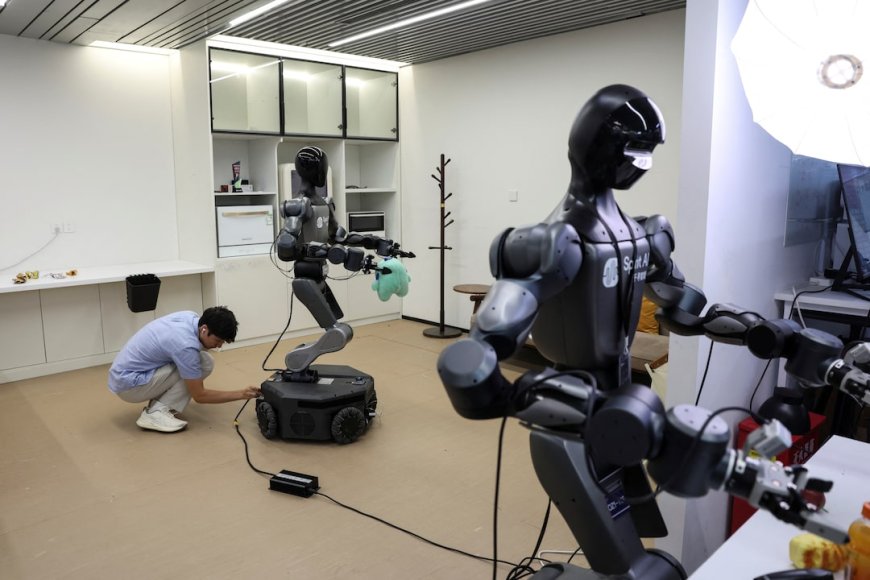
The race is also becoming increasingly commercial. Spirit AI already has dozens of its Moz1 wheeled humanoid robots deployed on production lines at battery manufacturer CATL and retailer JD.com, which is also an investor in the company. That means the company's technology is already being tested outside laboratories and demonstrations.
And Spirit AI is not alone. Chinese robotics companies are attracting substantial investment as investors increasingly look beyond flashy demonstrations and ask a much harder question: Can these machines actually make money?
That shift could become one of the defining themes of the next phase of robotics. The companies that succeed may not necessarily be the ones with the most impressive-looking robots. They may be the ones that can build reliable AI models, collect enough high-quality physical-world data and deploy robots cheaply enough for businesses to justify buying them.
The Real Bottleneck Is Data
The biggest obstacle may ultimately be something less exciting than robot hardware: training data.
AI systems need huge amounts of information to learn. For robots, that information has to describe not only language and images but also movement, physics, objects, environments and the consequences of physical actions. A robot needs to learn what happens when it pushes something, grabs something, drops something or encounters an object it has never seen before.
That makes real-world data extremely valuable. It also explains why companies are putting people into homes, factories and training centers to record human movements. The race for better robot brains could increasingly become a race for better physical-world datasets.
2027 Could Be an Important Test — But It Is Still a Prediction
If Spirit AI's prediction proves accurate, the middle of 2027 could become an important moment for the robotics industry. But it is worth keeping expectations realistic. Gao's timeline is a company executive's forecast, not a guarantee that humanoid robots will suddenly become generally capable next year.
There are still major problems involving reliability, safety, cost, energy consumption, fine motor control and the enormous variety of situations robots encounter outside controlled environments. Other Chinese robotics leaders have also offered different timelines. Reuters reported last month that ACE Robotics chairman Wang Xiaogang expected a “ChatGPT moment” for embodied intelligence by the end of 2027, while Unitree founder Wang Xingxing has suggested a major breakthrough could still be two to three years away.
Still, something important is clearly happening. The robotics industry is moving beyond the question of “Can we make a robot walk?” and toward a much harder question: “Can we make a robot understand what we want and figure out how to do it?”
That is the real reason the comparison with ChatGPT matters. The next revolution in AI may not simply give computers better answers. It could give machines the ability to turn those answers into physical actions in the real world. And if that happens, the biggest change may not be that robots finally look more human — it may be that, for the first time, they start becoming genuinely useful.
What's Your Reaction?
 Like
0
Like
0
 Dislike
0
Dislike
0
 Love
0
Love
0
 Funny
0
Funny
0
 Angry
0
Angry
0
 Sad
0
Sad
0
 Wow
0
Wow
0