













































Gemini 4 AI Agents Make Quantum Algorithms Cheaper — Fusion Simulation Cost Falls 11.8 Times
Google DeepMind says teams of Gemini 4 agents have found faster, cheaper quantum algorithms for fusion energy, chemistry and drug research, with every result proved correct in the Lean theorem prover. A fusion simulation now costs 11.8 times less to run, and a widely used maths routine runs 290 times faster.
Gemini 4 AI Agents Make Quantum Algorithms Cheaper — Fusion Simulation Cost Falls 11.8 Times
Google DeepMind has turned its latest AI model loose on one of quantum computing's hardest problems — designing the algorithms themselves — and the results are striking. Teams of Gemini 4 agents found cheaper quantum circuits for fusion energy, chemistry and drug research, cutting the cost of a fusion simulation by 11.8 times and speeding up a widely used maths routine by 290 times. Every result was proved correct mathematically before it counted.
The work, announced on 23 November 2026 in a collaboration between Google DeepMind and Google Quantum AI, tackles a bottleneck that sits between today's quantum hardware and the scientific problems it is meant to solve. Quantum computers could one day simulate molecules and materials far beyond the reach of classical supercomputers, but even the best known quantum algorithms still demand more resources than the first error-corrected machines are likely to offer. Making the algorithms cheaper is, in effect, bringing that future closer.
Agent teams that debate — and prove — their ideas
DeepMind did not simply ask a single model to optimise a circuit. For each of five problems, separate and independent teams of Gemini 4 agents were set to work hunting for improvements. Their ideas were checked with Lean, a formal theorem prover, before entering a shared notebook. Every four hours the teams met at a virtual conference to trade, debate and compare ideas, and as better ideas emerged the computational cost gradually fell until the experiment finished.
The proof step is the heart of the method. The circuits involved are far too large to test on classical computers or on today's small quantum processors, so the researchers had to prove mathematically that they work. Each problem was written as a formal Lean specification covering what the program must compute, how accurate it must be, and how qubits and operations are counted. Every proposed program had to arrive with proofs of both correctness and cost, and the agents used Lean's error messages to revise their work. An outside checker then re-ran each proof against a frozen specification, so the agents could not game the tests.
What got faster
The headline result concerns inertial confinement fusion, the approach that uses lasers to compress hydrogen fuel until it ignites. The agent teams found a quantum circuit for calculating an important property of that reaction, cutting the required computing cost — a metric combining qubits and operations — by 11.8 times, and lowering the memory needed from 5,650 to 4,338 error-corrected qubits.
The chemistry results were nearly as strong. A simulation of a light-sensitive molecule became eight times cheaper, after the agents simplified how the algorithm tracks particle positions and electric forces. For Cytochrome P450, the enzyme that breaks down most human medicines and matters greatly to drug design, the teams found a 2.5 times improvement and cut memory from 481 to 333 qubits by replacing bulky memory lookups.
The agents also improved the foundations. A specific implementation of Grover's algorithm, the fundamental quantum operation that searches an unsorted list, ran 2.57 times faster. And arcsin, a common routine that many quantum algorithms use to load numbers into quantum states, sped up by 290 times.
Why it matters — and what it does not yet do
DeepMind is careful about the limits. Even with these improvements, running the algorithms inside full scientific simulations would still demand more computing resources than the first error-corrected quantum computers are likely to provide. The gains narrow the hardware gap without closing it. What they do show is that algorithm design, not only hardware, drives progress towards useful quantum computing — and that a proof can vouch for circuits too large to test.
The approach may also travel well beyond quantum computing. DeepMind says the same method — AI agents searching for designs under the discipline of formal proof — could accelerate other parts of quantum research and scientific discovery more broadly. Proof-checked AI search compresses work that once took years of manual design, letting researchers focus on choosing problems and interpreting results.
To help the community build on the work, DeepMind is open-sourcing its Lean library for quantum algorithms, the problem specifications and the verified solutions on GitHub. The underlying paper, "Discovering formally verified quantum programs with AI", was posted to arXiv earlier this month and has not yet been peer-reviewed, so the results should be read as announced research rather than independently verified science.
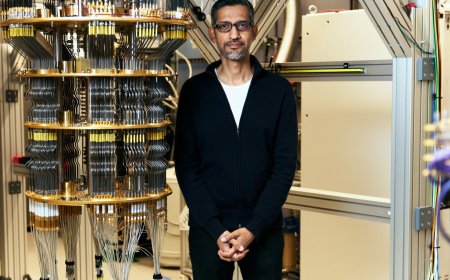
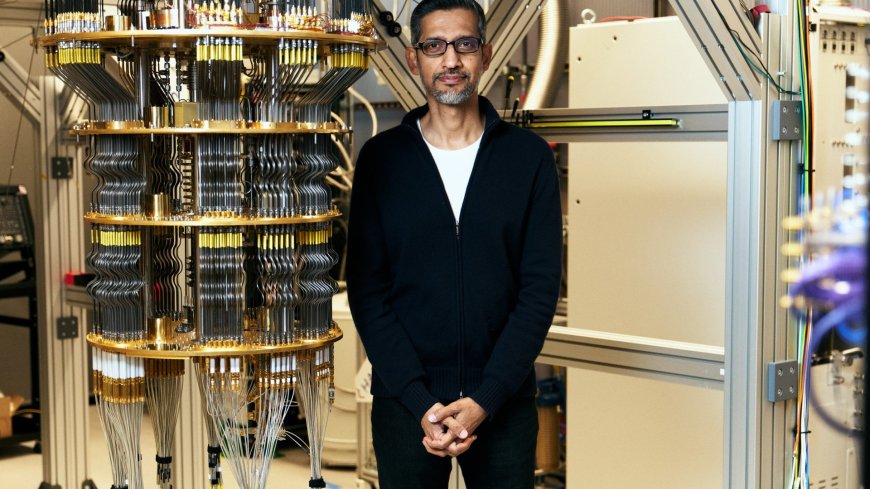
The photo above shows a Google quantum computer in a laboratory — representative of the quantum hardware this research is aimed at.
Gemini 4 itself only recently reached developers: Google opened Gemini 4 Carbon, its strongest model, to paying developers and AI Ultra subscribers earlier this month.
Sources
What's Your Reaction?
 Like
0
 Dislike
0
 Love
0
 Funny
0
 Angry
0
 Sad
0
 Wow
0