























































Amazon Confirms Purchase of Decart's AI Chip Optimisation Technology in Reported $7.5 Billion Deal
Amazon has confirmed it will buy the technology behind Israeli startup Decart's AI chip optimisation software and bring the company's founders and engineering team in-house, in a deal Bloomberg has reported to be worth about $7.5 billion. The move is aimed at making Amazon's Trainium chips faster and cheaper to run as the cloud giant prepares to sell its custom AI silicon to outside customers.

Amazon Confirms Purchase of Decart's AI Chip Optimisation Technology in Reported $7.5 Billion Deal
Amazon has confirmed it will buy the technology behind Israeli startup Decart's AI chip optimisation software and bring the company's founders and engineering team in-house, turning days of reports about a near-final deal into a signed agreement. The move is aimed at squeezing more performance out of Amazon's custom Trainium chips, just as the cloud giant prepares to sell that silicon to outside customers as a rival to Nvidia.
Amazon announced on Monday, November 23, that it has signed an agreement to purchase the proprietary technology behind the Decart Optimization Stack, known as DOS, and to bring Decart's three co-founders — Dean Leitersdorf, Moshe Shalev and Orian Leitersdorf — along with their team of AI researchers and engineers, into the company. Completion of the transaction is subject to customary closing conditions, including regulatory clearance.
Amazon did not disclose the financial terms of the deal. Bloomberg News, citing a person familiar with the matter, reported the value at about $7.5 billion. That figure has not been confirmed by either company, and it should be treated as reported, not official.
What the Decart Optimization Stack does
Decart, founded in 2023, built its name on software that helps companies run artificial intelligence systems faster and move them more easily between different kinds of AI chips, including hardware from Nvidia, Amazon and Google. Its Decart Optimization Stack sits between the AI model and the chip, tuning kernels, compilers and runtimes for the underlying hardware so that, in the company's words, every core stays busy.
Most AI chips, Decart has argued, spend much of their working life well below their full potential — a costly waste at a time when cutting-edge hardware is expensive and hard to come by. DOS is designed to close that gap, cutting latency, improving throughput and lowering the cost of both training and running AI models.
For Amazon, the appeal is direct. The company said the technology will help it further optimise both its inference and custom silicon performance, so more customers can train and run AI models faster and at lower cost. Amazon has long argued that inference speed and compute efficiency are central to the future of AI, and it has built that case around its custom silicon portfolio, from Graviton to Trainium.
Why Trainium is the centre of the deal
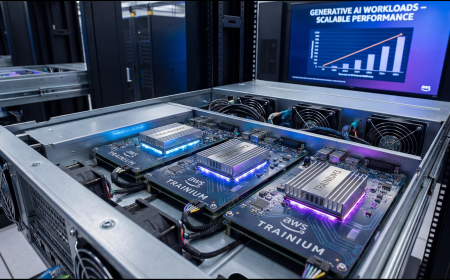
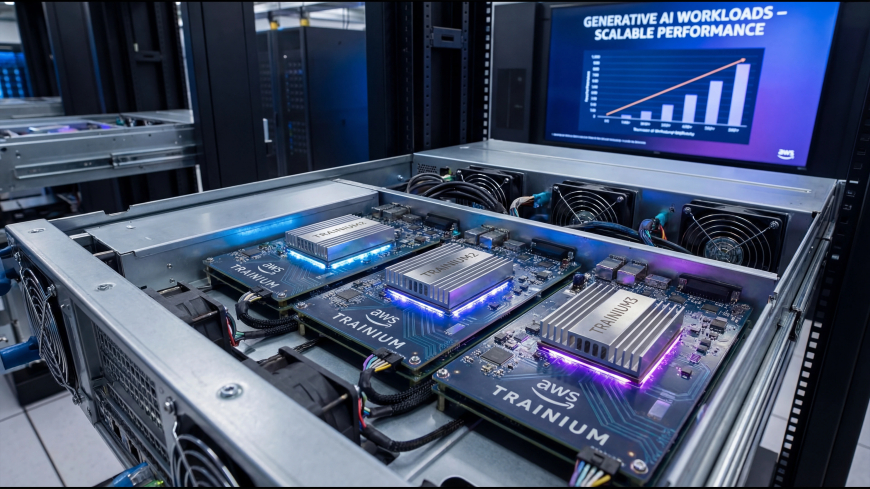
The Decart technology will be used to improve performance on Amazon's Trainium and Inferentia AI chips, and the timing is no accident. Amazon has so far used its Trainium chips in its own data centres, but it is preparing to start selling them to customers as a competitor to Nvidia, which has long set the standard for AI training hardware. Software that makes it easier for customers to run their workloads on Amazon chips rather than Nvidia's is a key part of that pitch.
Amazon and Decart are not starting from scratch. The two companies have worked together since 2025, and Amazon said the collaboration has already delivered strong performance results on Trainium through a full-stack approach spanning software and hardware.
"Every leap forward in AI starts with getting more out of every chip," said Peter DeSantis, Amazon's senior vice president for foundational AI models, custom silicon and quantum computing. "More efficient compute means better training, better reinforcement learning, faster inference, and better models for customers at a lower cost."
Dean Leitersdorf, Decart's co-founder and chief executive, said joining Amazon would give his team "the scale, the customers, and the infrastructure to pursue that mission faster than we could on our own."
The commercial momentum behind the chips is already visible. In its latest quarterly update on October 30, Amazon said revenue commitments for its Graviton and Trainium chips had each increased more than 20-fold year over year.
The road to the deal
The agreement closes a months-long saga around the three-year-old startup. In May, Decart raised $300 million in a funding round led by Radical Ventures, with Nvidia joining as a new investor. PitchBook data put the company's most recent valuation at nearly $4 billion — well below the $7.5 billion figure Bloomberg has attached to the Amazon deal.
Anthropic, the AI company behind Claude, had explored buying Decart earlier this year but decided against it after due diligence, Bloomberg reported in September. Amazon's deal is structured differently from a conventional takeover: it is an asset purchase, not a full acquisition of the company. Amazon is buying the technology behind DOS and hiring the team, while Decart's AI models — including Oasis, which generates interactive virtual worlds, and Lucy, a tool for editing video in real time — are not part of the deal. What happens to the rest of Decart after the transaction is not yet clear.
According to Israeli business newspaper Globes, the deal runs through Annapurna Labs, Amazon's chip unit, and is tied to performance targets over five years.
A wider talent-and-technology grab
The Decart deal is the latest in a run of Big Tech moves to buy, rather than build, the capabilities needed to stay at the frontier of AI development. Meta paid $14.3 billion last year for a 49 percent stake in Scale AI, and AMD agreed in September to buy World Labs for $8.2 billion. In each case, the prize has been a mix of scarce technology and the small teams of specialists who built it.
That pattern fits Decart neatly: a young company, a narrow but deep piece of optimisation software, and a team Amazon believes can push its custom silicon further. Whether the reported $7.5 billion price proves justified will depend on how much of that promise survives the move into Amazon's much larger chip operation — and on regulators, whose clearance the deal still needs.
Amazon first confirmed the outlines of the transaction on November 23, days after reports said the two sides were nearing a deal. The confirmation turns a reported negotiation into a signed agreement; the closing, and the price, remain to be settled.
Sources
- Reuters — "Amazon to buy Decart's AI chip optimization tech in latest AI talent grab" (November 23, 2026)
- Amazon — "Amazon to purchase Decart's AI optimization technology" (About Amazon, November 23, 2026)
- TechCrunch — "Amazon snaps up Decart's AI optimization tech for $7.5B as it prepares to sell Trainium chips" (November 23, 2026)
- GeekWire — "Amazon is buying Decart's AI chip software for a reported $7.5B and bringing its founders aboard" (November 23, 2026)
- The Register — "Amazon scoops up AI accelerator tech to keep chips busy at all times" (November 23, 2026)
What's Your Reaction?
 Like
0
 Dislike
0
 Love
0
 Funny
0
 Angry
0
 Sad
0
 Wow
0