










































Nothing Phone (3) Review: A Bold Design, Strong Cameras and a $799 Question
GSMArena's full review of the Nothing Phone (3) finds a strikingly original flagship with a Glyph Matrix display, a versatile triple 50MP camera system and fast Snapdragon 8s Gen 4 performance — but heavy thermal throttling, average battery life and a $799 price tag put it up against far better-equipped rivals.

Nothing Phone (3) Review: A Bold Design, Strong Cameras and a $799 Question
Nothing has never made a boring phone, and the Phone (3) is its most confident statement yet. The London-based startup's first true flagship pushes its transparent, industrial design language further than ever, swaps the familiar LED glyph strips for a tiny dot-matrix display on the back, and backs it all up with a triple 50MP camera system and a fast Snapdragon chip. GSMArena's full review, however, finds a phone that is easier to admire than to recommend outright — because at $799, it shares a price bracket with some of the most complete phones on the market.
The Phone (3) is a step up in ambition from the Phone (2), and a step up in price to match. The base 12GB/256GB model costs $799, €799, £799 or ₹79,999, while the 16GB/512GB version rises to $899, €899, £899 or ₹89,999. That places it at the top end of the premium midrange — or, depending on how you look at it, the bottom rung of the true flagship ladder. Whether the design alone justifies that is the question this review keeps coming back to.
Design: nothing else looks like this
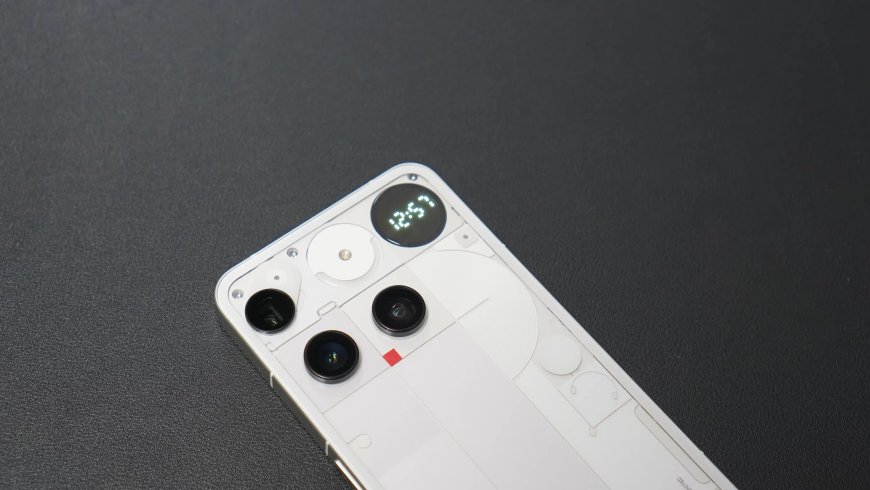
If there is one word for the Phone (3)'s design, it is different. The back is an odd combination of symmetry and asymmetry: from a distance it almost looks divided into three neat columns, until the misaligned camera module in the top-left corner breaks the pattern. GSMArena's reviewer is honest about it — the look is an acquired taste, one he never quite acquired, though he warmed to it over time.
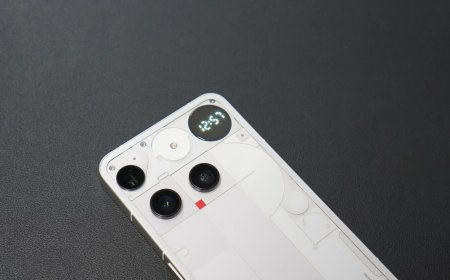
The biggest change is the Glyph Matrix, which replaces the LED strips of earlier Nothing phones. The signature lighting interface is now condensed into a small monochrome display of 489 LEDs on the upper back. It does more than flash for notifications: you can assign custom images, animations and app-specific messages, and there are even a few built-in games, including Spin the Bottle, Rock Paper Scissors and Magic 8 Ball. A capacitive touch circle below the display lets you interact with it, with haptic feedback on each press, and Nothing has said a developer SDK is coming so third parties can build their own ideas for it.
Under the showmanship, the build is genuinely premium. Gorilla Glass Victus covers the back, Gorilla Glass 7i protects the front, and an aluminium frame holds the two together with practically no flex. Ingress protection has jumped from the Phone (2)'s IP54 to a full IP68 rating, so the phone can survive 30 minutes in up to 1.5 metres of fresh water. The phone measures 160.6 x 75.6 x 9.0mm and weighs 218g, and it comes in just two colours, White or Black. One practical complaint: the glossy back attracts grease relentlessly, so keeping it clean without a case is a losing battle. The reviewer also notes the volume buttons sit a little low on the left frame, opposite the power button on the right.
Below the power button sits the new Essential Key, a shortcut to the phone's AI features, which we will come back to. The box, meanwhile, contains no charger — though some retailers bundle one — but does include a transparent TPU case and a USB-C cable.
Display: bright and sharp, but missing LTPO
The 6.67-inch OLED panel is one of the phone's clear strengths on paper: 1260 x 2800 resolution at around 460ppi, 120Hz refresh rate, HDR10+ certification and a claimed peak brightness of 4,500 nits. In GSMArena's lab testing it reached 756 nits with the brightness slider at maximum and a very respectable 1,507 nits in auto mode — comfortably bright enough for direct sunlight.
The disappointment is what the panel lacks. There is no LTPO technology here, only LTPS, so the refresh rate can only switch between 60Hz, 90Hz and 120Hz and can never drop below 60Hz. In practice, the interface runs at 120Hz while you are touching it and quickly falls to 60Hz, most apps top out at 90Hz, and high-frame-rate gaming simply did not work. For a phone at this price, the reviewer calls the crude refresh-rate handling a real missed opportunity — the screen is bright and sharp, but it does not feel as fluid as the best in this class.
Performance: fast in bursts, hot under pressure
Nothing has stepped back slightly on silicon. Where the Phone (2) used a proper flagship Snapdragon 8+ Gen 1, the Phone (3) runs the Snapdragon 8s Gen 4 — a sub-flagship 4nm chip with a 3.21GHz Cortex-X4 prime core, an Adreno 825 GPU, and 12GB or 16GB of RAM with UFS 4.0 storage. It is still a major upgrade over the Phone (2), and in benchmarks its CPU performance lands close to the Snapdragon 8 Gen 3 and MediaTek Dimensity 9400e, with strong AnTuTu results too.
The problem is sustained performance. The Phone (3) does not cool its chip well, and it throttles aggressively under stress testing, losing a large share of its peak performance. The throttling is severe enough that the phone could not even complete a 3DMark Wild Life Extreme stress test, and the frame becomes uncomfortably hot to hold during prolonged loads. For everyday use and short bursts of gaming the speed is excellent; for anyone who pushes a phone hard for long stretches, this is the review's clearest warning sign.
Battery and charging: decent, not special
The international model carries a 5,150mAh battery — the India variant gets a slightly larger 5,500mAh cell — and GSMArena's standardised testing produced an Active Use Score of 12 hours and 56 minutes. That is solid but not impressive, and the reviewer puts part of the blame on the Snapdragon 8s Gen 4, which appears to be a fairly power-hungry chip.
Charging is officially rated at 65W wired with Power Delivery and PPS, plus 15W wireless, 7.5W reverse charging and 5W reverse wireless. In testing, however, the phone never got close to 65W — closer to 40W in practice — so the headline figure is a little misleading. The verdict is blunt: battery life and charging are decent enough not to disappoint, but nothing to write home about at this price.
Cameras: three 50MP sensors, a real step forward
The camera system is the biggest upgrade over the Phone (2). All three rear cameras are 50MP: a main camera built around an OmniVision OV50H sensor with an f/1.7 lens and optical image stabilisation, a 3x periscope telephoto using a Samsung ISOCELL JN5 sensor with OIS, and an ultrawide on a Samsung ISOCELL JN1 sensor. The front camera is also 50MP, though it lacks autofocus. All cameras record 4K video at up to 60fps.
In daylight the main camera produces solid, natural-looking photos with good detail and little overprocessing, though pixel-peeping reveals some softness. Portraits are a highlight, with great skin tones, excellent subject separation and pleasing background blur. The 3x telephoto is usable rather than outstanding — dynamic range and colours are good, but the shots are not the cleanest or sharpest, and 6x digital zoom degrades further. The ultrawide is the weakest of the three: despite its 50MP resolution, fine detail is largely painted over by processing, and it has no autofocus, so no macro mode either. The telephoto does, however, take impressive macro shots.
Low-light performance is stronger. The main camera takes very good night photos with little noise, great colours and wide dynamic range, and the 3x telephoto stays surprisingly clean at 6x in the dark. Selfies are excellent in both daylight and low light, helped by a wide, forgiving focal plane. Video quality is good across the board — 4K footage from the main camera looks excellent in detail, colour and dynamic range, even if the bitrate is a little low — and the always-on gyro-based stabilisation does its job well.
Software: clean, stylish, and full of AI ideas
Nothing OS 3.5, running on Android 15, remains one of the cleanest Android skins around, staying close to stock Android while dressing it in Nothing's dot-matrix visual identity. The phone is promised up to five major Android upgrades, which is competitive for the class. There are 18 custom widgets, a basic always-on display, and a monochrome UI mode for those who want the full Nothing aesthetic.
The AI features are gathered under Essential Intelligence. The Essential Key captures screenshots or photos into the Essential Space hub, where they can be annotated, while a double-tap records a voice memo that is transcribed automatically, and reminders are organised intelligently. There is also a Wallpaper Studio that generates wallpapers from two words, an Essential News widget that summarises articles aloud, and ChatGPT integration that can send a screenshot straight to ChatGPT for analysis. The reviewer finds the ideas interesting but niche, and wishes the Essential Key could be remapped to another function.
The Glyph Matrix gets its own settings menu, with adjustable LED intensity, auto brightness and per-ringtone patterns, so you can identify callers from the light pattern alone. As it stands, though, it is a step behind the old Glyph Interface, which had integrations with Uber, Zomato and Google Calendar — the promised developer API may close that gap.
Speakers and connectivity
The stereo speaker setup — the earpiece doubling as a second speaker, plus a secondary grille on the top frame for a more balanced output — earned a Very Good mark in GSMArena's loudness testing, with good audio quality, some bass and well-presented highs. Connectivity is thoroughly modern: dual-SIM 5G, eSIM, tri-band Wi-Fi 7, Bluetooth 6.0, NFC and dual-band GPS. There is no headphone jack, no microSD slot and no FM radio, and the USB-C port is limited to USB 2.0 speeds with no video output.
The competition: a crowded $799 neighbourhood
This is where the Phone (3) has its hardest fight. GSMArena's verdict names five rivals that each beat it somewhere that matters. The Samsung Galaxy S25+ offers a proper flagship Snapdragon 8 Elite chip and seven years of OS updates, and its street price falls nicely after a few months. The OnePlus 13 brings a bigger QHD+ LTPO display, a 6,000mAh battery and faster charging for similar money. The Google Pixel 9 Pro XL wins outright on still photography thanks to Google's computational imaging and a 5x telephoto. The Honor 400 Pro matches it on performance with much faster charging, and the Realme GT 7 Pro undercuts the whole "flagship killer" idea with a Snapdragon 8 Elite, a 6,500mAh battery and 120W charging — though it skips wireless charging and the Nothing's design.
None of them looks like the Phone (3), though. And that, the review concludes, is the point.
Verdict: the most distinctive phone in its class, not the obvious best buy
GSMArena's review does not award the Phone (3) a numeric score, so here is its verdict in its own terms. On the plus side: a quirky design with IP68 protection and Gorilla Glass, excellent burst performance, a bright and sharp HDR10+ display, a versatile triple-camera system, clean and fast software with long-term support and playful AI and Glyph features, and very good stereo speakers.
On the minus side: an LTPS display without LTPO and limited refresh-rate handling, only average battery life and charging speeds for the price, poor thermal management under sustained loads, and a price that puts it against better-equipped competitors.
The Phone (3) is not the obvious best buy in its class, the review concludes — but it is the most distinctive, and for some buyers that will be more than enough. If you want the phone that looks like nothing else and still does almost everything well, this is it. If you want the best battery, the fastest sustained performance or the best camera for $799, one of its rivals will serve you better.
Sources
- GSMArena, Nothing Phone (3) review — introduction, specifications and pricing: https://www.gsmarena.com/nothing_phone_3-review-2853.php
- GSMArena, Nothing Phone (3) review — design and Glyph Matrix: https://www.gsmarena.com/nothing_phone_3-review-2853p2.php
- GSMArena, Nothing Phone (3) review — display, battery life, charging and speakers: https://www.gsmarena.com/nothing_phone_3-review-2853p3.php
- GSMArena, Nothing Phone (3) review — software and performance: https://www.gsmarena.com/nothing_phone_3-review-2853p4.php
- GSMArena, Nothing Phone (3) review — camera quality: https://www.gsmarena.com/nothing_phone_3-review-2853p5.php
- GSMArena, Nothing Phone (3) review — verdict, pros and cons: https://www.gsmarena.com/nothing_phone_3-review-2853p6.php
What's Your Reaction?
 Like
0
 Dislike
0
 Love
0
 Funny
0
 Angry
0
 Sad
0
 Wow
0