




















































US Stock Market Rebounds: S&P 500, Dow and Nasdaq Post Best Week in Over a Year
Wall Street closed a shortened Thanksgiving-week session sharply higher on Friday, November 27, 2026, with the S&P 500 up 1.6% to 7,297.49, the Nasdaq up 2.3% to 24,129.50 and the Dow up 1.2% to 50,774.94, capping the market's best week in more than a year as beaten-down AI and chip stocks rebounded.

US Stock Market Rebounds: S&P 500, Dow and Nasdaq Post Best Week in Over a Year
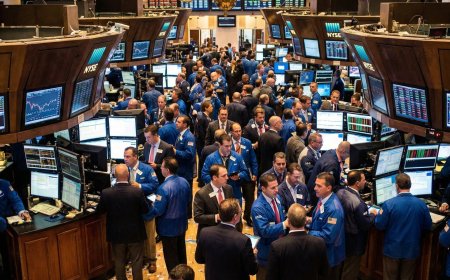
Wall Street ended a holiday-shortened week on a high on Friday, November 27, 2026, as investors piled back into the technology and chip stocks that had been sold off for weeks. Markets closed early, at 1 p.m. ET, after staying shut on Thursday for Thanksgiving, and the shortened session turned into one of the strongest days of the year.
The rally capped a week of sharp swings, and by the closing bell all three major indexes had posted their best weekly gains in more than a year — a striking reversal from the selloff that had pushed the market close to a bear market only days earlier.
Friday's numbers
The S&P 500 rose 114.71 points, or 1.6%, to 7,297.49. The Nasdaq Composite climbed 543.70 points, or 2.3%, to 24,129.50, and the Dow Jones Industrial Average gained 591.99 points, or 1.2%, to 50,774.94. The Nasdaq 100 rose 2.61% to 26,726.39 and the small-cap Russell 2000 added 1.71% to 2,750.30.
The gains were broad as well as large: four out of every five stocks in the S&P 500 rose on Friday, a sign that buyers were returning across the market rather than chasing a handful of names.
A week that swung wildly
The path higher was anything but smooth. Stocks opened the week with a huge rally on Monday, their best day since April 2025 — the month President Donald Trump paused most of the tariffs announced on "Liberation Day" that had sent markets reeling. Turbulence followed on Tuesday and Wednesday, with indexes swinging between modest losses and gains, before the Thanksgiving break.
For the week, the S&P 500 gained 5.6%, its strongest week since April 2025 and its best in 19 months. The Nasdaq rose 6.7%, its best week in seven months, and the Dow added 5.5%, its best week since 2022.
It was a sharp turnaround from the previous week, when the S&P 500 slumped and finished more than 10% below its all-time high set last month. The index has been flirting with a correction for weeks, and the Nasdaq came close to bear-market territory as tariff turmoil and the AI rout deepened — a selloff our earlier coverage tracked through its longest losing streak since Covid.
AI and chip stocks lead the rebound
Technology stocks led Friday's gains, and the buying was concentrated in the names that had been hit hardest. Memory-chip maker Micron surged 7.6%, Marvell rose more than 7%, and Sandisk jumped 16%, while the SOXX semiconductor ETF climbed nearly 5%. Dell added 6.7% and Broadcom jumped 3.8%. Microsoft, the market's most valuable company, rose 0.6%.
Anthropic, the first major AI lab to go public, rose 11% to $91.88. The shares remain above their $83 IPO price, though they have eased back from the $115 high reached on their first day of trading last week.
Nvidia rose a more modest 0.8% in a volatile session. The chipmaker has been the face of the AI boom, and it rattled the market earlier this month after chief executive Jensen Huang suddenly resigned and was then surprisingly reinstated. Companies including Nvidia and Broadcom have grown so valuable that their stock movements can often decide whether the whole market rises or falls — they were the key force behind the market's all-time high last month, and they have pulled it mostly lower ever since.
Behind the swings is a question Wall Street has not settled: whether the enormous investments in AI will produce enough profit to justify the large stock values. That doubt is what turned a strong year for tech into a correction, and it is what Friday's bargain hunting has not yet answered.
Amazon and the holiday shopper
Amazon jumped 4% as the holiday-shopping season kicked off, helped by encouraging early Black Friday sales data and optimism around its AI initiatives. The company is one of the most valuable on Wall Street and has been among the firms leaning hardest into AI.
Elsewhere, retailers were mixed: Target slipped 0.1% while Macy's rose 1.2%. Households are shopping for the holidays under a cloud of stubbornly hot inflation. The latest update this week showed that the rate of inflation worsened in October, with prices on everything from gas to groceries and clothing rising through the year, mostly because of higher energy costs.
Inflation, oil and rates still hang over the rally
Brent crude, the international oil benchmark, fell 0.9% to $90.84 on Friday. Oil prices have swung between $72 and $114 since the United States and Israel attacked Iran in February, and higher fuel prices have cut directly into household budgets while higher diesel prices pushed up shipping costs around the world — on top of a trade conflict between the US and much of the world that has also made many goods more expensive.
In the bond market, the yield on the 10-year Treasury rose to 4.94% from 4.85% late Wednesday. Gold jumped 3.75% to $3,668.50, according to the Motley Fool.
The economy remains strong, but growth is largely being driven by big tech firms spending to build AI infrastructure and by spending from upper-income households — a narrow base for a rally that now needs to broaden to last.
What comes next
A sharp rebound does not necessarily mean the correction is over. The sustainability of the recovery will depend heavily on corporate earnings, above all among technology companies, and on whether heavy spending on AI infrastructure turns into stronger revenue, better productivity and higher profits. The rebound in companies like Micron suggests confidence in long-term semiconductor demand is intact, but elevated valuations leave little room for disappointing results.
Investors now look to next Friday's jobs report on December 4 and the Federal Reserve's policy decision on December 9, which will shape expectations for interest rates into the new year. Until then, Friday's rally stands as proof that buyers are still willing to step in — and that the market's mood can turn in a single shortened session.
Sources
- Associated Press via Manila Times — Stocks jump to close out an erratic week that was also Wall Street's best in more than a year
- Motley Fool — Stock Market Today, Nov. 27: S&P 500 Posts Best Week in 19 Months as AI Stocks Rebound
- Reuters via Straits Times — Wall Street ends higher as battered AI stocks gain in volatile week
What's Your Reaction?
 Like
0
 Dislike
0
 Love
0
 Funny
0
 Angry
0
 Sad
0
 Wow
0