






























































How Cheap Drones Took the Sky From Armies Across the Sahel
Insurgents across the Sahel are using cheap off-the-shelf drones to strip governments of the air superiority they once held, a Reuters feature reported on 25 November 2026. From Mali to Burkina Faso and Niger, first-person-view drones costing a few hundred dollars now threaten aircraft, fuel depots and bases worth millions — and the tactics were honed in Ukraine's war.

How Cheap Drones Took the Sky From Armies Across the Sahel
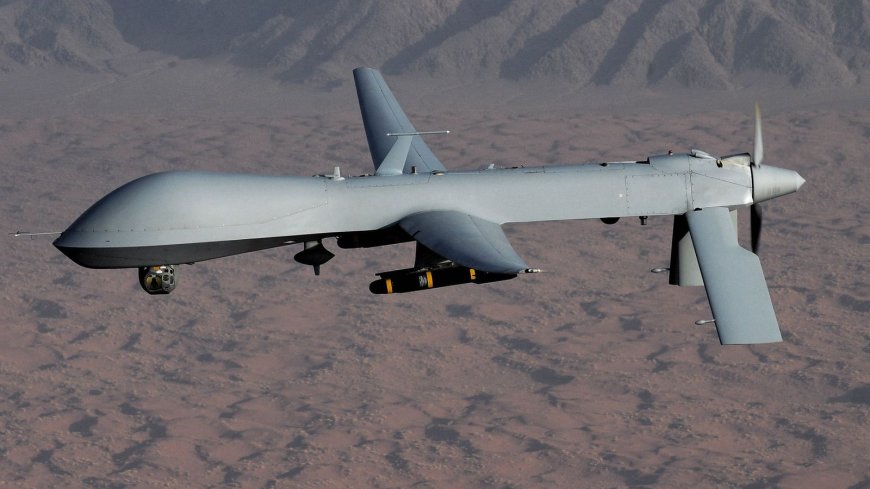
Featured image: an armed military drone flying over desert terrain. The photo is illustrative — the small first-person-view drones used by insurgents in the Sahel are far cheaper and smaller than the aircraft pictured.
The kamikaze quadcopter banks sharply, locks on to a Russian military vehicle and dives for the kill. Another drone hovers over an airfield. A strike narrowly misses a jet but hits three men identified as Russians.
Footage like this has become commonplace in the war in Ukraine. But these videos are not from Ukraine. They were filmed in Mali, some 5,000 kilometres away on the edge of the Sahara Desert, during a joint assault in April 2026 by Tuareg-led separatists and an al Qaeda affiliate on Mali's army and its Russian paramilitary backers.
That is the picture painted by a Reuters feature published on 25 November 2026, which reports that battlefield tactics honed in Ukraine have become a major factor in the resurgence of rebels across the Sahel — the vast belt of countries south of the Sahara.
Armed with drones costing a few hundred dollars, insurgents in Mali, Burkina Faso, Niger and beyond have robbed government forces of the air superiority they once commanded with fighter jets and attack helicopters. Now their multimillion-dollar military hardware is constantly threatened from above, as is critical infrastructure including gold mines, fuel depots, pipelines and ports — and even distant capital cities.
The April assault that showed the shift
The videos from the April assault show how far the change has gone. The separatists, now known as the Azawad Liberation Front (FLA), and fighters from Jama'at Nusrat al-Islam wal-Muslimin (JNIM), al Qaeda's affiliate in the region, filmed first-person-view (FPV) drones diving on Russian and Malian positions, including at the Sevare-Mopti airport in central Mali.
After JNIM ground attacks in April that killed Mali's defence minister outside the capital Bamako and struck the capital's main airport, the group released footage — verified by Reuters — showing drones targeting Russian and Malian soldiers at the airport. In one clip, Russian paramilitaries identified by JNIM with superimposed flags are hit by an explosion on the airport tarmac. Eight more Russians are targeted on a rooftop in the airport grounds, and seven Malians in and around another building nearby, according to the videos.
"In the past, the state always had the monopoly of the sky. It was the one thing they could control," said Niccola Milnes, an independent senior counterterrorism and security adviser. "Now that non-state actors can access these drones cheaply and modify them and attach payloads, it's obviously completely upended that."
Training by Ukrainians — and Kyiv's denial
The military calculus started to change in 2023, when FPV drones armed with basic explosives and flown by remote pilots proliferated in Ukraine. The cheap, accessible technology and the expertise that came with it soon made its way to West Africa, helped in part by Ukrainians keen to hurt Russian forces wherever possible, according to the separatists in Mali and experts on the conflict.
Russia began backing Mali's military government against jihadists and the Tuareg-led separatists in 2021 with the deployment of the Wagner mercenary group. In 2023, the Russian Defence Ministry created Africa Corps, a paramilitary force that replaced Wagner and absorbed many of its fighters.
That same year, the separatists were trained to use drones by Ukrainians during a 30-day course at a location outside Mali, said Mohamed Elmaouloud Ramadane, a spokesman for the group, now known as the Azawad Liberation Front. The FLA denied that Ukrainians had been directly involved in its operations, and Ramadane declined to provide details of the types of drones the group used. Reuters said it was unable to determine who from Ukraine had helped the FLA.
Neither Ukraine's military nor its intelligence services responded to requests for comment. In a 2 November statement, Ukraine's Ministry of Foreign Affairs firmly rejected accusations by Mali and Niger that Kyiv "supports illegal armed groups and interferes in the internal affairs of the Sahel states". Russia's Ministry of Defence did not respond to requests for comment.
Ukraine has carried out strikes on Russian assets far from its own front line, including in Africa, where it sank a Russian naval corvette in a Libyan port on a Sunday in November using maritime drones. Ukrainian Foreign Minister Andrii Sybiha defended the attack days later, saying Russia "systematically uses its military presence and logistical infrastructure outside its own territory, including in Africa, to support military operations".
Mali's government did not respond to detailed questions, but Foreign Minister Abdoulaye Diop acknowledged the increased threat posed by drones. "The ability of our armed forces to adapt to drone attacks has therefore become a critical issue," he told an arms fair in Mali's capital Bamako on 9 November.
JNIM: the region's most prolific drone user
In July 2024, about 10 months after they received the Ukrainian training, the separatists' dedicated "Unit 6" drone team first unleashed one-way attack, or kamikaze, drones against Russian and Malian forces during the battle for the town of Tinzaouaten on the Algerian border, Ramadane said.
By then, al Qaeda's affiliate JNIM had already deployed attack drones in Mali. It was a humble debut: in September 2023, a JNIM-operated quadcopter dropped two improvised explosive devices on a rival militia in the central Mopti region, but neither exploded or hurt anyone, according to Armed Conflict Location and Event Data (ACLED), a conflict monitoring group.
Since then, the frequency — and sophistication — of drone attacks has increased, with JNIM the most prolific, according to previously unpublished ACLED data. The figures show JNIM has carried out 187 drone attacks since 2023 through mid-November. Including the FLA and its predecessors, the number rises to 235 across four West African countries.
JNIM, an alliance of four jihadist groups formed in 2017, staged 81 attacks in 2025 and 96 through October this year, according to ACLED. It has increasingly paired drone attacks with ground assaults on bases in several countries. In February 2025, JNIM used FPV drones armed with explosives to attack military positions in the northern Burkina Faso town of Djibo. Two months later, it staged its only known drone attack in Togo, a kamikaze strike that killed five soldiers.
The region's Islamic State militants are also using drones for reconnaissance, tactical coordination and crude attacks. Islamic State West Africa Province, for example, has used attack drones 15 times since 2024, mostly in clashes with Nigeria's military, according to ACLED. While Islamic State drone use currently lacks the sophistication of other groups, it dispatched 13 trainers from the Middle East to share drone skills with Islamic State groups in the region, United Nations experts reported last year.
The economics favour the attacker
Reuters was unable to determine where the groups procured their drones. Experts said they bought commercially available models that were then smuggled into the desert and refitted for war.
"The economics favour the attacker: a munition costing a few hundred dollars can threaten aircraft, fuel depots and bases that are worth millions," said Justyna Gudzowska, executive director of The Sentry, an investigative and policy group. "The same pattern is visible in Burkina Faso and Niger."
Drones also allow militants to attack while reducing their exposure to direct combat and retaliatory airstrikes, said Heni Nsaibia, senior West Africa analyst at ACLED. "Drones also allow them to monitor military movements, conduct reconnaissance, and gather information during large-scale coordinated offensives and attacks on military bases and camps," he said.
JNIM has not shown significant technological advances in its drone attacks, mainly using them to drop explosives, including 60mm mortar bombs. This likely reflects a scarcity of advanced equipment and skilled operators, according to a study published in July by the Policy Center for the New South. "Unlike kamikaze strikes, which by default destroy the drone on impact, a drone dropping IEDs can return and be used again," the study's authors Milnes and Rida Lyammouri wrote. "This allows JNIM to maintain the region's highest tempo while preserving its inventory."
A drone swarm over Gao
While JNIM is the most prolific drone user in the region, the FLA has become one of the most advanced non-state drone operators in the world, according to Milnes and Lyammouri. The use of kamikaze drones by its Unit 6 team in the Tinzaouaten attack resulted in heavy losses for Mali's army and its Russian backers.
The FLA achieved a new milestone in March 2026, when it used roughly 25 drones in two waves to attack an air-defence system at the airport in Gao, the biggest city in northern Mali — the first "drone swarm" attack by a non-state group in the Sahel.
The FLA also adopted fibre-optic FPV drones last year, a technology used widely in Ukraine to bypass electronic jamming, according to the study. But in another sign of tactics from the Ukraine war being deployed in Mali, Russia's Africa Corps is trying to regain momentum with ZALA Lancet suicide drones, according to a report by research body Conflict Insights Group this month. Videos posted in October show the Shahed-style drones used extensively by Russia in Ukraine hitting FLA heartlands near Algeria.
So far, the region's militaries have not demonstrated decent jamming capabilities, Milnes said, underscoring how the insurgents appear to be one step ahead. Out of 245 strikes documented in the Policy Center for the New South study, there were only 10 instances of interception, jamming or surface-to-air missile fire deployed by governments.
Governments are buying drones too — and falling behind
Governments have been snapping up drones too. Most rely on larger, long-range models made by Turkey's Bayraktar, or Chinese-made Wing Loong or CH-4 drones. Bayraktar's TB2 and Akinci drones can also carry heavy guided weapons. Burkina Faso recently displayed a sophisticated new air defence system it had acquired from China, though analysts said such technologies were not best suited for fighting insurgents.
Nate Allen, associate professor of security studies at the Africa Center for Strategic Studies, said larger drones such as the TB2 played important roles, but future wars were likely to be dominated by cheaper systems. "So far, it is non-state armed actors, and not Africa's militaries, that are most effectively taking advantage of this shift," he said.
The trend reaches beyond the Sahel. Rebels in Ethiopia, in the Horn of Africa, reportedly used drones in an attack on the capital Addis Ababa last month. The conflict in West Africa is part of a broader pattern — stretching from South America to the Middle East and Asia — of militant groups using drones to reshape battlefield dynamics.
For governments across the Sahel, the message of the Reuters reporting is stark: the sky, once the one domain they could control, is now contested by enemies spending a few hundred dollars a time.
Sources
- Reuters, "African insurgents take war to the skies with off-the-shelf drones", 25 November 2026 (via ThePrint syndication: https://theprint.in/world/african-insurgents-take-war-to-the-skies-with-off-the-shelf-drones/3108284/)
- Daily Nation, "African insurgents take war to the skies with off-the-shelf drones", 25 November 2026 (https://nation.africa/kenya/news/africa/african-insurgents-war-to-the-skies-with-off-the-shelf-drones-5683366)
- The Straits Times, "African insurgents take war to the skies with off-the-shelf drones", 25 November 2026 (https://www.straitstimes.com/world/europe/african-insurgents-take-war-to-the-skies-with-off-the-shelf-drones)
What's Your Reaction?
 Like
0
 Dislike
0
 Love
0
 Funny
0
 Angry
0
 Sad
0
 Wow
0