



















































GPT-6 Designs Proteins That Bind in the Lab: OpenAI Reports 35 Hits From 322 Minibinders
OpenAI says its GPT-6.2 model designed small proteins that bound five cancer and immune targets in laboratory tests with research partner Onava — 35 of 322 minibinders showed binding. The result is a proof of principle, not a drug pipeline: specialised models still filtered the candidates, and the work has not been peer reviewed.
GPT-6 Designs Proteins That Bind in the Lab: OpenAI Reports 35 Hits From 322 Minibinders
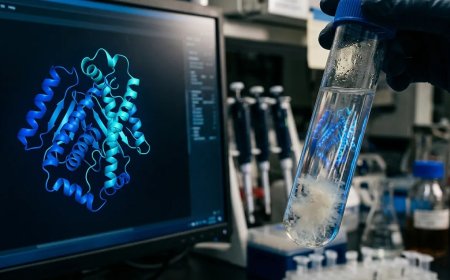
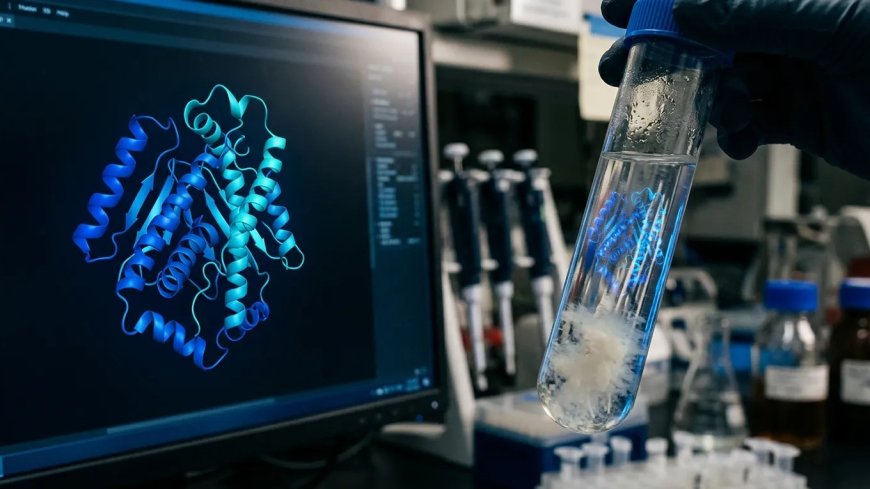
OpenAI says its GPT-6 models can design new proteins from plain-language prompts — and it now has laboratory results to back the claim. In a research post published on 24 November 2026, the company reported that proteins designed by GPT-6.2 bound to five biological targets in tests run with research partner Onava, a first wet-lab check on whether a general-purpose language model can do work long reserved for specialised biology software.
The headline figure is modest, and OpenAI says so itself. Of 322 small proteins, known as minibinders, that Onava made and tested in the lab, 35 showed evidence of binding to their intended target — a 10.9 percent hit rate. But the details around that number matter more than the number itself, because they show where the model is already useful, where it still leans on specialist tools, and how far this kind of result sits from a medicine.
What the model was asked to do
Proteins do most of the work inside living cells, and their shape decides what they can do. Designing a protein that grips a chosen target — say, a protein that helps a cancer cell hide from the immune system — means working out both a three-dimensional shape and the chain of amino acids that will fold into it. Until now, that job has belonged to specialised models such as RFdiffusion, which generate protein structures, and ProteinMPNN, which proposes sequences for them. Each accepts particular inputs and cannot easily take on new kinds of instructions without changes to its software.
OpenAI's claim is that the GPT-6 family can do this work intrinsically, using reasoning and general-purpose coding tools rather than calling a specialised biology model to generate the designs. In its preprint, titled GPT-6 as a Universal Foundation Model for Protein Biology: Beyond Specialized Models, the company describes asking GPT-6.2 to design minibinders for five targets, marking where each should attach and specifying how many coils or strands the design should contain. An internal research model followed those shape instructions with near-perfect fidelity in its three-dimensional designs.
The same prompt-driven flexibility showed up across 14 protein tasks OpenAI tested, from building proteins around a specified structural feature to predicting how small-molecule drugs dock onto proteins. GPT-6.2 matched the experimentally observed position and orientation of small molecules in 93 percent of scored docking predictions, against 50 percent for DiffDock-L, a specialised docking model. On motif scaffolding — designing a protein around a fixed arrangement of amino acids — the latest internal model passed 43.7 percent of its evaluations, compared with 27.8 percent for RFdiffusion.
The lab results: 35 hits from 322 designs
For the main experiment, OpenAI gave GPT-6.2 the three-dimensional structures of five target proteins and marked where a minibinder should attach. The model wrote code to produce three-dimensional designs, without using specialised protein AI models. Onava then made the proteins and measured how strongly they bound.
Every target produced at least one hit, but the spread was uneven. IL-17A, a protein involved in immune signalling, yielded 18 binders. VEGF-A, which drives blood-vessel growth, gave eight. PD-L1, the checkpoint protein some cancers use to evade the immune system, gave five. IL-7Rα gave three, and TrkA, a nerve-growth receptor, gave one. OpenAI notes that its hit rate sits below the figures reported in the original RFdiffusion study, while cautioning that rates depend heavily on how strictly researchers filter designs before lab testing and on how binding is defined.
That filtering is an important part of the story. The 322 minibinders tested in the lab were already a selected set: after GPT-6.2 proposed three-dimensional shapes, a specialised model called SolubleMPNN suggested the amino acid sequences, and other specialised models helped choose which candidates were most likely to fold as designed and bind at the intended site. The 10.9 percent figure therefore describes the lab-tested candidates, not every design the model initially produced.
Where the model did better: redesigning existing proteins
The results were considerably stronger when GPT-6.2 worked with existing structures rather than designing from scratch. Given three-dimensional models of confirmed minibinders with their original sequences withheld, the model proposed new sequences that bound in 75 of 88 designs targeting MDM2 (85 percent), 26 of 42 for VEGF-A (62 percent), and 8 of 59 for PD-1 (14 percent). The new sequences often differed substantially from the originals — a median of 50 percent of amino acids for VEGF-A and 43 percent for MDM2 — evidence, OpenAI says, that the model is doing more than memorising known proteins.
Antibody redesign told a similar story. Asked to design new binding loops for six small antibodies targeting IL-4Rα, the model produced designs of which 128 of 182 (70 percent) showed binding. And when fragments of five therapeutic antibodies were redesigned, 179 of 272 (66 percent) kept binding to their original targets, PD-1 or PD-L1.
The limits OpenAI itself flags
The company is careful about what the work does not show. Predicting a complete protein structure from its amino acid sequence remains a clear weakness: the latest internal model scored an average TM-score of 0.38 on that task, against 0.93 for the specialised model ESMFold2. The campaign also relied on specialised structure-prediction models such as Boltz-2 and ESMFold2 to filter candidates, so the results do not yet establish that a GPT model can generate new minibinders end to end, in a single zero-shot pass, without help from specialised models.
More fundamentally, binding is only one step toward a useful research tool or a medicine. OpenAI states that its public announcement provides no comprehensive assessment of affinity, selectivity, stability, toxicity or manufacturability for the tested designs. Further work would need to establish whether a designed protein does anything biologically useful — killing a cancer cell, for example — and whether it is safe. Joy Jiao, who leads life-sciences research at OpenAI, described the findings as a proof of principle, according to Nature's reporting of the work.
The research is a preprint: it has not undergone peer review, and no independent laboratory has yet repeated the experiments. That matters for a result reported by the same company whose model is under test, from a single partner laboratory.
Safety and what comes next
OpenAI also notes the dual-use side of the capability. The same skills that help scientists design proteins for new medicines could be misused, and the company says its Preparedness Framework guides how it assesses those risks. Its safety assessment places the ChatGPT version of GPT-6.2, released on 23 November, at its internal High threshold for biological and chemical capabilities.
Looking ahead, OpenAI says it wants to find minibinders for harder targets, test whether designed molecules produce a specific biological effect, make them bind more selectively and be practical to manufacture, and extend the approach beyond minibinders and antibody fragments to molecules that bind several targets at once, RNA and small molecules.
For drug discovery, the significance is less about the 10.9 percent hit rate than about the workflow it points to: a scientist describing a protein in plain language, and a general-purpose model drafting candidates to test in the lab. Whether that shortens the long road from a binding protein to a working drug will depend on the next rounds of experiments — and on independent labs getting the same results.
Sources
What's Your Reaction?
 Like
0
 Dislike
0
 Love
0
 Funny
0
 Angry
0
 Sad
0
 Wow
0