























































Dell Posts Record $54.9 Billion Quarter as AI Backlog Swells to $132.3 Billion — but Memory Shortage Will Run Into 2027
Dell Technologies reported a record fiscal third quarter on November 24, 2026, with revenue more than doubling to $54.9 billion on surging AI server demand. The company ended the quarter with a record $132.3 billion AI server backlog after booking $60.2 billion in new orders, and raised its full-year revenue forecast to $202 billion — while warning that the memory chip shortage will continue clearly into 2027.

Dell Posts Record $54.9 Billion Quarter as AI Backlog Swells to $132.3 Billion — but Memory Shortage Will Run Into 2027
Dell Technologies has delivered the biggest quarter in its history, and then warned investors that the hardest part of the AI boom is still ahead. The company reported record fiscal third-quarter revenue of $54.94 billion on Tuesday, November 24, 2026 — more than double the figure from a year earlier — as businesses and cloud providers rushed to buy its AI servers. Yet on the same earnings call, Dell said the memory chip shortage squeezing the whole industry will run well into 2027, a constraint that could slow how fast even a record order book turns into delivered machines.
It was a quarter that showed, in unusually stark terms, how completely artificial intelligence has remade Dell. Revenue rose 103 percent year over year, far above the $49.32 billion Wall Street had expected, according to data compiled by LSEG. Adjusted earnings per share came in at $9.45, comfortably ahead of the $6.59 analysts had forecast, while net income rose 266 percent to $5.67 billion. Shares rose about 5 percent in extended trading after the results, and Dell's board approved an additional $25 billion share repurchase plan.
AI servers now drive the company
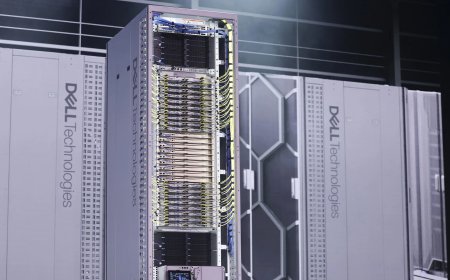
The engine of the quarter was Dell's Infrastructure Solutions Group, the division that houses its server and storage operations. Revenue there nearly tripled to $41.97 billion, and AI-optimized server revenue alone reached $22.0 billion, up 291 percent from a year earlier. Dell booked $60.2 billion in new AI server orders during the quarter and ended October with a record $132.3 billion backlog, up from $95 billion after the second quarter.
Chief Operating Officer Jeff Clarke said most of the new orders are built around Nvidia's Vera Rubin NVL72 platform, the next-generation AI system that is becoming the standard for large-scale deployments. More than 7,500 customers are now deploying Dell AI Factories, the company's bundle of servers, storage, networking and software for building and running AI models. Clarke said demand continues to accelerate and broaden globally, with enterprises "buying more compute to accommodate growing workloads, refreshing their installed base and modernizing their data centers to free up power and space to be positioned for the AI era."
The shift is visible in Dell's own accounts. In fiscal 2024, the year Dell began selling AI servers, the infrastructure division generated 38 percent of revenue. Over the last four quarters, Clarke said, that contribution has risen to 68 percent. The "vast majority" of Dell's sales and profits now come from infrastructure, not PCs.
Forecasts raised for the third time this year
Buoyed by the order book, Dell raised its annual forecasts for the third time in fiscal 2027. The company now expects full-year revenue of $202 billion, up from its previous target of $192 billion and above Wall Street's expectation of $194.48 billion. It lifted its AI-optimized server revenue forecast to $78 billion from $74 billion, and its adjusted earnings per share estimate to $29.68 from $25.50.
Dell also gave fourth-quarter guidance above expectations: revenue of about $56.3 billion and adjusted earnings of $8.40 per share, against analyst estimates of $53.61 billion and $7.50. The backlog, Dell said, spans nearly 100 sites globally, and no customer has rescheduled an order. Each order is vetted for customer quality, access to capital, land and power before it enters the book.
The memory crunch will not ease soon
The caution in the report came from the other side of the AI boom: memory. Both Dell and rival HP, which reported fourth-quarter revenue of $16 billion on the same day, warned of continued memory cost pressures. Clarke was blunt about the outlook for enterprise DRAM and NAND, the memory that goes into servers.
"The demand for those categories of memory continues to be way ahead of the supply," Clarke told analysts. "As more DRAM wafer capacity is set forth for GPUs and specifically building HBM, it comes at the expense of all other types of memory. We think that crunch continues clearly into '27. And while the rate of inflation won't be the same as we saw in '26, we still believe the market is inflationary."
The problem is structural. Chipmakers are devoting more of their factories to high-bandwidth memory, the fast memory that feeds data to the processors running AI models, leaving less capacity for the memory used in PCs and vehicles. The squeeze is already changing behaviour elsewhere: Tesla recently cut the memory planned for its updated driving system by 25 percent as costs rose, and customers are deferring PC upgrades to fund server and storage purchases instead.
Dell's own PC business showed the strain. PC unit revenue rose just 3 percent to $12.89 billion in the quarter, down from 20 percent growth in the previous three months, as customers prioritised spending on servers and storage. Dell expects the PC market to remain soft into fiscal 2028.
What it means
Dell's quarter captures the central tension in the AI hardware market right now. Demand has never been stronger — a $132.3 billion backlog is, by itself, more than Dell used to earn in a full year — but the components needed to fulfil it are getting scarcer and more expensive. The company's raised forecasts show confidence that it can convert that backlog into revenue; the memory warning shows the conversion will not be cheap or easy.
For now, the order book is doing the talking. Dell has now raised its outlook three times this year, and with the Vera Rubin cycle still ramping up, the backlog gives it visibility that few hardware makers can match. Whether the memory shortage lets it deliver on that visibility through 2027 is the question that will define Dell's next year.
Sources
Reuters, via Channel News Asia — Dell lifts annual forecasts after record quarter on surging AI server demand; Dell Technologies Q3 fiscal 2027 earnings call transcript; Zacks — DELL Q3 Earnings Call Highlights Higher Outlook as AI Orders Build; CRN — Dell AI Backlog Hits $132.3B. Related reading: Dell Unveils PowerEdge M8825 Server and AMD Helios Rack-Scale AI Solution.
What's Your Reaction?
 Like
0
 Dislike
0
 Love
0
 Funny
0
 Angry
0
 Sad
0
 Wow
0