


















































XPENG's IRON Humanoid Enters Mass Production in January 2027 as AI Day Sets Out Robotaxi and Driver-Assist Plans
XPENG unveiled the production version of its IRON humanoid robot at AI Day 2026 in Guangzhou on 25 November, confirming hardware mass production from January 2027, store trials in the first quarter and a public launch in the second quarter. The event also introduced the YOYO-01 robotaxi and a subscription model for the company's driver-assistance software from the second quarter of 2027.
XPENG's IRON Humanoid Enters Mass Production in January 2027 as AI Day Sets Out Robotaxi and Driver-Assist Plans
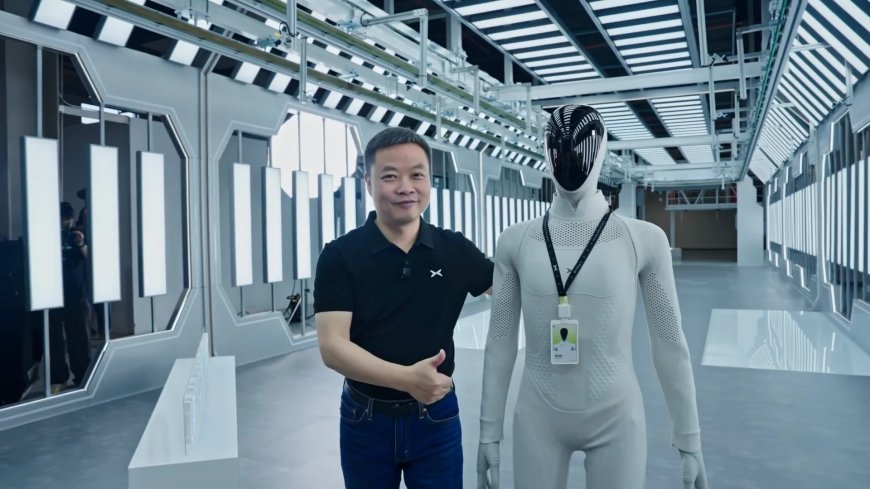
XPENG has put a date on its humanoid robot. At AI Day 2026 in Guangzhou on 25 November, the Chinese carmaker unveiled the production version of its general-purpose humanoid, IRON, and confirmed that hardware mass production will begin in January 2027, with the robot starting work as a sales assistant in XPENG stores in the first quarter and an official public launch in the second quarter.
It was the centrepiece of the company's eighth annual technology showcase, held under the theme "ORIGIN" at the South China University of Technology. But IRON was only part of the story. XPENG also used the event to set out its robotaxi plans, introduce a subscription model for its driver-assistance software, and present a single AI architecture it says will run across its cars, robotaxis, flying cars and robots.
A live debut, not a video
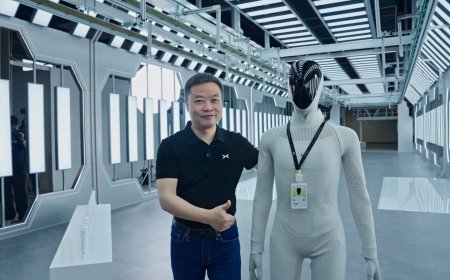
The IRON shown on stage is a new generation of the robot XPENG first revealed last year, built on what the company describes as a completely redesigned hardware platform. It walked onto the main stage holding a microphone, introduced itself and took unscripted questions from the audience — a deliberate break from the tightly edited demonstration videos that dominate humanoid robotics announcements.
The live format showed both the progress and the rough edges. Reporting from the event, Humanoids Daily noted that the robot handled walking, holding the microphone and standing close to crowds without incident, but that its conversation still faltered: during the press briefing it switched from English to Chinese between answers and kept ending its responses by asking questions back to reporters. Chairman and CEO He Xiaopeng laughed it off in front of the journalists, joking that the team still has more model training to do before IRON starts its first retail shift early next year.
Physically, the new IRON stands about 170 cm tall and weighs 62 kg. It has 76 degrees of freedom across its body and 22 in each hand, up from 21 in the earlier version, and more than 1,500 tactile sensing points, with 375 in each hand. The blank visor of earlier versions now displays animated eyes, and the hands are designed to warm to between 25 and 40 degrees Celsius so they feel more natural in human contact. A spine, bionic muscles and soft skin over the whole body are meant to make its movement more human-like and safer to be around.
One design decision is now final. The distinct male and female body styles XPENG showed at AI Day 2025 have been dropped. He Xiaopeng and vice chairman Brian Gu confirmed at the post-keynote briefing that the gender-neutral, unisex design shown on stage is the form factor going into mass production, a choice the company framed around manufacturing simplicity and the need for the robot to fit unobtrusively into varied workplaces.
Three chips, a solid-state battery and a five-layer safety net
IRON runs on three of XPENG's in-house Turing AI chips, delivering up to 2,250 TOPS of on-device computing power, so the robot can perceive, interpret and act without depending on a remote server or a teleoperator. Its power source is what XPENG describes as the robotics industry's first mass-produced solid-state battery, following last month's announcement that the cells had entered small-batch production. The company says the pack withstands penetration from sharp objects up to 8 millimetres, tolerates temperatures up to 200 degrees Celsius and offers 1,000-volt breakdown resistance, and that the robot can navigate to a dock and recharge itself, gaining 90 minutes of operating time from a 20-minute charge. Capacity and total runtime were not disclosed.
Because IRON is headed for public spaces, safety took up much of the technical presentation. XPENG detailed a five-layer physical safety architecture: full-body pinch protection, enclosed outer shells and rear perception sensors that let the robot detect people approaching from behind; a controlled fall response that bends the knees to soften impact, keeps hold of objects so they are not dropped on bystanders, and runs a self-check on the ground before either standing back up or cutting power; whole-body thermal management and electrical insulation; and a physical one-touch emergency stop button at the back of the neck. A redundant dual-channel communication system and an independent backup balance controller are designed to keep the robot upright if its primary compute system fails.
One brain for cars and robots
Underpinning the hardware is the Turing Physical AI Architecture, which XPENG calls VLA 3.0, a unified design spanning its electric vehicles, robotaxis, flying cars and humanoid robots. It divides intelligence into three loops: System 2 handles multi-step reasoning, memory and task planning; System 1, built on the new VLA 2.0 vision-language-action model, interprets surroundings and generates immediate actions; and System 0 manages motor control, power distribution and real-time hardware feedback. XPENG says VLA 2.0 now supports closed-loop training at 10 to 12 times previous speeds.
Above that sits WorldGPT, the world model XPENG unveiled the day before AI Day, which the company says plans actions and predicts how the environment will change from video footage and instructions across six kinds of machines — cars, boats, drones, single-arm robots, dual-arm robots and humanoids. XPENG reports 12 first places on public benchmarks and a 95.2 percent average success rate across 50 single-arm tasks, though those are the company's own figures and no independent benchmark result has been published yet. (Read more: XPENG unveils WorldGPT, a single AI model for cars, drones, boats and humanoid robots)
A factory, a data pipeline and a dated plan
What sets IRON apart from most humanoid announcements is the production substance behind it. The latest IRON rolled off a newly commissioned automated production line on 8 September 2026, after eight years of research and development, and in August the robotics business secured more than US$900 million in equity financing at a post-money valuation above US$6.3 billion, which XPENG called the largest single-round private financing in China's embodied AI industry.
At full capacity, the fully automated line — equipped with more than 600 AI holographic inspection checkpoints and more than 1,000 vehicle-grade tests — is designed to assemble one IRON unit every 2.5 minutes. A purpose-built 50,000-square-metre Robot Data Factory covering more than 250 scenarios across 15 job categories feeds the training pipeline. He Xiaopeng said XPENG may be investing more in robotics research and development than any other company in the industry, arguing that mass production is essential to building a real-world data flywheel.
The commercial plan is deliberately phased. In the first quarter of 2027 the first mass-produced robots will begin an "internship" as sales associates and tour guides inside XPENG retail stores. The official public launch and external enterprise deliveries follow in the second quarter, targeting retail, hospitality, education and front-desk reception roles, with a European rollout planned for the second half of 2027. Commercial workplaces come first; households are not part of the opening phase.
XPENG also sketched out how it intends to make money from IRON beyond hardware sales: software subscriptions, token-powered plans and an open skill ecosystem in which businesses and developers can download "one-click skill packs" or customise workflows so the robot acquires new job capabilities after delivery. No price has been announced — for the hardware, the software tiers or the token plans.
Robotaxi YOYO-01 and a subscription for driver assistance
AI Day was not only about robots. XPENG confirmed that its first purpose-built robotaxi, the YOYO-01, will arrive in 2027. The company has already begun driverless passenger rides under the YOYO name in selected areas of China, and plans demonstration operations with no one in the driver's seat in some areas before the end of 2026. But XPENG stressed it will not operate fleets itself. It will supply the vehicle platform and autonomous-driving technology to partners around the world and offer them a ready-to-deploy robotaxi business model, with operations scaling up from 2028, starting overseas.
The other change that will reach ordinary buyers sooner is the way XPENG charges for driver assistance. From the second quarter of 2027, its Turing AI Driving system will be sold as a subscription to new car buyers worldwide. Customers who order before the service starts will keep their driver-assistance features for life, He Xiaopeng said, but new buyers after that date will pay. No price was announced, and XPENG did not say which functions the subscription covers. The move reverses the company's October 2024 position that advanced driver assistance would be standard with no paid subscription — He argued that driving AI needs constant training, and that a subscription provides sustainable funding for it. Global deliveries of the second-generation VLA driving system are targeted for the first half of 2027.
Why it matters
IRON matters less as a single robot than as a test of a strategy: a carmaker becoming a physical AI company by owning the whole stack — chips, models, hardware and a production line — and aiming it at several kinds of machine at once. If VLA 2.0 genuinely transfers across cars, flying cars and humanoids, that is evidence for the generalist bet that one learned system can power many bodies. If it does not, IRON is still a well-funded humanoid with a factory and a dated launch plan, which is more than most competitors can show.
The comparison set is moving at the same time: Figure's humanoids have appeared at public events, Boston Dynamics' Atlas is heading for factory testing, and several Chinese makers are shipping wheeled and bipedal robots into industrial trials. What IRON's first retail shifts in early 2027 will actually prove is the claim that matters most — that the robot can work a real shift, unsupervised, without a script. Until then, the dates are the story: mass production in January, store trials in the first quarter, a public launch in the second.
Sources
- XPENG press release, "XPENG Achieves New Milestone in Humanoid Robotics as IRON Brings Human-Centric Intelligence into the Mass Production Era", GlobeNewswire, 25 November 2026 (via TradingView)
- Robot Embodiment, "XPENG IRON Humanoid: Specs, Physical AI and the 2027 Production Plan", 25 November 2026
- Humanoids Daily, "XPENG Details Mass-Production IRON Humanoid at AI Day 2026, Confirms Unisex Form Factor and VLA 3.0", 25 November 2026
- Gasgoo, "XPENG unveils Turing embodied intelligence architecture, advancing AI across vehicles and robots", 25 November 2026
- eletric-vehicles.com, "XPeng to Start Charging New Buyers for Driver Assist in Q2 2027", 25 November 2026
- ChinaEVHome, "XPeng to Roll Out Second-Gen VLA Overseas in 2027, Launch Turing AI Driving Subscription", 25 November 2026
- XPENG GURU, "AI Day: XPENG moves driver assistance to a subscription and lifts 5C charging to 6C", 25 November 2026
What's Your Reaction?
 Like
0
 Dislike
0
 Love
0
 Funny
0
 Angry
0
 Sad
0
 Wow
0