
















































Kioxia and Nvidia Use 144 SSDs to Push GPU Memory Beyond 1 Petabyte
Kioxia and Nvidia have shown that solid-state drives can stretch effective GPU memory past the petabyte mark. In a proof-of-concept test, 144 Kioxia XD8 SSDs on an Nvidia GB200 NVL72 rack delivered about 1.1 petabytes of flash capacity through Nvidia's SCADA software, opening a new way to feed giant AI datasets to GPUs. A faster GP2 drive built for the same job arrives for sampling at the end of 2027.


Kioxia and Nvidia Use 144 SSDs to Push GPU Memory Beyond 1 Petabyte
Graphics processors have a memory problem. The high-bandwidth memory stacked beside today's AI chips is fast, but it is expensive and limited in size, and the datasets AI models need to chew through keep getting bigger. Kioxia and Nvidia now say they have a way around that limit: let the GPU reach into a large pool of flash storage as if it were memory.
The two companies announced a collaboration on November 25, 2026, showing that Kioxia SSDs working with Nvidia software can extend effective GPU memory capacity to petabyte scale. The demonstration ran on an Nvidia GB200 NVL72 rack-scale system fitted with 144 Kioxia XD8 Series SSDs, delivering roughly 1.1 petabytes of raw flash capacity. It is a proof of concept, not a product launch, but it points at a different way of building AI infrastructure.
How flash storage becomes GPU memory
The trick is software. Nvidia's SCADA library, short for Scaled Accelerated Data Access, is designed to extend effective GPU memory using NVMe SSDs, including fine-grained access at small block sizes. Working under Nvidia's Storage-Next initiative, SCADA lets GPUs pull data from flash in 512-byte chunks, fetching only the pieces a workload actually needs instead of shuttling whole datasets back and forth.
That matters because high-bandwidth memory alone forces large AI workloads into smaller segments, with data moving repeatedly between memory and slower storage. By sitting a flash tier behind SCADA, the collaboration aims to make much larger datasets directly accessible to the GPU.
"The intelligence of AI agents will increasingly depend on the knowledge they can access, not just the compute power they consume," said Jason Hardy, vice president of storage technology at Nvidia. "Through innovations like SCADA and Storage-Next, Nvidia is working with partners like Kioxia to improve memory efficiency and extend the effective capacity of GPU memory, enabling AI agents to access vastly larger knowledge bases and unlock new levels of intelligence."
Inside the 1.1-petabyte test rack
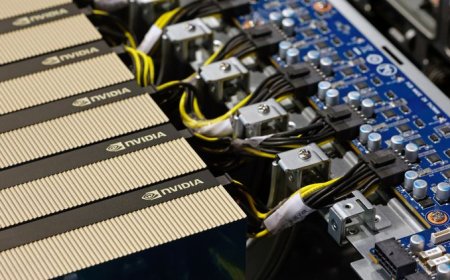
The test system was built around Nvidia's GB200 NVL72 rack, which connects 36 Grace CPUs and 72 Blackwell GPUs in a liquid-cooled design, with an NVLink Switch System supplying 130 terabytes per second of GPU-to-GPU communication. Across 18 server nodes, each holding eight drives, the rack carried 144 Kioxia XD8 Series 7.68-terabyte E1.S NVMe SSDs, giving each node nearly 60 terabytes of flash-based extended memory capacity.
According to Kioxia, the architecture supports 512-byte accesses and could hold a database of 2 trillion 512-byte vectors across the system. The workloads the companies have in mind are large-scale vector databases and the huge datasets used in graph neural networks, where the data regularly outgrows the memory sitting next to the GPU.
There is an obvious trade-off. Flash is far slower than high-bandwidth memory, so the SSD tier works as an extension for data that does not fit in HBM, not as a replacement for it. Kioxia and Nvidia say they are still evaluating the technical feasibility and performance of SCADA, and no commercial availability or timeline has been announced.
A faster drive built for the same job
Alongside the collaboration, Kioxia announced on November 26 the GP2 Series, the second generation of its Super High IOPS SSD line built for direct GPU access. The GP2 uses Kioxia's third-generation XL-FLASH low-latency memory and targets PCIe 6.0 and NVMe 2.3 specifications.
Kioxia reports the GP2 delivers more than 18 million random read operations per second at a 512-byte block size, nearly double the first-generation GP1, with up to 28 gigabytes per second of expected sequential read throughput. Evaluation samples will reach select customers by the end of 2027, and Kioxia is targeting up to 100 million random read IOPS with a future GP Series drive in 2028.
The GP2 was not part of the demonstration rack, which used the current XD8 Series drives. The XD8 ships in 1.92, 3.84 and 7.68-terabyte capacities in the E1.S form factor for cloud and hyperscale servers.
Why this matters for AI data centers
Memory has become one of the tightest bottlenecks in AI computing. High-bandwidth memory is costly and in short supply, and it sets a hard ceiling on how much data a GPU can work with at once. If a flash tier can take over part of that job for the right workloads, data centers could build larger knowledge bases for AI agents and retrieval systems without waiting for more HBM supply.
The idea is not unique to Kioxia. Nvidia's SCADA software works with NVMe SSDs generally, and other memory makers sell drives that could play the same role. What Kioxia is betting on is that its low-latency flash and its GP Series drives, purpose-built for GPU access, give it an edge as the approach moves from testing toward real deployments.
For now, the petabyte-scale result is a laboratory milestone. Whether it becomes a standard part of AI server design will depend on the performance numbers that emerge as Kioxia and Nvidia keep testing, and on whether customers decide the extra capacity is worth the slower access. The GP2 sampling date at the end of 2027 is the next real checkpoint.
Sources
- Business Wire — Kioxia and NVIDIA Collaborate to Expand Effective High-Bandwidth Memory Capacity with SSDs
- IT Business Today — Kioxia and NVIDIA Expand High Bandwidth Memory with SSDs
- TrendForce — Kioxia, NVIDIA Begin 1.1 PB SSD-Based GPU Memory Expansion Tests to Address HBM Capacity Limits
- HotHardware — Kioxia And NVIDIA Tap 144 SSDs To Push AI GPU Memory Past 1 Petabyte
Related reading: Chinese AI Models Carry a Blackwell Chip Fingerprint, Research Finds
What's Your Reaction?
 Like
0
 Dislike
0
 Love
0
 Funny
0
 Angry
0
 Sad
0
 Wow
0