





















































SpaceX Has Designed a Rooftop Mini Cell Tower to End Phone Dead Zones, Elon Musk Says
Elon Musk says SpaceX has completed the design of a miniature rooftop cell tower that could bring mobile coverage indoors where Starlink satellite signals cannot reach, with production targeted for 2027 alongside a new Direct-to-Cell V2 satellite constellation offering 40 times more bandwidth.
SpaceX Has Designed a Rooftop Mini Cell Tower to End Phone Dead Zones, Elon Musk Says
SpaceX has finished designing a miniature cell tower that sits on a rooftop like a Starlink dish, Elon Musk said this week — the missing piece, in his telling, of a plan to give mobile phones a signal just about anywhere on Earth, including inside buildings where satellite coverage gives up.
Musk described the device during an interview at The New York Times DealBook Summit on 18 November, speaking remotely from China. The design is complete, he said, and the small base stations could go into production in 2027 — though he hedged the timing himself, saying they were "going into production, I think, next year." SpaceX has not announced a price, a consumer launch date, or technical details such as coverage range or supported bands.
Why satellites alone cannot fix indoor coverage
The problem Musk pointed to is physical. Starlink's Direct-to-Cell service lets compatible phones connect directly to satellites, without a nearby tower. But a signal beamed down from space has to get through whatever sits above the phone — and thick roofs, concrete and especially metal can weaken it or block it altogether.
"We've got a plan that enables ubiquitous access on Earth, including via cell phone," Musk said at the summit. "But there is a missing piece of the puzzle here which is that if you're indoors, especially if you have a metal roof, that blocks the signal from space. So we need something that's terrestrial that addresses situations where people are, you know, in a building with a thick roof essentially."
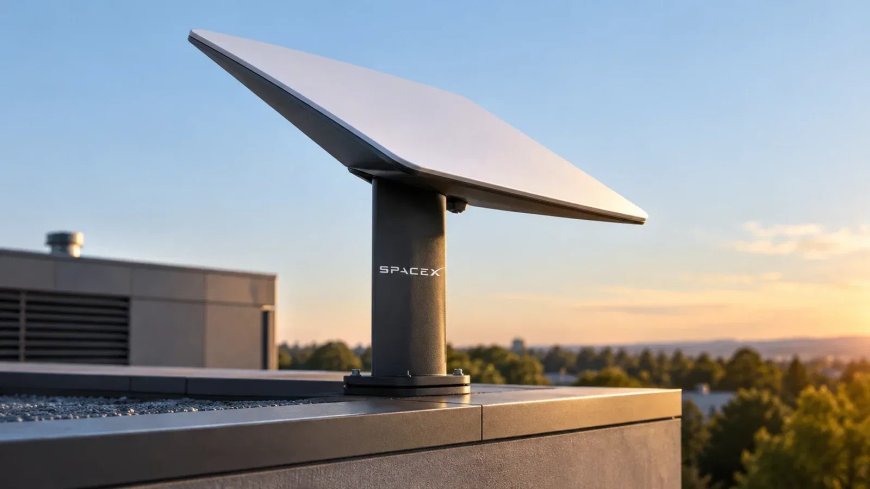
The rooftop unit is meant to close that gap. Instead of asking the satellite to punch through a roof, SpaceX would put a small cellular base station on the building itself, bringing the signal closer to the people using it. Musk described it as "a micro cell tower thing that you just put on your roof, like a Starlink dish."
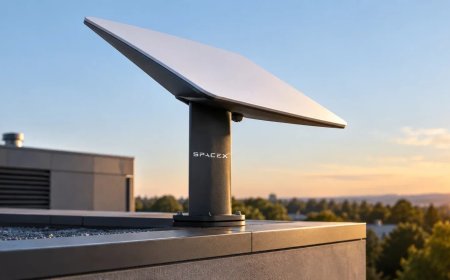
SpaceX has not released images of the mini cell tower itself. The photo above shows a Starlink terminal installed on a rooftop — the kind of mounting Musk described for the new device.
A satellite upgrade and a spectrum buying spree
The rooftop hardware is only one half of the plan. Musk also said SpaceX will begin launching its next-generation Direct-to-Cell V2 satellite constellation in 2027, which he said will deliver 40 times the bandwidth of the current generation.
The groundwork for a terrestrial network has been building for years. SpaceX received Federal Communications Commission approval in 2024 to move ahead with a direct-to-phone version of Starlink, in partnership with T-Mobile. It then bought its way into the wireless spectrum it needs: a $17 billion deal with EchoStar in 2025, followed by an agreement this year to acquire a portfolio of low-band spectrum valued at $8 billion.
Combining that spectrum with the mini cell towers, Musk said, should boost signals and end the dead-zone problem.
Small cells, not big towers
The idea of using small ground stations is not new, but until this week it was unclear how far SpaceX had taken the hardware. SpaceX President Gwynne Shotwell said during the company's August earnings call that it would not build large cell towers, and would instead deploy small, low-power cellular base stations.
Details are still being worked out. Musk said one approach under consideration is to bundle the small cellular base stations together with Starlink terminals, so a home or business could install both pieces of hardware at once. Nothing on that front has been confirmed.
What it means for the big carriers
SpaceX's push into hybrid satellite-and-cellular service has fuelled speculation that legacy telecom companies could be in trouble. Musk does not see it that way. He said he does not expect AT&T, Verizon or other carriers to go out of business, though they might lose some revenue.
His argument is that demand for wireless bandwidth is about to grow far beyond what people use today — and that the growth will be driven not by humans, but by artificial intelligence. "I actually think that the demand for bandwidth will be tremendous in the future," he said, "and a lot, and that bandwidth will be driven primarily by superintelligence and robots, and they're going to need a lot more bandwidth than humans."
For now, the rooftop cell tower remains a plan with a finished design and a tentative 2027 production target — and a chief executive with a well-known history of missing his own production deadlines. Whether the device arrives on schedule, and what it costs when it does, are questions SpaceX has yet to answer.
Related: SpaceX Plans $74 Billion AI Supercomputing Campuses in Texas and Arizona
Sources
- TechCrunch — Elon Musk says SpaceX has a plan to eliminate cell phone dead zones (Kirsten Korosec, 19 November 2026)
- iTech Post — Elon Musk Reveals How SpaceX and Starlink Mobile Could End Cell Phone Dead Zones
- Gadgets Now — SpaceX Mini Cell Towers: How Elon Musk Plans to End Mobile Network Dead Zones
What's Your Reaction?
 Like
0
 Dislike
0
 Love
0
 Funny
0
 Angry
0
 Sad
0
 Wow
0