




























































Poco F9 Ultra Review: A 24-Hour Battery and a Subwoofer in Your Pocket — at a Much Higher Price
Poco's F9 Ultra is the company's most ambitious phone yet — an 8,050mAh battery that lasted 24 hours 35 minutes in GSMArena's tests, the fastest Snapdragon chip available, a 185Hz display and a dedicated subwoofer that the review calls the best phone audio it has heard. But it costs far more than the F8 Ultra it replaces, and its 200MP main camera uses a smaller sensor than last year's, so low-light photos are actually a step back.
Poco F9 Ultra Review: A 24-Hour Battery and a Subwoofer in Your Pocket — at a Much Higher Price
Poco's F9 Ultra is the most ambitious phone the brand has ever made, and the review's headline numbers are hard to ignore: an 8,050mAh battery that lasted 24 hours 35 minutes in GSMArena's Active Use test, the fastest Snapdragon chip you can get in an Android phone, a 185Hz display, and a 2.1-channel speaker system with a dedicated subwoofer that the review calls the best phone audio it has heard for low-end sound. GSMArena rates the phone 4.4 out of 5. But the F9 Ultra also asks for a lot more money than the F8 Ultra it replaces — and in one important area, the camera, it is actually a step back.
The price is the first thing to reckon with. The 12GB/256GB model costs $799 or €1,099, the 16GB/512GB model $949 or €1,199.90, and a new 16GB/1TB tier $1,199 or €1,399.90. Early-bird pricing was lower — $729 for the base model and $799 for the 512GB model — but even so, this is a major hike: the Poco F8 Ultra launched last year at €749, $729 or £830. The review lists that price jump as one of the phone's four cons.
Design: the same look, bigger and heavier
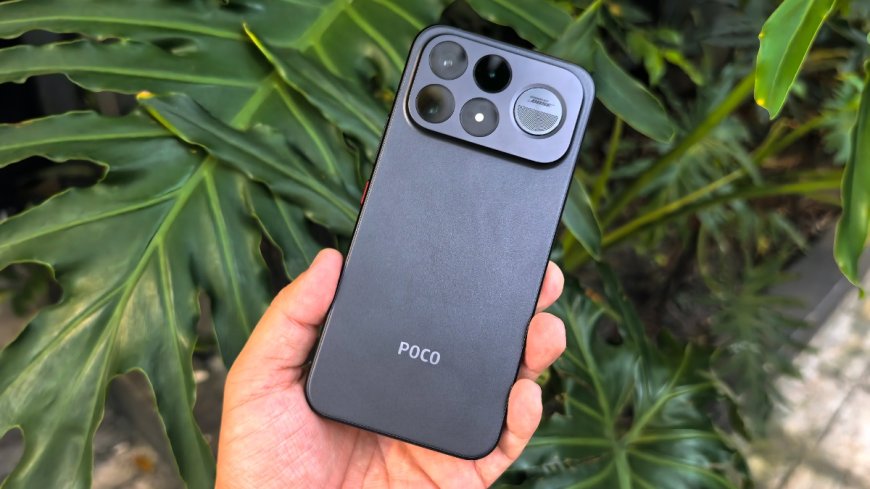
The design is essentially the same as the Poco F8 Ultra, now wrapped around a bigger 6.9-inch display. The review calls it "a huge, good-looking phone", with a comfortable anodized aluminium frame, a glass-fibre-reinforced plastic back, and the return of the LED ring around the subwoofer. At 163.5 x 77.9 x 8.7mm and 235g, the weight is noticeable, and the review notes the camera island is a bit too large for its lenses. The back panel feels premium but can be slippery. The phone is IP68 and IP69 rated — dust and water resistant, including water jets — and comes in Black and Dark Cherry; the review unit was Dark Cherry. The ultrasonic fingerprint sensor is accurate and fast, Face Unlock is available, and the IR blaster is retained. There is no microSD slot, no 3.5mm headphone jack and no FM radio.

Display: 185Hz, very bright, with a 10,000-nit claim that needs context
The 6.90-inch AMOLED display is a 1200 x 2608 panel with a 185Hz adaptive refresh rate — LTPO technology that drops to 1Hz when idle and rises to 185Hz when interaction is required — plus Dolby Vision, HDR Vivid, HDR10+ and Gorilla Glass 7i. Poco advertises a 10,000-nit peak brightness, but the review is careful about what that means: it is a 1% HDR peak, not sustained brightness. In GSMArena's own tests the panel measured 1,283 nits at 75% fill and 4,333 nits at 10% fill for HDR content, with a minimum brightness of 3.1 nits. That is bright enough for outdoor use and ahead of the iPhone 17's 1,181 nits in the same chart, though behind the Honor 600 Pro at 1,578 and the Galaxy S26 at 1,596. The review calls the 185Hz panel "a huge improvement" over the 120Hz panel on the F8 Ultra, and notes Vivid and Pro colour modes — Vivid is native with a slightly warm white, Pro is more vibrant.

Performance: the fastest Android chip, with heat under pressure
The Snapdragon 8 Elite Gen 5 — a 3nm octa-core chip with two 4.6GHz Oryon cores and six 3.62GHz Oryon cores, an Adreno 840 GPU, LPDDR5X RAM and UFS 4.1 storage — is, in the review's words, "the fastest chip you can get in an Android phone". The numbers back that up: Geekbench 6 single-core 3,974 and multi-core 12,803, AnTuTu v10 at 4,071,297, 3DMark Solar Bay 14,187, Wild Life Extreme 7,847, Steel Nomad Light 4,480 and PCMark Work 3.0 at 22,781. Under sustained load the phone held 93.05% of its peak performance in the throttling test, which the review describes as consistent — but it also notes the phone heats up and throttles heavily under prolonged load, and lists that as a con. The review also observes that the F9 Ultra is a bit slower than the F8 Ultra in some benchmarks despite sharing the same chip family.
Software: HyperOS 3, the best on a Poco yet
The F9 Ultra runs HyperOS 3 based on Android 16, with 4 major Android OS updates and 6 years of security patches promised. The review praises the clean, bloatware-light experience — "the best software on any Poco phone" — and highlights Hyper Island, the iOS-style notification hub, HyperConnect for seamless connectivity with Apple devices, Macs and Windows PCs, and the HyperAI suite: text translation, call transcription, Gemini AI, Vision Care and AI subtitles. The phone has 5G, two SIM slots plus eSIM, dual-band GPS, Wi-Fi 7, Bluetooth 6.0 with Dual Audio and Auracast, NFC, an IR blaster and USB-C 3.2 with DisplayPort output.
Battery: one of the best scores GSMArena has ever seen
The 8,050mAh silicon-carbon battery is the star of this phone. GSMArena's Active Use Score came in at 24 hours 35 minutes — calls 48:51, web browsing 26:32, video playback 29:34 and gaming 13:13 — which the review calls one of the best battery scores it has seen on any flagship, and "a huge improvement" over the F8 Ultra. For context, the chart puts it behind only the Poco X8 Pro Max at 29:05h, on par with the iPhone 17 at 26:35h, and ahead of the Galaxy S26 at 21:39h and the Xiaomi 17 Pro at 25:16h. Charging is 100W wired HyperCharge — 32% in 15 minutes, 61% in 30 minutes and a full charge in under an hour — plus 50W wireless, 27W reverse wired and 22.5W reverse wireless, with battery lifespan provisions such as charging to 80% to extend the battery's life. (One passage in the review's charging text calls the battery 8,500mAh; the specs page, the design page and the battery chart all say 8,050mAh — that figure belongs to the Poco X8 Pro Max in the comparison chart.)
The speakers deserve their own mention. The 2.1-channel stereo setup — two main speakers plus a dedicated subwoofer — measured -26.0 LUFS, a Good loudness result at the top end of that category, and GSMArena calls the sound "excellent quality" with clean mids and highs and "convincing low-end" from the subwoofer — "the best sound we've heard on a phone" in terms of low-end, though the subwoofer does not drown out the stereo pair.
Camera: a very good system with a smaller sensor than last year
The rear camera system is a 200MP main camera (f/1.7, OIS), a 50MP telephoto (f/3.0, 5x optical zoom, 10x optical-quality zoom, OIS) and an 8MP ultrawide (120 degrees), with a 32MP front camera. Video goes up to 8K at 30fps with HDR10+, 4K at 30/60fps and 1080p up to 240fps, with gyro-EIS. The review calls the camera "a very good" all-round system, and the 5x telephoto is its standout — excellent detail, sharpness and colours, "a joy to use", with 10x optical-quality zoom also excellent. In daylight the 200MP main camera delivers excellent detail and sharpness with good dynamic range and natural colours.

A portrait camera sample taken with the Poco F9 Ultra.
The problem is the sensor. The 200MP main camera uses a smaller 1/1.56-inch sensor, down from the 1/1.4-inch sensor in the F8 Ultra, so the review calls it a "sidegrade" and says low-light performance is "worse" than the F8 Ultra's in some areas — the camera's "greatest weakness". Night Mode still gives a significant improvement in detail and dynamic range, and low light is "very good" on its own terms, but the comparison with last year stings. The 8MP ultrawide is good in daylight but lacks autofocus, so there is no macro mode, and the review calls it "relatively basic". The 32MP front camera is good with natural skin tones but "not the best" for portraits. Video is strong — 8K30 with HDR10+ is "excellent" with good stabilisation, and 4K at 60/120fps is "very good" with EIS and HDR10+.
Price and verdict
The Poco F9 Ultra costs $799 for 12GB/256GB, $949 for 16GB/512GB and $1,199 for 16GB/1TB, with early-bird prices from $729. GSMArena rates it 4.4 out of 5. At first glance it could be a Poco F8 Ultra with a different name, the review says, but the differences are big enough to make it a much better phone — a premium design, a bigger display, a bigger battery and a much better camera. The review says it would happily recommend the F9 Ultra to people who prioritise battery life, a big bright display and powerful audio, but not to people who prioritise a top-tier camera, since the main camera uses a smaller sensor than last year. The competition it names is the Google Pixel 10 Pro XL (better camera, 5 years of OS updates, but a smaller battery and slower charging), the OnePlus 15, the Motorola Edge 70 Ultra, the Xiaomi 17T Pro — and the Poco F8 Ultra itself, which remains the cheaper option with the larger main sensor. For a closer look at Poco's other new phone, see our Poco F9 Pro review.
Pros and cons
Pros: excellent premium build; outstandingly bright and fast AMOLED display; superb battery life; excellent stereo speakers with dedicated subwoofer; top-tier Snapdragon 8 Elite Gen 5 performance; top-notch main camera with a standout 5x telephoto.
Cons: somewhat heavy; major price hike compared to the previous generation; runs hot and throttles heavily under prolonged load; ultrawide camera still lacks autofocus.
Sources
What's Your Reaction?
 Like
0
 Dislike
0
 Love
0
 Funny
0
 Angry
0
 Sad
0
 Wow
0