





















































Huawei Pura 90s Pro Max Review: A Brilliant Camera Phone With a Mid-Range Chip and No Google
Huawei's Pura 90s Pro Max is a mightily capable camera phone — a 200MP telephoto, a variable-aperture main camera and superb video — and GSMArena rates it 4.2 out of 5. But its Kirin 9030S chip performs like a mid-ranger, there is no Google Mobile Services, and it costs €1,199.
Huawei Pura 90s Pro Max Review: A Brilliant Camera Phone With a Mid-Range Chip and No Google
Huawei's Pura 90s Pro Max is a solid smartphone — impressive design, a great multimedia screen and quite good speakers, with a versatile camera set offering excellent photo and video quality across the board, and very good selfies despite a more basic sensor. GSMArena rates it 4.2 out of 5. But the mid-range Kirin chip is not worthy of a flagship with a €1,000-plus price tag, and there is no Google Mobile Services. Overall, it is an intriguing smartphone with a very specific target audience: if the camera system is the top priority, its compromises are easy to forgive; if not, more complete flagship experiences exist for the same money.
The phone costs €1,199. The review unit is the global edition of the China-exclusive Pura 90 Pro Max, described as a "special edition... a holiday phone". The retail bundle includes a 100W charger, a USB-C cable and a clear protective case, though the reviewers did not receive the retail box.
Design: the volcano camera housing, in four colours
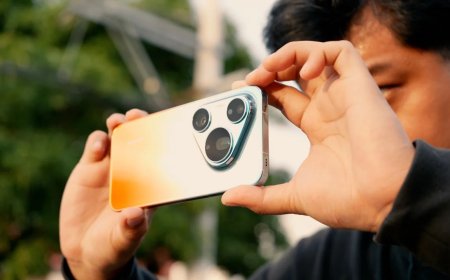
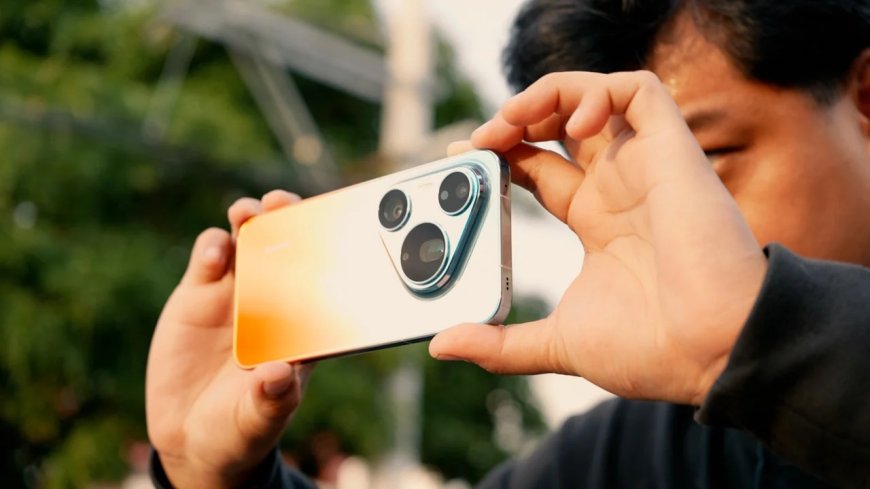
The signature triangular ("volcano-like") camera housing is about 0.5cm thick, so the phone never lies flat — but it does not wobble. Three separate lens rings hold the 50MP primary, 200MP telephoto and 40MP ultrawide cameras; the colour-spectrum sensor and laser emitter sit inside the ultrawide and telephoto rings, with the LED flash outside them. At 164.0 x 77.1 x 8.1mm and 231g, it is the same size and weight as the iPhone 17 Pro Max. The front is a nearly all-screen 6.9-inch OLED with thin bezels and a small selfie-camera perforation, and the near-invisible earpiece doubles as the second speaker. The polished metal frame is slippery and easy to smudge (especially the black unit), and the glass-and-polished-aluminium body is "incredibly slippery", with fingerprints showing on the back glass. Colours are Orange Ocean, Blaze Purple (with a dual-tone gradient mid-frame, claimed as an industry first), Graphite Black (the review unit) and Blush Gold. The phone is IP68/IP69 rated (up to 2m for 30 minutes), with Huawei Kunlun Glass on the front, an aluminium frame and a glass back. The left side is empty; the volume rocker and power button (with the always-on, fast and accurate fingerprint scanner) are on the right; the bottom holds the primary mic, the USB-C port, the dual-SIM tray and the second speaker.

Display: bright, high-resolution, near-perfectly calibrated
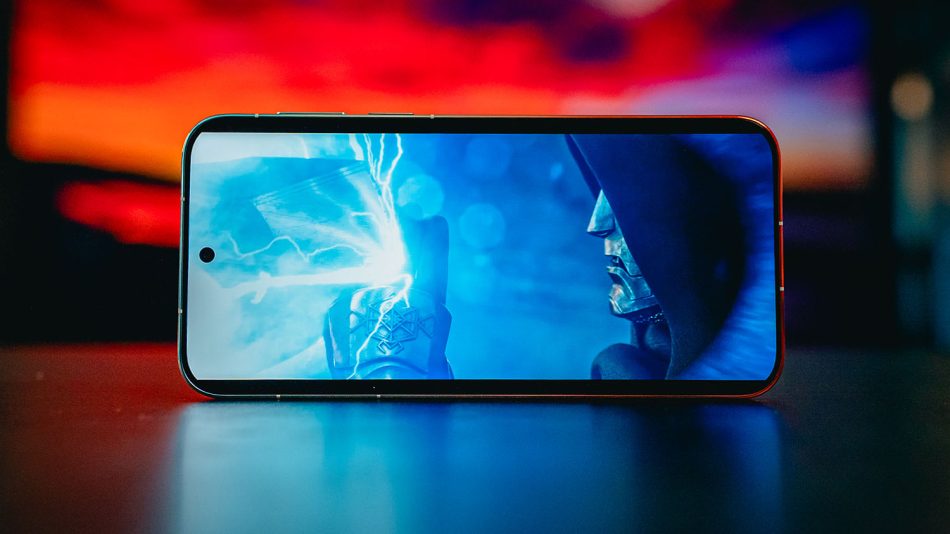
The 6.90-inch LTPO OLED display is a 1308 x 2880 panel (460ppi) with 1 billion colours, a 120Hz refresh rate and HDR. In GSMArena's lab tests it measured 1,192 nits maximum brightness (75% fill) and a peak of 1,777 nits on a 10% white patch, with a minimum of 1 nit. Refresh rate modes are High, Standard and Dynamic; the refresh-rate tracker only registered 60, 90 and 120Hz. HDR10 is supported — YouTube and Netflix offer FullHD HDR10 through GBox. Colour modes are Default (Vivid), Original and Vivid; the Original mode is described as accurate and the display as "near-perfect" in calibration.
Performance: the phone's biggest weakness
The Kirin 9030S is a 5nm chip and a downclocked version of the regular Kirin 9030, with an 8-core CPU (1x 2.7GHz Taishan V124 Big + 3x 2.15GHz Taishan V124 Mid + 4x 1.62GHz Taishan V124 Little) and a Maleoon 935F GPU at about 1,433 GFLOPS — about 60% of the regular Kirin 9030's GPU and half of the Pro version's. The numbers are mid-range: Geekbench 6 at 1,336 single-core (the same as a Snapdragon 7 Gen 4 in the Motorola Edge 70) and 4,522 multi-core, AnTuTu 11 at 1,293,328, and 3DMark Wild Life Extreme at 1,606 highest and 983 lowest. Under load the phone retained only 48% of CPU performance and 61% of GPU performance. The review calls performance "the phone's biggest weakness" — acceptable for the occasional game, but at this price point hard to justify — and it is slower than the Kirin 9020 in the Pura 80 Ultra as well. The phone has 12GB of LPDDR5X RAM and 256GB or 512GB of UFS storage.
Software: EMUI 16 on an Android 16 core, without Google
The global model runs EMUI 16 on an Android 16 core, with Huawei Mobile Services instead of Google Mobile Services; the Chinese model runs HarmonyOS. Celia AI is included (with AI-generated memes and image restyling), along with Air gestures and smart sensing, Huawei-built apps (Gallery, Music, Video, Themes, Health), Petal Maps, Petal Search and Huawei Browser. AppGallery carries ads and pop-ups, but APKPure and GBox (a virtual environment for Google services) work, so pretty much any app can be installed — Gemini does not work, ChatGPT does. AI image manipulation is limited to Object Removal; the EU version lacks AI Remove, AI Best Expression, AI Move and AI De-glare. AI Composition is present: it understands the scene and intent, suggests composition, focal length and aspect ratio, offers continuous 1x–10x zoom suggestions and pitch/tilt and camera-position guidance, and recognises humans, pets and architecture. Split-screen multitasking and pop-up windows are supported.
Battery: good life, but slow for a 100W charger
The global unit is rated 5,270mAh (typical 5,400–5,500mAh); the Chinese unit is rated 5,850mAh (typical 6,000mAh — the figure in the specs table). The Active Use Score is 13 hours 2 minutes (calls 23:44, web 12:21, video 20:32, gaming 6:49). Charging is 100W wired and 80W wireless, with 18W reverse wired and reverse wireless: 39% in 15 minutes, 60% in 30 minutes and a full charge in 61 minutes — "not very fast, especially considering the 100W charger and the rated 5,270mAh battery". It trails the Pura 80 Ultra (80% in 30 min), the Oppo Find X9 Ultra (75%), the Xiaomi 17 Ultra (72%), the vivo X300 Ultra (66%) and the iPhone 17 Pro Max (65%). The speakers measured -25.0 LUFS, rated "Very Good" — a bottom speaker plus an amplified earpiece, with good highs and good-enough vocals and thump.
Camera: the 200MP telephoto is the biggest highlight
The main camera drops the 1-inch sensor, which "isn't really a big deal" because the 1/1.28-inch LOFIC RYYB sensor with a physical variable aperture (f/1.4–4.0) delivers. The rear setup is a 50MP main camera (24mm, PDAF, Laser AF, OIS) with a 40MP ultrawide (f/2.2, 13mm, autofocus, macro, RYYB) and a 200MP telephoto (f/2.6, 89mm hardware / 96mm EXIF, 1/1.28-inch RYYB, PDAF, OIS, 4x optical zoom — listed as 3.7x — with up to 20x lossless zoom that works in video too), plus a True-to-Color colour spectrum sensor (43% better colour restoration accuracy than the Pura 80). The front camera is a 13MP ultrawide selfie camera (f/2.0, 21mm, autofocus). Video goes up to 4K60 on all four cameras; there is no 8K and no 24fps in 4K even in Pro mode, HDR Vivid goes up to 4K30 (not in Pro mode), and there is no Log option.

A daylight ultrawide camera sample taken with the Huawei Pura 90s Pro Max.
The main camera's default output is 12.6MP, with 25MP and 50MP modes; the aperture is only adjustable in Pro mode (Photo mode sticks to about f/2.0 in most cases), and portraits have lively skin tones. The new telephoto is the biggest highlight: a 200MP 1/1.28-inch RYYB sensor (possibly a SmartSens SCC80XS — Huawei never confirmed the sensor; the first of its kind in the industry) with a fixed lens and CIPA-rated 7 stops of stabilisation. 4x shots are very good, the 5.6x (134mm) portrait preset works well, 8x is still very good, but 10x has a "dreamy/generated" look and low-light 10x is "plasticky" (though "alright"); the reviewer wants an 8x shortcut in the app instead of 10x. The 40MP ultrawide is very good in daylight, slightly soft in indoor shadows, soft in 40MP mode, and its Super macro mode with a manual focusing slider is "addictive". Selfies are very good: 0.8x native, 1x with negligible quality loss in good light (more in low light), and 2x with a significant drop. In low light, the main camera is very good to excellent, high contrast and vibrant, with the reviewer preferring full auto over Night mode (warmer, brighter); 2x is patchy; the telephoto at 4x is very good, with occasional white-balance and over-saturation issues; the ultrawide is good in the dark with soft detail, and Night mode on it blows out highlights. The photo verdict: a mightily capable photo camera — the move away from the 1-inch sensor is not a big deal, the 4x telephoto is top-class at its nominal focal length and quite good at twice that, 10x is more questionable but still alright, the ultrawide does well by day and mostly okay at night, and selfies are excellent. Video is 4K60 on all four cameras, very good and consistent in colour and tone day and night across all cameras, with solid stabilisation; walking shake is handled well, though the start and end of pans are slightly hesitant.
Price and verdict
The Huawei Pura 90s Pro Max costs €1,199. GSMArena rates it 4.2 out of 5. It is a solid smartphone — impressive design, a great multimedia screen and quite good speakers, with a versatile camera set offering excellent photo and video quality across the board, and very good selfies despite a more basic sensor. But the mid-range Kirin chip (its GPU worse than the Mate X7's) is not worthy of a flagship with a €1,000-plus price tag, even though connectivity got an upgrade with 5G and Wi-Fi 7. EMUI is the universal dilemma of leaving Google behind: most people can live with it — Android 16 core, nearly any app installable, GBox for GMS apps, powerful customisation — but sooner or later an app simply won't work, and not everyone wants to sideload from outside the official store. Overall, an intriguing smartphone with a very specific target audience: if the camera system is the top priority, its compromises are easy to forgive; if not, more complete flagship experiences exist for the same money. The competition it names is the Xiaomi 17 Ultra (the most powerful Snapdragon chip, better screen, cameras with continuous zoom and battery life, complete Android with all Google services — the same asking price or lower), the Oppo Find X9 Ultra (€1,500, flagship-grade design, screen and Elite chip, two telephoto cameras and a high-resolution selfie camera) and the vivo X300 Ultra (even more expensive, an equally good — or better — cameraphone). The Huawei's one unique feature is the main camera's variable aperture, though its benefits outside a few specific use cases are dubious.
Pros and cons
Pros: likable design, premium build; bright HDR screen, high-resolution; good battery life; loud stereo speakers, very good sound output; excellent photos from all cameras, variable aperture on the main camera; superb videos and video stabilisation from all cameras; EMUI is now based on Android 16; 5G support.
Cons: mid-range performance, still throttles; charging speed could be faster; no Google Mobile Services; 8x zoom should have been the standard instead of 10x.
Sources
What's Your Reaction?
 Like
0
 Dislike
0
 Love
0
 Funny
0
 Angry
0
 Sad
0
 Wow
0