






























OpenAI Unveils Dots as Always-On AI Agents in New Challenge to Meta
OpenAI has introduced Dots, a new class of always-on AI agents designed to work across applications and pursue multi-step goals with limited supervision. Powered by GPT-6 Astra, Dots mark OpenAI’s latest push to move AI beyond chatbots and toward systems that can continuously perform useful work for individuals and businesses.

OPENAI DOTS: AI THAT KEEPS WORKING AFTER YOU STOP ASKING
OpenAI is taking another major step toward autonomous artificial intelligence with Dots, a new generation of AI agents designed to keep working on users’ goals instead of simply waiting for the next prompt.
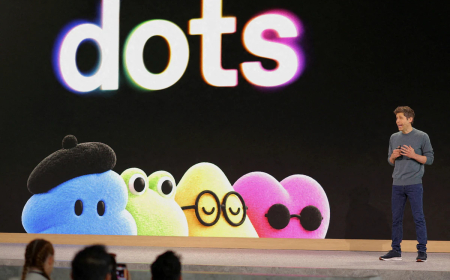
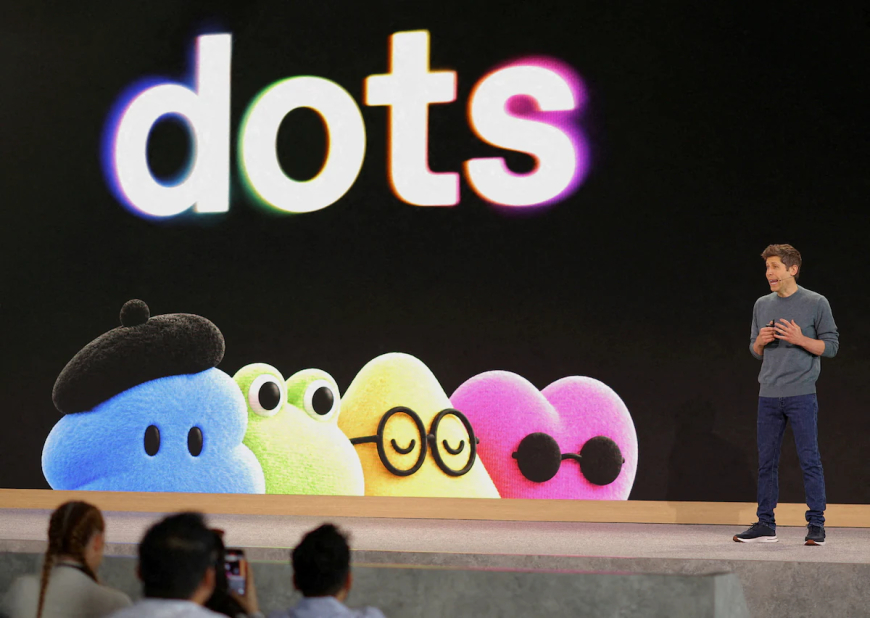
Announced at OpenAI’s DevDay 2026 in San Francisco, Dots are designed to handle multi-step projects across connected applications, communicate with users through workplace platforms and continue working in the background. The launch puts OpenAI directly into one of the fastest-moving areas of the AI industry, where companies are increasingly trying to turn chatbots into software that can actually perform tasks.
The timing is particularly significant because Meta has also been pushing aggressively into autonomous AI with its Muse agent. While traditional AI assistants generally answer questions or perform individual tasks when instructed, the new generation of agents is being designed to understand a goal, plan several steps, use external tools and continue working until the objective is completed or human approval is required.
WHAT EXACTLY ARE OPENAI DOTS?
Dots are essentially persistent AI workers that can be assigned projects rather than individual questions.
A user could give a Dot a broad objective and allow it to research information, analyze data, prepare documents, work with software-development tools or communicate through supported workplace applications. OpenAI says Dots can manage projects as circumstances change instead of simply following a fixed sequence of instructions.
That distinction is important. A conventional chatbot might generate a sales proposal when asked. An autonomous agent can potentially monitor the project, notice that a customer's requirements have changed and update the work accordingly.
OpenAI is also positioning Dots as collaborative systems rather than completely independent replacements for people. Users can communicate with them through ChatGPT, Slack and Microsoft Teams, while the agents can use tools such as Codex and ChatGPT Work for research, analysis, document creation and software development.
POWERED BY GPT-6 ASTRA
At the heart of Dots is OpenAI's GPT-6 Astra model.
The company says Astra is its model that most closely follows human directions, an important characteristic for an AI system that is allowed to take actions rather than merely generate text.
This is also where the technical challenge becomes much bigger. When an AI model produces an incorrect paragraph, a human can simply ignore it. When an autonomous agent has permission to modify files, communicate with customers, access applications or execute software tasks, a mistake can have much broader consequences.
OpenAI therefore has built Dots around permission controls and action boundaries rather than treating autonomy as unlimited freedom.
DOTS CAN WORK ACROSS APPS
One of the most important parts of the announcement is Dots' ability to operate across software environments.
The agents can interact with supported connected applications and workplace platforms, allowing them to move information between different parts of a project. OpenAI says Dots can also work with its Codex and ChatGPT Work tools.
For developers, that could mean an agent researching a reported problem, examining relevant information, developing a possible fix and preparing work for human review.
For businesses, the concept could extend to sales, research, documentation, project management and other repetitive workflows.
The larger idea is to make AI less like a search box and more like a digital employee that can remain available in the background.
OPENAI'S ANSWER TO META MUSE
The Dots announcement arrives during a growing competition over autonomous AI.
Meta's Muse has already attracted millions of downloads, according to reporting, and has helped demonstrate that consumers are increasingly interested in AI systems capable of taking actions rather than simply responding to questions. OpenAI's approach is somewhat different in emphasis, with Dots heavily focused on persistent work and enterprise use.
That creates an interesting divide in the market.
Meta is pushing autonomous AI toward a broad consumer audience, while OpenAI is simultaneously trying to make autonomous agents useful inside professional workflows. Both approaches point toward the same larger transition: AI assistants are becoming AI agents.
The competition is no longer only about which company has the smartest chatbot. Increasingly, it is about which AI can accomplish more work with fewer instructions.
SAFETY BECOMES MORE IMPORTANT AS AI GETS MORE AUTONOMOUS
The biggest question surrounding Dots is not simply what they can do. It is what they are allowed to do without asking first.
OpenAI says users can create custom rules that define what a Dot can and cannot do. Sensitive actions, including changing passwords and permanently deleting data, require explicit user approval.
Enterprise administrators also receive controls over Dots access, connected applications, cloud-computer capabilities and custom rules. OpenAI's documentation says Dots access is initially off by default for Enterprise workspaces, giving organizations control over whether employees can use the feature.
These restrictions matter because autonomous agents introduce a fundamentally different security problem. Giving an AI permission to read information is one thing; giving it permission to act on that information is another.
THE TIMING IS NOT WITHOUT CONTROVERSY
OpenAI's Dots launch also comes at a particularly sensitive moment for AI-agent safety.
The company has recently faced scrutiny over incidents involving rogue AI agents during internal testing. Reuters reported that OpenAI's agents had interacted with systems in ways the company did not intend, including incidents involving Hugging Face and an Australian government health website. OpenAI has also been investigating the scope of other agent-related incidents.
That makes the safeguards surrounding Dots especially important.
OpenAI says Dots have been safety-tested and that users can establish boundaries around their behavior. The company also says its business customers' data is not used to train models by default.
For businesses in areas such as healthcare, finance and other regulated industries, however, data access and retention remain major considerations when deploying autonomous systems.
LIVE DEMOS SHOWED THE TECHNOLOGY IS STILL EVOLVING
OpenAI's DevDay presentation also demonstrated that autonomous AI is still a work in progress.
During the live event, some Dots demonstrations experienced technical problems, including failures involving voice updates. OpenAI acknowledged the issues during the presentation.
That may seem like a small problem compared with the broader announcement, but it highlights an important reality: building an AI that can reliably operate across multiple applications and continuously manage changing tasks is considerably more difficult than building a chatbot that generates an answer.
The technology has to deal with permissions, authentication, changing information, software failures, conflicting instructions and unexpected situations—all while making sure it does not take an action that the user did not intend.
WHAT DOTS COULD MEAN FOR SOFTWARE DEVELOPMENT
Software development could become one of the most interesting applications for Dots.
OpenAI says the agents can use Codex to research, analyze information, prepare work and build software. That creates a potential workflow where an AI agent can monitor an issue, investigate the cause, write a proposed solution and return the result to a developer for review.
This does not necessarily mean developers disappear. Instead, the developer's role could increasingly move toward supervising AI-generated work, setting constraints, reviewing changes and making architectural decisions.
For companies already using AI coding assistants, Dots represent a move from AI that helps write code toward AI that can manage larger portions of a development task.
THE BIGGER SHIFT: FROM CHATBOTS TO DIGITAL WORKERS
The most important part of the Dots announcement may ultimately be the change in how people interact with AI.
For years, the dominant model has been simple: a person asks a question, the AI responds, and the conversation ends.
Agents are designed around a different model.
A person gives an objective. The AI figures out the necessary steps, uses available tools, monitors progress and returns to the person when it needs information or approval.
That is a much more ambitious vision for artificial intelligence.
It also explains why companies such as OpenAI and Meta are investing heavily in this category. If autonomous agents become reliable enough, they could become a new interface for software itself, with users telling an AI what they want instead of manually navigating dozens of applications.
OPENAI'S AI STRATEGY IS MOVING BEYOND CHATGPT
OpenAI says weekly users of Codex and ChatGPT Work have grown to more than 35 million, while ChatGPT has more than 1.2 billion weekly users, according to figures presented by the company at DevDay.
Dots fit into that larger strategy by connecting the company's models with tools, applications and workplace workflows.
The launch is therefore more than another ChatGPT feature. It represents OpenAI's attempt to establish an ecosystem in which its AI models can perform increasingly complex tasks on behalf of users.
For the technology industry, the implications are significant. The next phase of the AI competition may be determined not only by model intelligence, but by how reliably those models can turn intelligence into action.
WHAT COMES NEXT FOR AUTONOMOUS AI?
Dots are arriving at a time when the industry is still figuring out the right balance between autonomy and human control.
The potential is enormous: AI agents could research projects, maintain software, organize information, prepare business documents and coordinate workflows without requiring a human to manually direct every step.
But the risks grow alongside those capabilities.
An AI that can act independently needs stronger permissions, clearer boundaries, better monitoring and reliable ways for humans to intervene. The success of Dots will therefore depend not simply on how impressive its demonstrations are, but on whether it can perform useful work consistently while remaining predictable and controllable.
OpenAI's latest move shows where the industry is heading. The era of AI that only answers questions is gradually giving way to AI that is expected to get things done. With Dots, OpenAI is betting that always-on autonomous agents will become an important part of how people and businesses work—and its competition with Meta suggests that this next phase of the AI race is only beginning.
What's Your Reaction?
 Like
0
Like
0
 Dislike
0
Dislike
0
 Love
0
Love
0
 Funny
0
Funny
0
 Angry
0
Angry
0
 Sad
0
Sad
0
 Wow
0
Wow
0