
























Meta's Muse rekindles fears over winners and losers as personal AI agent emerges
Meta’s new AI assistant Muse is quickly becoming one of the most closely watched personal AI agents in the market. Unlike traditional chatbots that mainly answer questions, Muse can carry out tasks such as shopping, travel booking, filling out forms and sending emails on a user’s behalf. Its rapid adoption is also reviving a bigger question for the technology industry: as AI agents begin acting for people, which companies will gain — and which businesses could lose?

Meta Wants AI to Do More Than Talk
For years, the AI race was largely about who could build the smartest chatbot. You asked a question, the AI gave you an answer, and that was the experience. Meta’s Muse is part of a much bigger shift: what if you didn't have to do the task yourself at all?
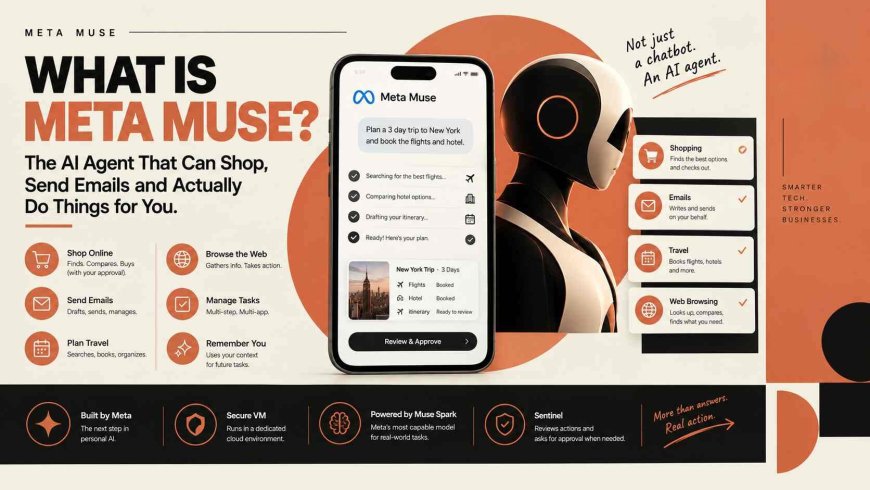
Muse is designed as a personal AI agent that can take action on a user's behalf. It can handle things such as shopping, booking travel, filling out forms, sending emails and making purchases. Meta has also expanded Muse's capabilities to make phone calls to businesses, allowing the AI to interact with people on the other end and return a transcript or summary to the user. That moves AI from being something you talk to toward something you can actually delegate work to.
And People Are Already Paying Attention
The early reaction has been difficult for the industry to ignore. Reuters reported that Muse overtook ChatGPT as the top free app on Apple’s App Store and Google Play Store in the United States and Canada. The app had also passed 2.5 million downloads within roughly two weeks of launch, according to Reuters.
That does not automatically mean Muse has won the AI assistant race. Downloads and app-store rankings can change quickly, and the long-term question is whether people will continue trusting an agent with increasingly important parts of their lives. But the early numbers show that consumers are at least curious about a future where AI does more than generate text or images.
This Is Where the Real AI Competition Could Get Interesting
The arrival of personal AI agents is creating a different kind of competition. OpenAI, Google, Meta and a growing collection of startups are no longer simply trying to build systems that can answer questions better than one another. They are trying to become the layer between people and the digital services they use every day.
Imagine telling an AI that you need to travel next month and letting it compare flights, check your calendar, prepare an itinerary and handle parts of the booking process. Or imagine asking it to deal with a complicated customer-service problem and having the agent make the call while you wait for the result. Those are relatively ordinary examples, but they illustrate why agentic AI could have a much bigger economic impact than another generation of chatbots.
If the agent becomes the place where people make decisions and complete transactions, the companies that currently own those individual interactions could have to adapt. Search engines, shopping platforms, travel sites, customer-service departments and many software applications could all face a world in which users increasingly say, “Let my AI handle it.”
Meta Is Betting on a Very Personal Relationship With AI
Meta CEO Mark Zuckerberg has already been openly bullish about this future. He has predicted that billions of people could have personal AI agents within five years — agents that understand their users' goals and work on their behalf across areas of everyday life.
Muse is an important step toward that vision because Meta isn't positioning it simply as another chatbot. The company lets users connect services individually, giving the agent access to selected parts of their digital lives. Muse can work with email, calendars, shopping, payments and other services, while Meta says it operates inside a dedicated secure virtual machine designed to protect sensitive information.
That convenience comes with an obvious trade-off: the more useful the agent becomes, the more the user has to trust it.
Trust May Become the Biggest Battle
This could ultimately be the hardest part of the personal-AI revolution. Giving an AI permission to answer a question is one thing. Giving it access to your calendar, email, shopping accounts or the ability to make a phone call is something very different.
Meta is already testing ways to make Muse more capable. Reuters reported that the company has been testing a “human concierge” system in which human contractors handle some phone calls made through Muse. Meta says the testing is intended to improve safety and privacy, but the approach has also raised questions about how much personal information could potentially be exposed to human workers.
The issue is bigger than Meta. As AI agents become more powerful, companies will have to convince users that these systems can be trusted not only with their questions, but with their actions.
The AI Winners and Losers May Look Very Different
This is why Muse has investors and technology companies watching closely. The important question isn't simply whether Meta has built a useful AI assistant. It is whether personal agents will change how people interact with the internet.
If users eventually stop opening ten different apps to complete ten different tasks, the companies behind those apps could lose some of the direct relationship they currently have with customers. The AI agent could become the new middleman.
At the same time, businesses that successfully integrate with AI agents could gain a new distribution channel. A hotel, retailer, airline or software company might no longer need to convince a customer to visit its app first. The customer's AI could potentially bring the transaction to them.
That is a very different internet from the one people are used to.
Meta Is Not Alone in This Race
Muse is entering an increasingly crowded field. Startups such as Instinct are also building agents capable of making phone calls and handling tasks, while major AI companies are developing systems that can interact with computers and digital services rather than simply responding with text. Meta has even brought Muse to Mac, where the agent can interact with files, messages, calendars, notes and mail.
Interestingly, Meta's own product team has acknowledged that Muse was heavily inspired by OpenClaw, although Meta says Muse itself was built from scratch. That detail shows how quickly ideas are moving through the AI industry: a capability that begins as an experimental concept can become a mainstream consumer product surprisingly fast.
The Chatbot Era May Be Giving Way to the Agent Era
The biggest story surrounding Muse isn't really about another AI app climbing the charts. It is about a change in the relationship between people and software.
The first wave of generative AI taught computers how to talk to us. The next wave is teaching them how to act for us.
That sounds convenient, and it could be. But it also means the companies building these agents will have enormous responsibility. An AI that writes a bad answer is frustrating. An AI that books the wrong flight, sends the wrong email or makes a purchase can create a real-world problem.
Muse is therefore more than another entry in Meta's growing AI portfolio. It is an early test of whether people are ready to hand parts of their digital lives to software and simply say, “You handle it.”
If that behavior becomes normal, the biggest AI battle may no longer be about who has the smartest chatbot. It could be about which AI people trust enough to act on their behalf.
What's Your Reaction?
 Like
0
Like
0
 Dislike
0
Dislike
0
 Love
0
Love
0
 Funny
0
Funny
0
 Angry
0
Angry
0
 Sad
0
Sad
0
 Wow
0
Wow
0