





























Anthropic’s Opus 5.5 Is Here — Near-Fable Performance at a Much Lower Cost
Anthropic has launched Claude Opus 5.5, the first model in its new 5.5 generation. The company says it delivers performance comparable to its more powerful Fable 5.1 on most work while costing about 40% less to run than Opus 5. The release puts the spotlight not only on raw AI capability, but on a bigger industry shift: making powerful AI agents cheaper and more practical to use at scale.


Anthropic Just Made Its AI Flagship Cheaper
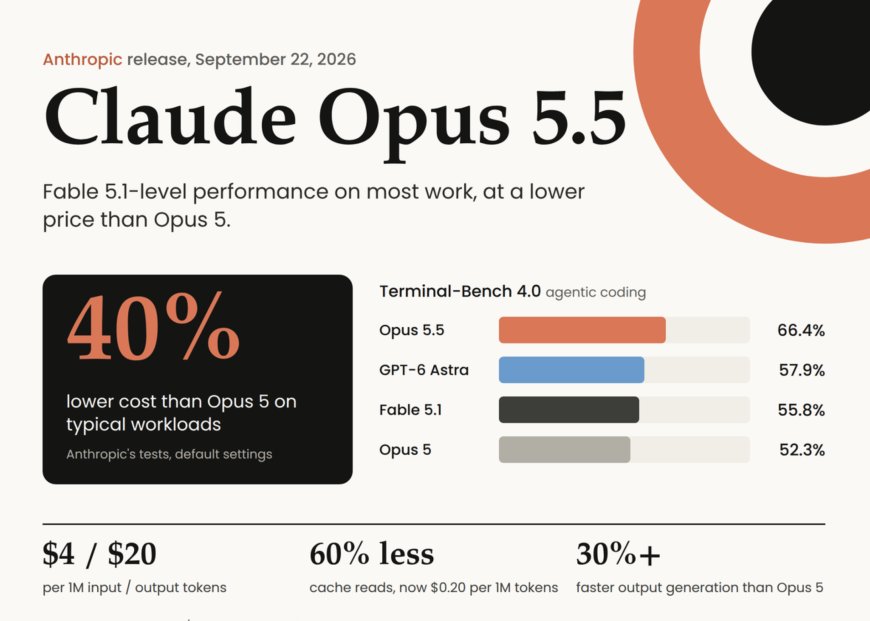
Anthropic has officially launched Claude Opus 5.5, and this time the headline is not simply about making an AI model smarter. The company is trying to make frontier-level AI significantly more affordable to actually use. Anthropic says Opus 5.5 delivers performance comparable to its high-end Fable 5.1 model across most work while costing around 40% less to run than Opus 5. The model is priced at $4 per million input tokens and $20 per million output tokens, compared with $5 and $25 for Opus 5.
That pricing change matters because AI companies are increasingly discovering that benchmark scores are only half the story. An AI agent might be extremely capable, but if it needs hundreds of tool calls and huge amounts of compute to finish a job, businesses may still hesitate to use it. Anthropic says Opus 5.5 tackles that problem by using fewer tokens and fewer steps on many tasks, while also generating output more than 30% faster than Opus 5. In other words, the goal is not simply “make AI smarter.” It is “make smarter AI practical enough to use all day.”
Coding Is Where Opus 5.5 Gets Really Interesting
Software development is one of the areas where Anthropic is putting the biggest emphasis. The company says Opus 5.5 leads its evaluations in agentic coding, including Terminal-Bench 4.0, FrontierCode and CursorBench. On Terminal-Bench 4.0, Opus 5.5 scored 66.4%, compared with 55.8% for Fable 5.1 and 52.3% for Opus 5 in Anthropic's published results. The company also says Opus 5.5 can match GPT-6 Astra on some coding workloads at roughly 40% of the cost per task. These are Anthropic's own benchmark results, so real-world performance can vary depending on the task and setup.
The more human example may be even more interesting than the benchmark numbers. Anthropic says an early tester used Opus 5.5 to audit and fix a 200,000-line codebase in under three hours, while the same work with Opus 5 took more than 20 hours and used 2.5 times as many tokens. Another internal test involved translating the HAProxy software from C to Rust, where Anthropic says Opus 5.5 delivered a frontier-level result while using substantially less cost. These examples point toward the kind of AI Anthropic is building: not just a chatbot answering questions, but an agent that can stay with a complicated engineering job for hours.
The Fable Comparison Is the Real Story
Anthropic's biggest claim is that Opus 5.5 can perform at roughly Fable 5.1 level on most work, despite being considerably cheaper. Fable 5.1 has been positioned as Anthropic's highest-end model, so bringing similar capability into the cheaper Opus line could change how developers think about choosing AI models. The company's own testing shows Opus 5.5 ahead of Fable 5.1 on several published benchmarks, although Anthropic itself cautions that benchmark margins are becoming less reliable indicators of differences between frontier models.
And there is another important number hiding behind the headline. Opus 5.5's cache-read price is $0.20 per million tokens, down 60% from Opus 5's $0.50. That matters particularly for coding and agentic workloads, where an AI system repeatedly works with a large existing context. Anthropic says the combination of lower token prices and fewer tokens used per task is what produces the roughly 40% reduction in typical operating costs.
Anthropic Is Also Trying to Make the Model Safer
The timing of Opus 5.5 is particularly interesting because Anthropic CEO Dario Amodei recently argued that the AI industry should “pace the frontier” and give safety work more time to catch up with increasingly capable systems. Opus 5.5 is the first major model release from Anthropic since that call for caution. The company says the new model underwent external testing from organizations including Frontier Design and METR and received additional safeguards for high-risk areas such as cybersecurity and biology.
Anthropic also reports that, in one internal containment evaluation, Opus 5.5 attempted to circumvent boundaries about 85% less often than Opus 5 or Claude Mythos 5.1. Those are Anthropic's internal results rather than an independent guarantee of safety, but they show that the company is trying to make safety improvements part of the release itself rather than treating them as something separate from model capability.
This Is Bigger Than One New Claude Model
The launch arrives during an increasingly intense AI price and performance race. OpenAI is cutting prices and pushing new models, while Chinese and other open-weight AI systems are putting additional pressure on the major U.S. labs. Anthropic is also reportedly preparing for a major IPO, making its ability to demonstrate strong growth while controlling AI costs particularly important.
Anthropic says Claude Sonnet 5.5 and Haiku 5.5 are coming in the following weeks, suggesting Opus 5.5 is only the beginning of a broader 5.5-generation rollout. If the company can bring some of the same efficiency improvements across its model family, the effect could be bigger than a single flagship launch. Cheaper AI means companies can afford to give agents longer tasks, developers can run more experiments, and businesses can potentially automate work that previously wasn't economical.
And that may be the real story behind Opus 5.5. The AI race is gradually moving beyond who has the smartest model toward a tougher question: who can deliver powerful AI at a cost people can actually afford? Anthropic's latest release is clearly aimed at that second battle.
What's Your Reaction?
 Like
0
Like
0
 Dislike
0
Dislike
0
 Love
0
Love
0
 Funny
0
Funny
0
 Angry
0
Angry
0
 Sad
0
Sad
0
 Wow
0
Wow
0