



















































Sony Xperia 10 VIII Review: Light, Compact — and Practically Impossible to Recommend at €600
Sony's smallest, lightest Xperia is almost the same phone as last year's Xperia 10 VII — the same Snapdragon 6 Gen 3 chip, the same 50MP + 13MP cameras and the same 5,000mAh battery — with a brighter 120Hz display and a new Misty Lilac colour. But the price jumped from €450 to €600, and GSMArena rates it 3.7 out of 5, calling it "practically impossible to recommend" at that price.
Sony Xperia 10 VIII Review: Light, Compact — and Practically Impossible to Recommend at €600
Sony's Xperia 10 VIII is the smallest, lightest Xperia the company makes — a 6.10-inch phone with a tall 21:9 display, a 5,000mAh battery, a 3.5mm headphone jack and a microSD slot. It is also, in GSMArena's words, "the same phone as the Xperia 10 VII" in almost every respect: the same Snapdragon 6 Gen 3 chipset, the same 50MP + 13MP cameras and the same 5,000mAh battery. The changes are a brighter display (1,500 nits peak, up from 1,000), a new 120Hz OLED panel and a new Misty Lilac colour. The review rates the phone 3.7 out of 5. The problem is the price: €600 / £550, up from €450 / £400 for the Xperia 10 VII — and at that price, the review says, the phone is "practically impossible to recommend".
The phone costs $599.99 / £549.00 for the single 128GB / 8GB RAM configuration. The box includes a 30W charger, a USB cable and a black silicone case, though the review notes EU models ship without a charger.
Design: light, compact, and a bit dated
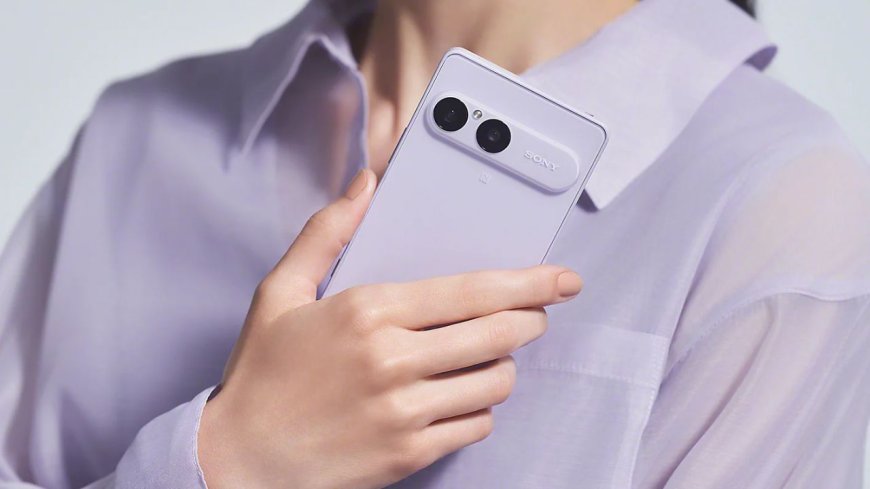
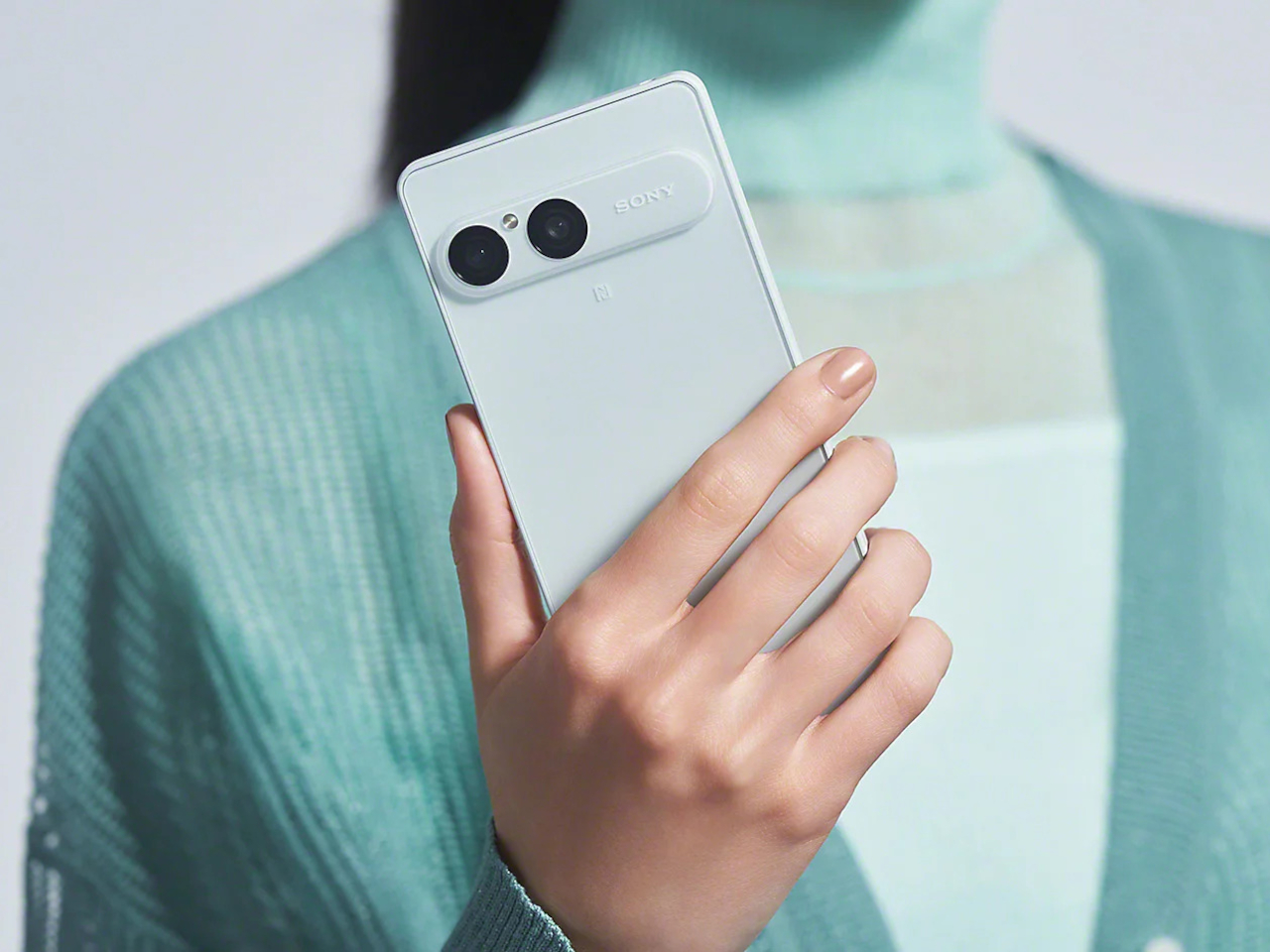
The design is unchanged from the Xperia 10 VII — a very simple, almost retro look with big bezels, a punch-hole-free display and a side-mounted fingerprint reader that is "accurate and snappy". At 153 x 72 x 8.3mm and just 168g, it is light and easy to hold, and the review calls the shape "nice to hold". The catch is the materials: Gorilla Glass Victus 2 on the front, but a plastic frame and a plastic back that the review says feels "cheap" in the hand. The phone is IP65/IP68 dust and water resistant (IP68 to 1.5m for 30 minutes). Colours are Frozen White, Frosted Gray and Misty Lilac — the review unit was Misty Lilac. The 3.5mm headphone jack and the microSDXC slot (shared with the SIM slot) are retained, as is the dedicated camera shutter button, which can be remapped to launch the camera or take a screenshot, though it is not two-stage. There is no FM radio.
Display: brighter, smoother, and still Sony's tall format
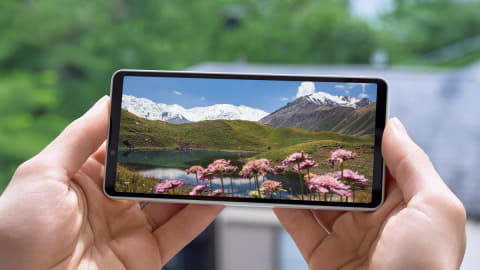
The 6.10-inch OLED display is a 1080 x 2340 panel (422ppi) with a 120Hz refresh rate, HDR, Triluminos colour (DCI-P3), 1 billion colours and Gorilla Glass Victus 2. GSMArena's lab tests measured 657 nits in manual mode and 1,509 nits in automatic mode, with a peak of 1,527 nits on a 10% white window and a minimum brightness of 1.8 nits (down to 1.0 nit with Extra-dim). That is a big step up from the Xperia 10 VII's 494 nits manual / 1,024 nits auto, and the review says brightness is excellent — though the quoted 1,500-nit peak is a peak, not sustained. The 120Hz panel uses LTPO technology with a 1–120Hz adaptive range, though it drops to 60Hz most frequently, and HDR video works in YouTube. Sony has added automatic colour adjustment to the surroundings, and the review notes hue shifts when moving to extremes.
Performance: the same chip as last year
The Snapdragon 6 Gen 3 is a 4nm octa-core chip — four Cortex-A78 cores at 2.4GHz and four Cortex-A55 cores at 1.8GHz, with an Adreno 710 GPU — and it is the same chip as in the Xperia 10 VII. The review calls it a "perplexing" choice, and the numbers are modest: Geekbench 6 single-core 983 (against 1,024 for the Xperia 10 VII and 1,047 for the Motorola Edge 60), AnTuTu v10 at 604,429 (against 600,667 for the Xperia 10 VII), and 3DMark Wild Life Extreme at 867 — the same score as the Xperia 10 VII. The chip is "not power-hungry", and the review says the phone's surface never gets uncomfortable under sustained load. The phone has 8GB of RAM and 128GB of storage, plus the microSDXC slot.
Software: clean Android, close to stock
The phone runs Android 16, with up to 4 major Android OS updates and 6 years of security patches promised. The software is close to stock Android, with a few pre-installed apps (Facebook, Netflix and others), and the review calls Sony's software "clean, bloatware-light and easy to use", with a "Side sense" menu and the dedicated camera shutter button. The review says it is "the best software on any Sony phone", though it notes the phone is "not as fast as the Xperia 10 VII" in some areas.
Battery: one day reliably, not much else
The 5,000mAh battery is unchanged from last year, and GSMArena's Active Use Score came in at 13 hours 37 minutes — calls 31:55, web browsing 14:43, video playback 23:35 and gaming 5:52. The review says battery life is "better than the Xperia 10 VII" but the delta is small: one day reliably, "not much else, despite two-day marketing". Charging is 30W USB PD — the charging chart shows 42% in 30 minutes, against 40% for the Xperia 10 VII on the same 30W, 52% for the Pixel 10a and 90% for the Poco F7 on 90W. There is no wireless charging. The front-facing stereo speakers measured a Good -27.9 LUFS, and GSMArena calls the sound "excellent quality" at normal volume, though the speakers are "not the loudest" and the sound is "a bit thin" — the 3.5mm headphone jack is there for listeners who want more.
Camera: the same hardware, struggling in low light
The camera hardware is the same as on the Xperia 10 VII: a 50MP Sony IMX766 main camera (f/1.9, OIS) with a 13MP ultrawide (fixed focus) and an 8MP front camera. Video goes up to 4K at 30fps and 1080p at 30/60/120fps, with gyro-EIS and OIS. The review calls the camera "a very good" all-round system for the price, but its detailed findings are more mixed than that summary suggests.
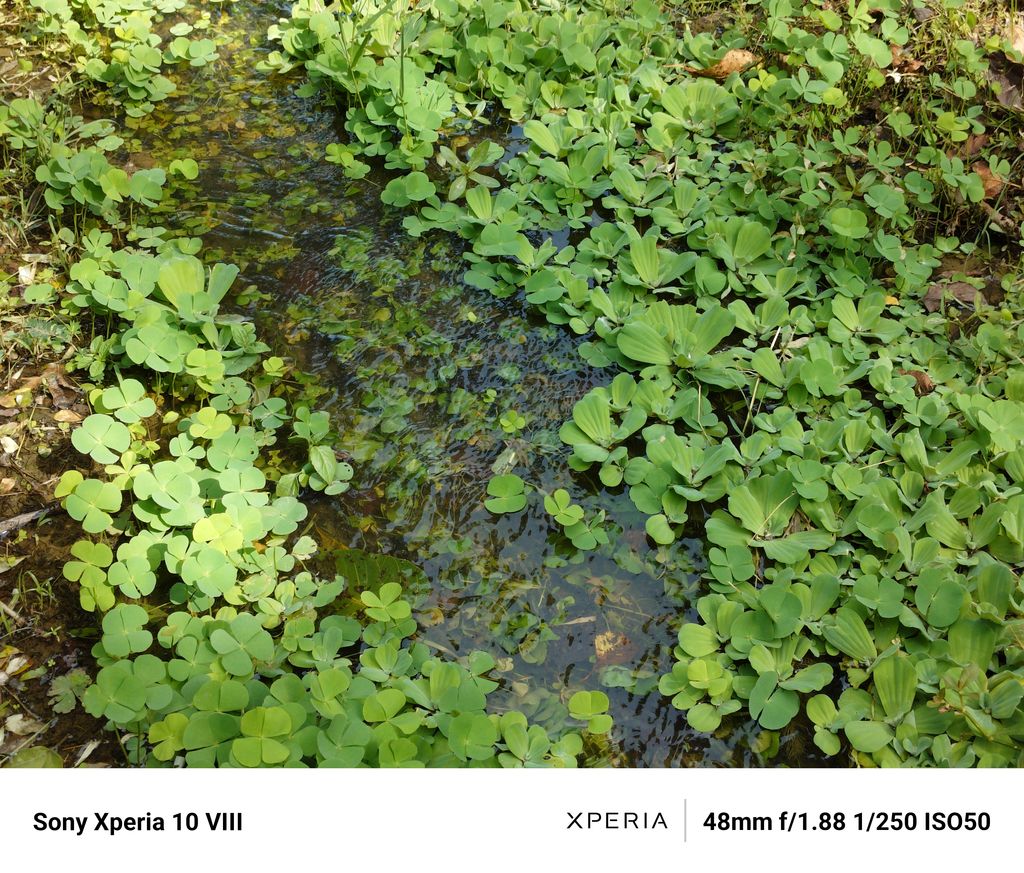
A daytime outdoor camera sample taken with the Sony Xperia 10 VIII.
In daylight, the main camera is "alright": contrast is moderate, colours are slightly oversaturated but natural-looking, fine details are "unhurriedly rendered", and there is minor noise. Skin tones are well rendered, but bokeh is not convincing, less accurate and "not worth it". At 2x zoom, foliage and textures look very digital, though facade lines stay mostly straight; bokeh does not work at 2x, and headshots in Photo mode are "if lucky". Close-ups at 2x are good, with a minimum focus distance of about 2cm. The 13MP ultrawide has "not a lot to like" — soft and noisy, with poor dynamic range. Selfies are decently detailed but "riddled with noise", with colours mostly accurate. In low light, colours are often off, partly due to AWB missteps, with aggressive highlight restoration, decent detail in well-lit areas and a gritty digital rendition with plenty of noise. Night mode is automatic, and the review says it is "not as good" as on the Xperia 10 VII in some areas.
Price and verdict
The Xperia 10 VIII costs $599.99 / £549.00 for 128GB with 8GB of RAM — €600 at launch, against €450 for the Xperia 10 VII. GSMArena rates it 3.7 out of 5. The verdict is blunt: the phone is unique, with its 21:9 display, 3.5mm headphone jack and microSD slot, and its charm only goes so far. It is barely upgraded beyond brightness and speakers, charging is slow, the battery is merely adequate, and the camera is struggling. At €600 it is "practically impossible to recommend" — the review says it does not make sense above €350, and hopes the price will drop. The competition it names is the Google Pixel 10a (€549, with a bigger 5,100mAh battery, better camera and 5 years of OS updates), the Samsung Galaxy A57 (from €310, with a bigger display, a 5,000mAh battery and a more powerful chipset), the Poco X8 Pro (about €340, with a Dimensity 8500 Ultra chip, a 6,500mAh battery and 100W charging) and the Nothing Phone (4a) with its 3x telephoto camera.
Pros and cons
Pros: light and compact; IP65/IP68-rated; 21:9 OLED display with 120Hz; 3.5mm headphone jack and microSD slot; front-facing stereo speakers; good battery life.
Cons: slow charging; weak chipset, unchanged from last year; plastic build; no wireless charging; camera struggling in low light; big price hike versus the Xperia 10 VII.
Sources
What's Your Reaction?
 Like
0
 Dislike
0
 Love
0
 Funny
0
 Angry
0
 Sad
0
 Wow
0