












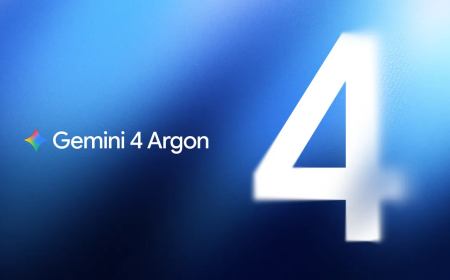












Google Unveils Gemini 4 Argon After Months of Delays, With a Major Focus on Advanced AI Work
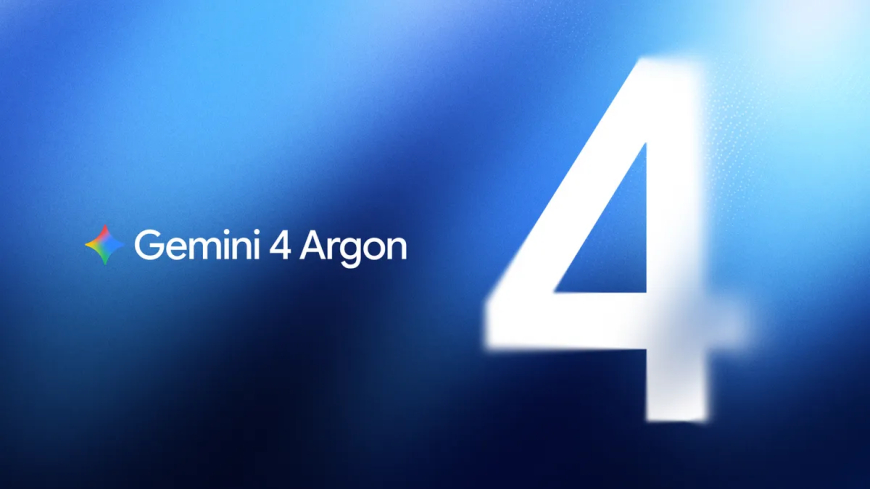
Google has announced Gemini 4 Argon, the flagship model that will anchor its next generation of Gemini AI systems. The new model is designed for complex software engineering, enterprise knowledge work and cybersecurity, but its initial availability is limited to selected cybersecurity partners as Google continues safety testing ahead of a wider release.

Google Gemini 4 Argon Arrives After a Long Wait
Google has officially unveiled Gemini 4 Argon, the flagship artificial intelligence model that will form the foundation of the company's new Gemini 4 generation. The announcement comes after months of delays and a period in which Google focused heavily on smaller Gemini Flash models rather than releasing the next major flagship system.
Google announced Argon on September 30, describing it as its most capable model yet for complex workloads. Unlike a conventional consumer-facing model launch, however, this is a carefully controlled release. Google is initially making Argon available to selected cybersecurity partners and is not yet giving the public a firm date for general availability.
The announcement marks an important new stage for Google's AI strategy. The company has been competing with increasingly capable models from OpenAI and Anthropic, while also expanding Gemini beyond a chatbot into coding, enterprise software, search, productivity and autonomous agent workflows.
Gemini 4 Argon Is Built for Complex, Long-Horizon Tasks
Google says Argon is larger than its previous top-tier Pro models and has been designed to handle demanding tasks that require sustained reasoning rather than short question-and-answer interactions.
Its initial focus areas include software engineering, enterprise knowledge work and cybersecurity defense. These are areas where an AI system may need to work through many connected steps, understand large amounts of information and maintain context over an extended workflow.
Google says the model has demonstrated frontier-level performance on selected coding and cybersecurity benchmarks. The company has positioned its results alongside leading systems from OpenAI and Anthropic, although these comparisons should be understood as Google's own assessment of benchmark performance rather than an independent overall ranking of AI models.
A Major Upgrade for Coding and Software Development
Software engineering is one of the areas where Google is placing particularly strong emphasis on Gemini 4 Argon.
The company says Argon is capable of working through complicated programming tasks and longer development workflows. Rather than simply generating a small piece of code from a prompt, the model is intended to reason through larger software-engineering problems and work across substantial codebases.
Google has also been using the model internally. According to reporting on the launch, Argon has been involved in work ranging from improving Google's infrastructure to helping migrate large C and C++ codebases toward Rust.
That direction reflects a broader change in how frontier AI models are being developed. The emphasis is increasingly moving from chat-based assistance toward AI agents capable of completing multi-step technical work.
One-Million-Token Output Changes the Scale of AI Work
One of the most notable technical changes associated with Gemini 4 Argon is its much larger output capacity.
Google says Argon can support an output limit of up to 1 million tokens, dramatically increasing the amount of material the model can generate in a single interaction compared with previous Gemini systems.
A larger output window can be particularly useful for software development, lengthy reports, complex research tasks and other workflows where an AI system needs to produce or process a substantial amount of information without repeatedly breaking the work into smaller requests.
However, a larger context or output limit does not automatically mean every task will produce better results. The usefulness of such a capability depends on the model's reasoning quality, reliability, tool use and ability to maintain consistency across long workflows.
Cybersecurity Is at the Center of the First Release
Google is taking a particularly cautious approach to Gemini 4 Argon because of its capabilities in cybersecurity.
The company says the model is initially being provided to trusted cyber defenders through its Fairwind Program. The idea is to use advanced AI capabilities in defensive security work while collecting additional information about potential misuse before opening access more broadly.
Google has also highlighted Argon's ability to identify security vulnerabilities and assist with defensive analysis. One reported example involves cybersecurity company Wiz using Argon to identify a critical vulnerability in software used in hospitals, although Google's public announcement does not provide enough information to independently assess the broader significance of that discovery.
The controlled rollout reflects a growing issue for frontier AI developers: the same capabilities that can help security researchers discover vulnerabilities can potentially create additional risks if powerful systems are released without sufficient safeguards.
Why Google Delayed Its Next Flagship Model
Gemini 4's arrival follows a period of uncertainty around Google's flagship AI roadmap.
Google had previously indicated that Gemini 3.5 Pro would arrive earlier in 2026. That model did not ultimately launch as originally expected. Instead, Google concentrated on Gemini 3.5 Flash and later Gemini 3.8 Flash models while continuing development of its next-generation flagship system.
Google's leadership had already acknowledged that Gemini 4 was undergoing a major training effort. In its second-quarter 2026 earnings update, Alphabet said Google had started its most ambitious Gemini 4 pre-training run and was encouraged by the progress.
By late September, Google's DeepMind leadership said Gemini 4 was moving through post-training, setting the stage for the Argon announcement.
Google Is Not Releasing Gemini 4 to Everyone Yet
For ordinary Gemini users, the most important detail is that Gemini 4 Argon is not yet a normal public release.
Google is beginning with selected cybersecurity partners while it continues testing safety systems and evaluating the model's behavior. The company has not announced a specific date for broad public availability.
Google says the eventual rollout will expand beyond cybersecurity partners, with paid API customers and Google AI Ultra subscribers expected to be among the early groups receiving access once the broader release begins.
This means the September 30 announcement should be viewed as the beginning of the Gemini 4 rollout rather than a traditional launch where everyone can immediately open the Gemini app and start using the new flagship model.
Gemini 4 Could Change Google's AI Strategy
The importance of Gemini 4 goes beyond another improvement in chatbot performance. Google is increasingly positioning Gemini as the intelligence layer behind a much wider ecosystem of products and services.
The company already uses Gemini across Search, Android, Workspace, developer tools and its Gemini application. Google's agent-focused initiatives are also designed to let AI systems perform actions and complete longer workflows instead of simply responding to individual prompts.
A more capable Gemini 4 therefore gives Google a foundation for expanding those experiences. If Argon's performance and reliability translate into the broader Gemini product family, users could eventually see more sophisticated coding assistance, research tools, AI agents and enterprise automation.
But the company still has to demonstrate that those capabilities can be delivered reliably and safely at large scale.
The Next Gemini Battle Will Be About More Than Benchmarks
Google's latest announcement arrives during an increasingly competitive period for frontier AI. OpenAI, Anthropic and Google are all pushing toward models capable of handling increasingly complex reasoning, coding and agentic tasks.
For Google, Gemini 4 represents an opportunity to strengthen its position after a year in which the company released several intermediate and specialized models instead of immediately following Gemini 3 with a new flagship.
Argon's controlled rollout also shows how the AI industry is changing. The question is no longer simply how intelligent a model can become. Companies now have to consider how powerful models should be tested, what they can safely do, how much autonomy they should receive and how quickly their capabilities should be made available.
Gemini 4 Argon is therefore both a major technical announcement and an early look at Google's next phase of AI development. The real test will come when the model moves beyond trusted testers and into the hands of developers, businesses and everyday Gemini users.
What's Your Reaction?
 Like
0
Like
0
 Dislike
0
Dislike
0
 Love
0
Love
0
 Funny
0
Funny
0
 Angry
0
Angry
0
 Sad
0
Sad
0
 Wow
0
Wow
0