




























































FCC Approves SpaceX Starmind Plan for One Million AI Data-Center Satellites in Orbit
The Federal Communications Commission has authorised SpaceX to deploy up to one million Starmind satellites to operate as AI data centres in orbit — the first US approval of its kind — with the first satellite due by November 2033 and the full constellation by 2040.
FCC Approves SpaceX Starmind Plan for One Million AI Data-Center Satellites in Orbit
The Federal Communications Commission has authorised SpaceX to deploy up to one million satellites to operate as data centres in orbit, clearing the way for the company's Starmind network and marking the first time the United States has approved a constellation of space-based data centres.
The decision, announced on Wednesday, November 25, 2026, gives SpaceX the regulatory green light for its most ambitious project yet: a fleet of solar-powered satellites carrying AI processors, linked by lasers, that would handle computing work above the atmosphere and send the results back to Earth. The FCC said the approval was intended to help meet rapidly growing demand for AI computing power.
SpaceX applied to the FCC in January 2026, describing Starmind as a way of "capturing solar energy in space to power low-cost, high-performance AI compute for Earth." The concept rests on a simple advantage: in orbit, solar panels can collect sunlight almost continuously, without night, weather or land constraints. The satellites would work as interconnected data centres, rather than as an extension of the Starlink broadband network.
A fourteen-year build-out
The authorisation comes with a strict deployment schedule. SpaceX must place its first operational Starmind satellite in orbit by November 25, 2033. By the same date in 2035, it must have deployed 100,000 satellites — a tenth of the full constellation. Half the constellation, 500,000 satellites, must be in place by November 2038, and the entire one-million-satellite network by November 25, 2040.
That scale dwarfs anything in orbit today. Only around 17,000 satellites currently circle the Earth, and SpaceX's own Starlink network accounts for just over 11,000 of them. A completed Starmind constellation would increase the total number of satellites in orbit roughly fifty-fold.
SpaceX has said it plans to deploy the satellites at altitudes of 500 to 1,002 kilometres. The satellites would communicate with one another primarily through laser links, including links to Starlink spacecraft, with radiofrequency communications approved as a backup for controlling the network from the ground if the primary systems fail.
Objections from rivals were rejected
The approval came despite formal objections from Amazon, Viasat and the American Astronomical Society, which warned about orbital debris and congestion, radiofrequency interference, harm to scientific research and environmental consequences. Amazon, which is building its own rival to Starlink, argued in its petition that the application lacked basic detail and called it "a lofty ambition rather than a real plan" that still "risks real harm."
The FCC dismissed some of the concerns raised by opponents, including potential threats to scientific research, on the grounds that they fell outside its regulatory authority. FCC Chair Brendan Carr said the action "opens a bold new frontier for the computing infrastructure needed to power America's leadership and growth." Elon Musk thanked Carr in a post on X, writing: "Much appreciate. This will be a great asset to America and the world."
SpaceX is not the only company pursuing the idea. Google and Blue Origin are also working on orbital data-centre concepts, but SpaceX's application is the first to receive FCC approval. The agency said it is continuing to review other orbital data-centre proposals.
Approval is not the same as liftoff
The FCC's decision does not mean orbital data centres are imminent. SpaceX faces major technical and economic challenges, including how to manufacture and launch satellites at a dramatically lower cost, how to keep processors cool in space, and how to secure financing for chips destined for orbit.
Further regulatory hurdles also remain. The FCC has not yet approved SpaceX's plans for handling orbital debris from satellites operating above 600 kilometres. SpaceX had asked for a waiver of existing rules, which require satellites ending missions below 2,000 kilometres to re-enter Earth's atmosphere within five years; the company would prefer to move some retired satellites into so-called graveyard orbits, or even into orbits around the sun. That request was not granted in this authorisation.
Even so, the company has set a faster pace than the FCC's deadlines require. SpaceX Chief Financial Officer Bret Johnsen said last week that the company plans to launch its first data centres into space in 2027 and expand through 2029, while Musk has said the company could begin demonstrating its AI satellite technology by late 2027, with broader deployment potentially starting as early as 2028.
Why it matters
AI data centres on Earth are running into hard limits: power grids are strained, land near cheap energy is scarce, and local opposition to new facilities is growing. SpaceX is betting that orbit, with its near-constant sunlight and no neighbours to object, offers a way around those constraints. Whether a million satellites can be built, launched and operated economically — and safely, in an increasingly crowded sky — remains an open question. The FCC's approval is the first step, not the answer.
Related: SpaceX's $74 billion AI supercomputing campuses in Texas and Arizona
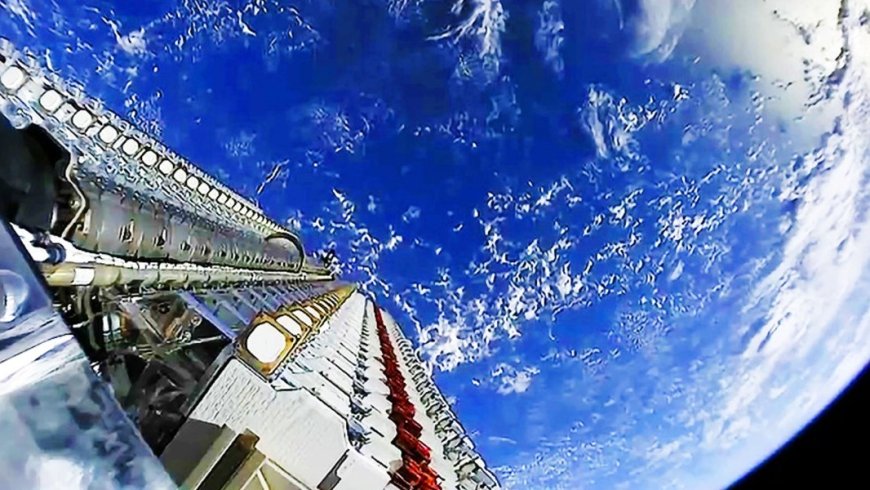
Image note: the photo above shows SpaceX Starlink satellites deployed above Earth. Starmind satellites have not launched yet, so no photograph of the new constellation exists.
Sources
- Reuters — US authorizes SpaceX to deploy 1 million satellites for data centers in space
- TechCrunch — FCC approves SpaceX plan to put AI data centers in space
- The Wall Street Journal — SpaceX Gets Approval to Launch One Million Satellites for Orbital Data Centers
- CNN — US authorizes SpaceX to deploy 1 million satellites for AI data centers in space
- GeekWire — FCC clears SpaceX to put a million data center satellites in orbit
- SpacePolicyOnline — FCC Approves Elon Musk's One Million Orbital Data Centers
- Channel News Asia — US authorizes SpaceX to deploy 1 million satellites for data centers in space
- USA Today — FCC approves SpaceX plan for 1 million data center satellites in space
- Gizmodo — FCC Approves SpaceX's Plan to Deploy 1 Million Satellites to Orbit
- Engadget — SpaceX gets FCC approval to deploy 1 million satellites for its AI orbital data center
What's Your Reaction?
 Like
0
 Dislike
0
 Love
0
 Funny
0
 Angry
0
 Sad
0
 Wow
0