




















































iPhone 17 Pro Review: A Fresh Look, a Faster Chip and a Bigger Battery — But the Spark Is Muted
Apple's iPhone 17 Pro trades titanium for an aluminium unibody, adds a vapour chamber, a 48MP 4x telephoto and a much bigger battery. GSMArena's full review rates it 4.4 out of 5 — an excellent premium phone that somehow never quite excites.

iPhone 17 Pro Review: A Fresh Look, a Faster Chip and a Bigger Battery — But the Spark Is Muted
It has been a while since an iPhone Pro actually looked different. The iPhone 17 Pro, announced on September 9, 2025 and on sale from September 19 at $1,099 for 256GB, is the first Pro in years to break the mould — a new aluminium unibody, a new vapour chamber, a new telephoto camera and the biggest battery jump of this year's lineup. GSMArena put the phone through its full lab review on September 30, 2025 and scored it 4.4 out of 5. The verdict is hard to argue with: this is an excellent premium package that somehow never quite excites. Here is what the testing actually found.
A new body, for better and for worse
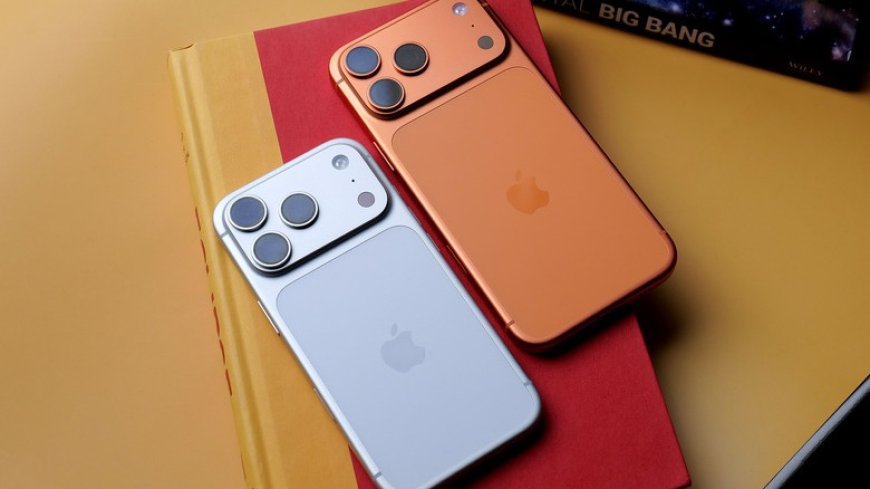
Out goes titanium, in comes aluminium. Apple calls the iPhone 17 Pro an aluminium unibody, though the design is not quite as seamless as the word suggests: because aluminium would block wireless charging, the back has a glass cut-out where the charging coil sits, and the join is more visible than Apple fans are used to. GSMArena's reviewers found the older design more finished, and this one almost like a last-minute decision.
There are practical trade-offs too. Aluminium is softer than titanium, so the 17 Pro is likely to pick up scuffs more easily than its predecessors, and the sharp edge of the enlarged camera island has already shown a tendency to chip. On the plus side, the metal is part of the cooling story: paired with a new vapour chamber, it is meant to pull heat away from the A19 Pro chip, and Apple claims 40 percent better performance under prolonged load.
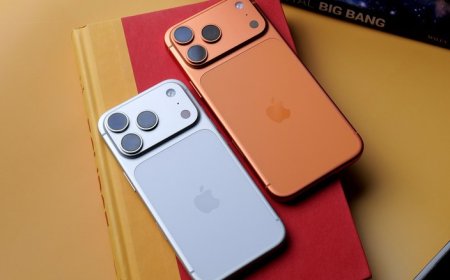
Three colours are on offer — Silver, Cosmic Orange and Deep Blue. The orange draws a lot of attention, the silver's white-ish glass makes for a little too much contrast, and the reviewers' pick was Deep Blue, the most quietly stylish of the three. The phone measures 150.0 x 71.9 x 8.8mm and weighs 206g — heavy for its size, though the gently rounded aluminium edges help it disappear in the hand. Water resistance is Apple's usual overachieving IP68, rated to 6 metres for 30 minutes rather than the standard 1.5 metres.
Up front, the display is protected by new Ceramic Shield 2 glass with an anti-reflective coating, and the pill-shaped Face ID cutout is unchanged — no fingerprint reader, again. The Action button returns, and the Camera Control key is still there, more of a shortcut to launch the camera than a genuine control.
Display: bright when it wants to be
The 6.3-inch LTPO Super Retina XDR OLED is, on paper, barely different from the iPhone 16 Pro's panel: 120Hz ProMotion, HDR10 and Dolby Vision, 1,000 nits typical brightness, 1,600 nits in HDR and up to 3,000 nits peak outdoors. In GSMArena's lab, manual brightness topped out at 818 nits and bright ambient light pushed it to 1,012 nits, while a small 15 percent white patch hit 2,755 nits — so the 3,000-nit claim is plausible for a small area, but the phone is simply less willing than before to reach those peaks on demand. Sunlight legibility is still excellent, helped by the new anti-reflective coating, and the display drops to 1Hz for static images and the always-on mode.
Performance: the A19 Pro is fast, then it warms up
The A19 Pro is a 3nm chip with a six-core CPU — two performance cores up to 4.26GHz and four efficiency cores up to 2.6GHz — plus a six-core GPU and a 16-core Neural Engine. It is joined by 12GB of RAM, up from 8GB, and 256GB, 512GB or 1TB of storage. (There is no 2TB option on the smaller Pro; that is reserved for the Pro Max.)
The benchmarks are strong. Against the iPhone 16 Pro, GSMArena measured a 14 percent gain in single-core CPU performance and 20 percent in multi-core, and AnTuTu improved by 30 percent — 55 percent against the two-year-old iPhone 15 Pro. In 3DMark's Solar Bay ray-tracing test the phone matched the best current Androids, though it sat a notch below them in Wild Life Extreme.
Sustained performance is the weaker half of the story. Under prolonged CPU load the chip throttled to around 84 percent of its initial score — only slightly better than the 16 Pro — and the 3DMark Wild Life Extreme stress test returned a 64 percent stability rating. Surface temperatures stayed relatively low, barely passing 45 degrees at the hottest spot, so the aluminium body and vapour chamber are doing something — just not working miracles.
Connectivity is thoroughly modern: 5G, eSIM, Wi-Fi 7, Bluetooth 6.0, ultra-wideband and a USB-C 3.2 Gen 2 port good for 10Gbps transfers and DisplayPort output. The phone runs iOS 26 out of the box, with Apple's new Liquid Glass design language — prettier, but, in the reviewers' view, no more intuitive than before.
Battery life: the biggest upgrade of all
If one thing justifies this generation, it is the battery. The SIM-tray version carries a 3,998mAh cell, up from 3,582mAh in the 16 Pro — nearly 12 percent more — while the eSIM-only version gets 4,252mAh, a 19 percent increase. GSMArena's Active Use Score came in at 15 hours 23 minutes, comfortably ahead of both the Pixel 10 Pro and the Galaxy S25, with video playback and gaming runtimes both improved.
Charging is faster too, though it comes with a catch. The iPhone 17 series adopts the AVS charging standard, and Apple sells a new 40W Dynamic Power Adapter with 60W Max that is only available in North America for now. Apple promises 50 percent in 20 minutes with a 40W adapter or better; in testing with a 45W USB Power Delivery charger, the phone reached 70 percent at the half-hour mark and 100 percent in 1 hour 18 minutes. Wireless charging goes up to 25W over MagSafe and Qi2, with 50 percent in 30 minutes confirmed in testing.
Cameras: a new telephoto, a clever selfie camera, and familiar excellence
The camera system is the closest thing to a generational leap in this phone. All three rear cameras are now 48MP: the main camera (f/1.8, 24mm), the ultrawide (f/2.2, 13mm) and a new telephoto that swaps the old 5x, 12MP unit for a 48MP sensor at 4x zoom (100mm, f/2.8) with the tetraprism design retained. All three can now shoot in 24MP by default and 48MP on demand. The front camera is an 18MP unit with a square sensor, which lets it shoot landscape selfies while the phone is held vertically — a neat trick that solves a problem most people never knew they had.
In daylight, the main camera produces lively, likeable colours with accurate white balance, strong detail in 24MP shots and wide dynamic range, though faces can be softened and skin tones can run warm. The 2x crop from the main sensor is properly good, and 48MP mode adds detail when you want it. The telephoto is good but not amazing: fine detail and dynamic range, but a processed look to textures and no real advantage at 8x over the iPhone 16 Pro, and its roughly 85cm minimum focusing distance rules out close-ups. The ultrawide is solid for interiors and wide vistas, if a little muted next to the main camera.
At night the main camera is excellent, with great detail and dependable white balance, and the 2x mode is top-class. The telephoto holds up on colour and dynamic range but gets grainy and soft up close, and the ultrawide is merely on par with rival flagships. Selfies are wider and higher-resolution than before, and you no longer need to rotate the phone for a landscape group shot.
Video remains the iPhone's strongest suit. All cameras record 4K at up to 60fps, the main camera reaches 4K at 120fps, and Dolby Vision, ProRes and Apple Log 2 are all available. Footage is consistently excellent across zoom levels, with great contrast and stabilisation, though the old problem of internal lens reflections from bright lights persists at night.
Speakers, competition and the verdict
One small step back: the stereo speakers scored an Average mark in GSMArena's loudness test, a notch below the 16 Pro, after teardowns showed smaller drivers. Sound quality itself is cleaner and more composed than before, and still better than the Pixel 10 Pro and Galaxy S25.
Choosing between iPhones is the real decision for most buyers. If you own an iPhone 16 Pro, there is little reason to upgrade. The Pro Max adds screen size and battery for a premium, the standard iPhone 17 makes a lot of sense this year if the camera is not your priority, and the iPhone Air is more fashion statement than camera phone. On the Android side, the Pixel 10 Pro is the closest analogue but cannot match the battery life, the Galaxy S25 Ultra may edge the iPhone on still photography but is huge and heavy, and Chinese cameraphones like the vivo X200 Pro, Oppo Find X8 Pro and Xiaomi 15 Ultra offer serious competition for the same money. Our full review of the bigger sibling is here: iPhone 17 Pro Max review.
GSMArena's conclusion sums the phone up well: it is "an excellent premium package with huge sales numbers in its future — it's just that we're not exactly feeling it." The redesign is welcome, the battery is genuinely better and the A19 Pro is fast, but the telephoto is not the upgrade it promised to be, the aluminium scratches, and iOS 26 is prettier rather than better. If you are buying a new iPhone now, the 17 Pro is the easy choice over the old model. If you already own a recent Pro, this one can wait.
Pros
- Nice OLED display with Dolby Vision and HDR10
- Great battery life for the class, fast charging too
- Excellent performance
- Class-leading video quality
- Reliably great photo quality, though not truly exciting
- Superb water resistance
Cons
- Heavy for its size and battery capacity
- Significant thermal throttling under prolonged graphics loads
- The new telephoto camera isn't the massive upgrade we hoped for
Sources
What's Your Reaction?
 Like
0
 Dislike
0
 Love
0
 Funny
0
 Angry
0
 Sad
0
 Wow
0