




























































Atom Computing Secures $100 Million US CHIPS Award to Scale Neutral-Atom Quantum Computers
The US Department of Commerce has finalised an award of up to $100 million to Atom Computing under the CHIPS and Science Act, funding the hardware and systems work needed to scale its neutral-atom quantum computers toward tens of thousands of qubits.
Atom Computing Secures $100 Million US CHIPS Award to Scale Neutral-Atom Quantum Computers
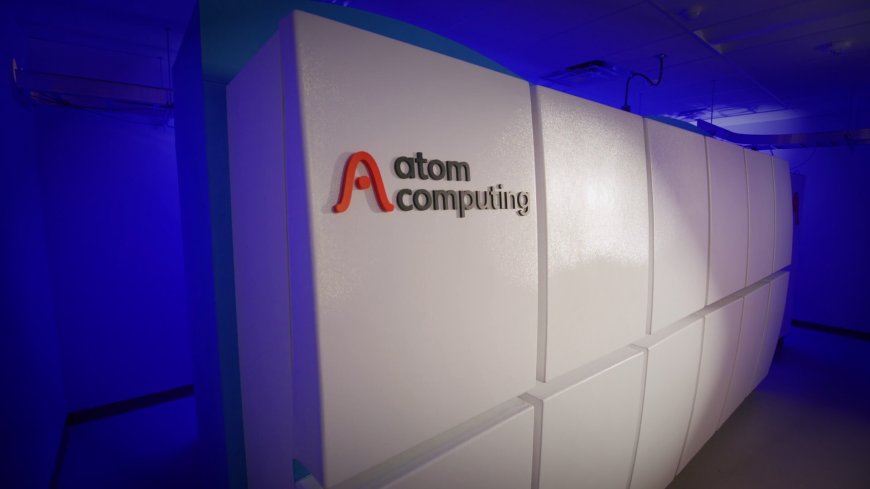
Atom Computing has locked in one of the largest public funding awards in the quantum computing sector. The US Department of Commerce announced on November 13, 2026 that it has signed a final research and development award of up to $100 million for the neutral-atom quantum computing company under the CHIPS and Science Act.
The money will fund the unglamorous engineering at the heart of the quantum race: the semiconductors, control systems and integration work needed to build utility-scale machines that can manipulate, control and address tens of thousands of qubits — and prove that they work.
What the $100 Million Award Covers
The award comes from the Commerce Department's CHIPS Research and Development Office, based at the National Institute of Standards and Technology (NIST). According to the announcement, the funded research will accelerate several strategic initiatives for the development of semiconductors and related technology supporting utility-scale, commercially useful neutral-atom quantum computers.
That scope is deliberately practical. It covers hardware development and the systems integration needed to manipulate, control and address tens of thousands of qubits, and to validate their performance. In plain terms, the government is paying for the step between a working prototype and a machine that can be built, operated and trusted at commercial scale.
It is worth being precise about what the award does not claim. Atom Computing is not announcing tens of thousands of working qubits, a fault-tolerant processor or a commercially useful quantum application. The funding targets the engineering needed to get there — controlling far larger qubit arrays than the company has demonstrated so far.
From a Letter of Intent to a Signed Award
The finalised award converts a letter of intent announced earlier this year. On May 21, 2026, the Commerce Department unveiled planned incentives totalling $2.013 billion for nine quantum companies and suppliers across competing hardware approaches, including superconducting, trapped-ion, photonic, silicon-spin and neutral-atom systems. Atom Computing's $100 million was part of that package, alongside allocations for IBM, GlobalFoundries, D-Wave, Rigetti, Infleqtion, PsiQuantum, Quantinuum and Diraq.
Atom's chief executive and founder Ben Bloom said the contract would let the company move faster on the engineering behind fault-tolerant quantum computing. "This $100 million contract enables us to aggressively scale the engineering required to bring fault-tolerant quantum computing to market," Bloom said.
The company says it will use the funding to build critical technologies in-house, expand its engineering and testbed infrastructure, and deepen collaboration with supply-chain partners as it scales manufacturing.
Why Neutral Atoms Are Drawing Big Bets
Atom Computing builds quantum systems using arrays of optically trapped neutral atoms — individual atoms held in place by laser light and used as qubits. Neutral-atom systems are one of the few architectures with a credible path to very large physical-qubit arrays, because atoms can be arranged in dense, reconfigurable grids without the complex wiring that other approaches require.
The company has claimed several milestones on that path, including a platform with more than 1,000 qubits and the first commercial logical-qubit system. In 2025, it sold its first on-premises quantum computer to QuNorth, a Nordic initiative backed by Denmark's export and investment fund EIFO and the Novo Nordisk Foundation. Atom has also reached the final stage of DARPA's Quantum Benchmarking Initiative, where the US government assesses whether proposed systems can be built and operated as designed.
The award also follows a separate $100 million Series C funding round led by Third Point Ventures, giving Atom both private and public capital behind the same scaling effort. Washington, meanwhile, is spreading large bets across rival quantum architectures rather than backing a single winner — a pattern also visible in the broader push for domestic AI hardware, including Google's new TPU variants for AI workloads.
What Comes Next
The award does not move useful enterprise quantum computing from "later" to "next year." The commercial timeline depends on logical-qubit performance — error-corrected qubits that can run real calculations reliably — not on the award date. What the funding does change is the engineering runway: Atom now has the resources to build the control electronics, optics and integration needed to test systems at a scale the field has not yet reached.
For the US quantum programme, the signing matters as a signal. The May letters of intent were promises; this is a definitive agreement, and it shows the Commerce Department moving from announcing quantum incentives to actually closing them. More of the nine companies in the $2.013 billion package are expected to follow with their own finalised awards.
Sources
- National Institute of Standards and Technology — Department of Commerce Announces Finalization of CHIPS R&D Award with Atom Computing Inc. (November 13, 2026)
- Dealroom — Atom Computing locks in $100M US quantum award (November 13, 2026)
- Quantum Zeitgeist — Commerce Dept. Funds Atom Computing With Up To $100M For Quantum Development
- DC STEM Digest — Department of Commerce Announces Finalization of CHIPS R&D Award with Atom Computing Inc. (November 14, 2026)
What's Your Reaction?
 Like
0
 Dislike
0
 Love
0
 Funny
0
 Angry
0
 Sad
0
 Wow
0