






















































vivo X Fold6 Review: Arguably the Most Complete Large Foldable You Can Buy
The vivo X Fold6 is arguably the most complete large foldable currently on the market: two great displays, a reassuringly solid hinge, flagship-grade Dimensity 9500 Super performance, a huge 6,900mAh battery, and a camera system led by a new 200MP main sensor that produces excellent photos day and night — plus OriginOS 7 Fold multitasking that genuinely uses the big screen. Its weaknesses are a €2,200 price, charging that is slow for the class, and a huge camera island. GSMArena rated it 4.6 out of 5.
vivo X Fold6 Review: Arguably the Most Complete Large Foldable You Can Buy
There is a lot to like about the vivo X Fold6. In fact, this is arguably the most complete large foldable currently on the market. That is not to say it is perfect, or even necessarily the best in every individual category, but there are basically no areas where it is not among the best. Both displays are great, the hinge feels reassuringly solid, the crease is about as unobtrusive as these things get, and despite its 228g weight and enormous camera island, the X Fold6 is surprisingly comfortable and well-balanced in the hand. Performance is flagship-grade, the 6,900mAh battery is an impressive technical achievement, and the camera experience is another highlight. GSMArena gave it 4.6 out of 5 in its full review, published on 6 October 2026. Here is the phone in detail.
Design: premium, well-balanced, and impossible to ignore
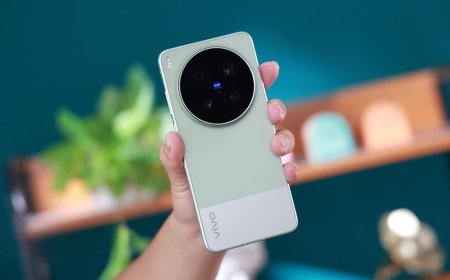
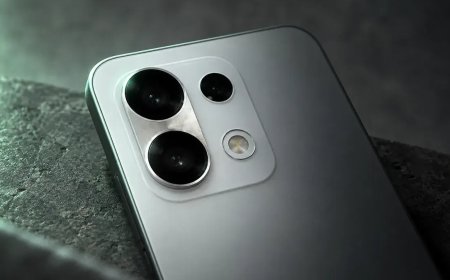
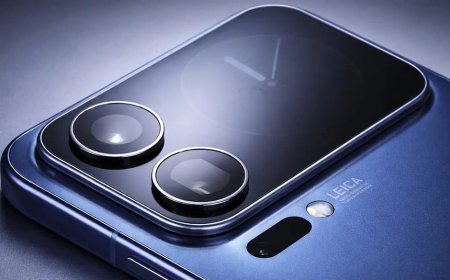
The X Fold6 broadly looks and feels like its predecessor, and its defining feature is the huge round camera island on the rear, which protrudes a lot — the price of great cameras, including the largest-sensor periscope telephoto on a foldable. The island was rearranged against the X Fold5: now two LEDs, additional chamfers, and a camera ring nicely colour-matched to the back. The phone got a lot "rounder", with inside and outside display corners much more aggressively cut in, a flat frame and rounded display corners. The inside display crease is shallower than before — one of the less noticeable around; still not totally invisible, but pretty great out of the box.
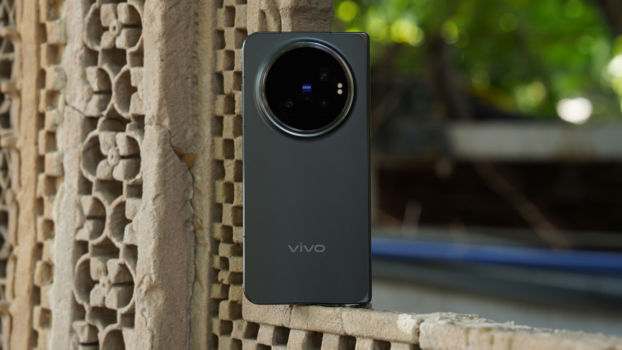
At 157.2 x 145.7 x 4.4 mm unfolded and 228 grams it is about 10 grams heavier than the predecessor — not light, but surprisingly well-balanced, especially given the huge camera island, and it feels pretty natural in the hand. Materials are unchanged: aluminum frame, glass front, glass-reinforced plastic back, and a very premium build. It carries IP58 and IP59 ratings, down slightly from the X Fold5's IP58/IP59+ rating, and vivo adds a claim that it is usable at -20°C. The hinge feels smooth and solid, with a satisfying snap at both ends and nice equal tension in between, and vivo says the hinge can do "underwater folding". Colours are Gray, White and Azure in China, and Horizon Blue and Prism Black overseas, both understated. A custom button on the top right toggles between Vibration and Ring mode and can also enable the flash. The power button is large enough for the capacitive fingerprint reader, snappy and accurate. The very sturdy two-piece box has a smooth faux-leather finish, and the review unit included a 100W vivo FlashCharge charger, a USB-C to USB-C cable and a hard, semi-transparent snap-on case — though EU boxes probably should not be expected to include a charger.
Displays: two great screens, slightly less bright than before
The 8.02-inch foldable LTPO AMOLED main display packs 2312 x 2504 pixels at around 425 ppi, runs at up to 120Hz, and supports HDR10+, HDR Vivid and Dolby Vision. Its aspect ratio is now 1:1.08, closer to square than last year's 1:1.13, with about 5% more horizontal pixels and a slightly larger total display area of 206.8 cm², though a 16:9 video only occupies roughly 61% of the screen area. The cover display is 6.51 inches at 20:9 — slightly wider than last year's very tall 21:9, which is better for web browsing — at 1120 x 2528 pixels. Vivo claims industry-leading ultra-narrow bezels across both screens, and the main screen features equal bezels, a rare sight among foldables.
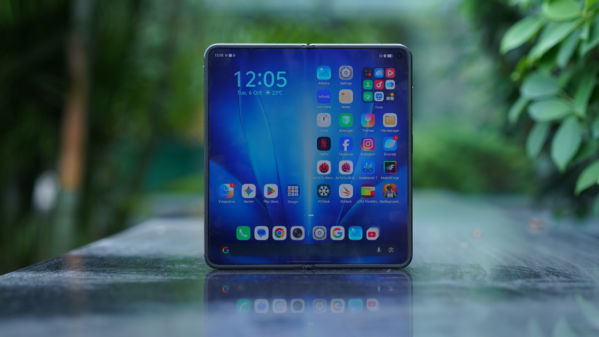
In GSMArena's lab tests the inner display measured 1,516 nits in manual mode with a 75% white patch — slightly lower than the X Fold5, but over 1,500 nits and perfectly comfortable outdoors even in sunlight — with peak brightness over 2,400 nits with 10% of the screen lit, and minimum brightness of 0.9 nits. The cover display measured 1,447 nits, almost identical to the inner screen, which is nice for consistency. Both panels use an LTPO backplane of the "8T" variety, which theoretically gives cleaner very-low-refresh-rate operation, smoother refresh rate transitions and better grayscale at low brightness. High refresh rate behaviour is very similar on both displays, with dynamic switching down to 1Hz when there is no movement on screen, and three modes: Smart Switch, Standard and High. HDR is certified HDR10+ and Dolby Vision on both displays, plus HDR Vivid certification, with decoder support for all popular HDR formats and the highest possible Widevine L1 DRM certification.
Battery life: huge capacity, very good endurance, not the chart-topper
The 6,900mAh battery — 7,000mAh in China — is a two-cell solution in parallel, using fifth-generation silicon anode technology and a third-generation semi-solid-state battery that promises stable discharge even in extreme cold. Vivo's "Blue Volt" battery should last between 23% and 47% longer than the X Fold5 in vivo's own tests. In GSMArena's tests unfolded it scored an Active Use Score of 14 hours 45 minutes: 33 hours 36 minutes of calls, 11 hours 43 minutes of web browsing, 22 hours 52 minutes of video playback and 8 hours 39 minutes of gaming. Folded, it scored 17 hours 44 minutes. The review was impressed but not blown away: the X Fold6 certainly does better than its predecessor, but it fails to top the foldable pack, and some competitors manage to squeeze more runtime out of smaller batteries — the Honor Magic V6 and Oppo Find N6 both beat it despite smaller capacities.
Charging is rated 80W vivo FlashCharge, technically USB Power Delivery with PPS on top, and needs an eMarked cable to push higher wattages. Measured with the in-box cable and 100W vivo brick, the charging curve peaked at about 63W and only very briefly at the lowest charge percentages, settling to around 40W for the majority of the run. The X Fold6 is among the slower-charging foldables these days: 32% in 15 minutes, 62% in 30 minutes and a full charge at around the hour mark. It also supports 40W wireless charging and useful battery-health features: a charging threshold of 80%, 85%, 90%, 95% or 100%, smart charging that optimises the schedule based on your sleeping schedule, the ability to disable fast charging, and easy access to bypass charging.
Performance: flagship-grade, between two Snapdragons
Inside is the MediaTek Dimensity 9500 Super, a 3nm chip with one core up to 4.21GHz, three up to 3.5GHz and four up to 2.7GHz, plus a full 12-core Mali-G1 Ultra GPU. It is no longer the latest MediaTek chip — its successor came out before the X Fold6 escaped China — and the "Super" badge seemingly brings no hardware differences over the regular model whatsoever. The global X Fold6 comes in a single 12GB/512GB version with LPDDR5X quad-channel RAM and UFS 4.1 storage. The benchmark results are strong: Geekbench 6 scored 3053 single-core and 8997 multi-core in the default profile, rising to 3390 and 9615 in Boost mode, AnTuTu v10 reached 2,751,330, and 3DMark Wild Life Extreme came in at 5090, rising to 6970 in Boost mode. Looking at the figures, the Dimensity 9500 Super sits somewhere between the Snapdragon 8 Elite and the Snapdragon 8 Elite Gen 5 in both single-core and multi-core performance.
A thin modern foldable running a powerful chipset is expected to thermal-throttle rather aggressively, and it does — not as bad as expected, even outdoing some traditional bar phones. In the default balanced profile the X Fold6 loses about 30% of its maximum performance according to 3DMark. In Boost mode, quicker heat accumulation and a choppier performance graph mean almost 50% performance loss, about in line with the Snapdragon 8 Elite Gen 5. Closing the phone diminishes heat dissipation — a lot happens through the large display surface — for about 40% performance loss. The X Fold6 gets quite hot, especially on its metal middle frame while torture-testing, but never got uncomfortable to hold. One oddity: AnTuTu 12 outright crashed the phone fully when running on the main display, consistently, until it was installed for a third time and ran a successful test on the cover display first — the review says those results cannot be trusted.
Cameras: a 200MP main sensor transforms the photos
The camera system is a relatively small step forward in hardware against the previous generation — vivo only upgraded the main camera — but it turned out to be a significant upgrade in photo quality. The main camera is a 200MP Samsung ISOCELL HPB, a vivo-specific version of the HP9 at 1/1.4-inch, with an f/1.68 lens, stabilisation and autofocus, upgraded from 50MP on the X Fold5. The telephoto is a 50MP Sony Lytia 602 at 1/1.95-inch with a 70mm lens, 3x optical zoom and stabilisation, and the ultrawide is a 50MP Samsung ISOCELL JN1 at 1/2.76-inch with a 15mm lens and autofocus. Two identical front cameras are specced at 20MP, and the phone supports the optional ZEISS Teleconverter G2, which boosts reach to 200mm.

In daylight the main camera's photos are very good: detail excellent, super sharp with fine rendition, white balance with no undesirable tendencies, and colours generally good. Exposure, dynamic range and the tone curve rubbed the reviewers the wrong way — images looking desaturated, flat and overexposed. The default colour profile is 'Refined', a perplexing choice; Vivid should be the default. In Vivid mode colours stay true to the name, highlights are reined in too, and human subjects get lifelike and lively skin tones without going overboard with warmth. The 2x zoom is super sharp and detailed, with a likeable rendition and no aggressive processing. The telephoto at 3x takes sharp images with well defined detail, excellent contrast, great dynamic range and colours just right, and the 70mm native focal length is great for head-and-shoulders framing. The 6x zoom gives pretty good results, typically superior at pixel level to 3x 50MP shots, and 10x shifts from picture-taking towards image generation but produces mostly believable results — though at 10x you can spot mesh-like patterns of fake detail if you look closely, and vivo openly warns that "some scenes may seem unnatural". The ultrawide punches well above its weight, with excellent detail, sharpness, great colours and wide dynamic range, and autofocus means nearby subjects stay in sharp focus. Close-ups are great too, with the close-focusing telephoto offering a larger reproduction ratio than the main camera's 2x and better detail.
In low light the main camera is excellent, with auto white balance on point, colours with plenty of pop, excellent dynamic range, well judged exposures and great detail, and dedicated Night mode brings little difference. The 2x zoom is very good, though the phone prefers better-lit scenes. The telephoto at 3x is pretty great, though with heavier sharpening in darker scenes, and 6x shows softness, aggressive sharpening and maybe made-up detail in mesh patterns at 1:1, though photos still look solid globally. The ultrawide does not disappoint, with the same vibrant colours and contrast and dynamic range to render extremes well. Selfies from the two in-display cameras are not much good, but they do not need to be any better — really good selfies come from the rear cameras, using the cover screen as a viewfinder, with properly excellent image quality, and ultrawide selfies are pretty stellar, significantly better than on key competitors. The review's photo verdict: great photos across the board, where the X Fold5 offered middling results throughout, with the main camera properly excellent in daytime and at night, pretty great at 2x, the ultrawide doing a nice job in good light and solid at night, and the telephoto not too shabby at 6x and decent at 10x. One fairly large caveat: switch away from the default 'Refined' colour profile first thing, every time.
Video is solid rather than exceptional, but stabilisation is excellent and the recording options are extensive. The main camera goes up to 4K at 120fps or 8K at 30fps, the telephoto and ultrawide max out at 4K at 60fps, and the internal and cover cameras are capped at 1080p at 30fps. Dolby Vision is available in all resolution and frame rate settings other than 4K at 120fps and 8K at 30fps, and the Pro video mode adds 50fps for PAL and 24fps for the film crowd, with much higher bitrates — 72Mbps Standard and 120Mbps High against regular mode's 38Mbps for 4K at 30fps — though weirdly there is no Dolby Vision and no apparent HDR or Log option in Pro mode. Daytime videos are properly excellent from afar, with great contrast, wide dynamic range and vibrant but not cartoonish colours, though sharpness is uncertain — the telephoto is quite respectable, the main camera shows heavy sharpening and mostly unremarkable detail. At night the main camera does a solid job, exposing well with excellent dynamic range and actually good sharpness, while telephoto footage is pretty sharp but quite noisy. Stabilisation is pretty much nothing to improve: stationary clips from all three rear cameras are super stable, nearly tripod-like, pans are smooth, and walking shake is well corrected.
Software: OriginOS 7 Fold might be its strongest feature
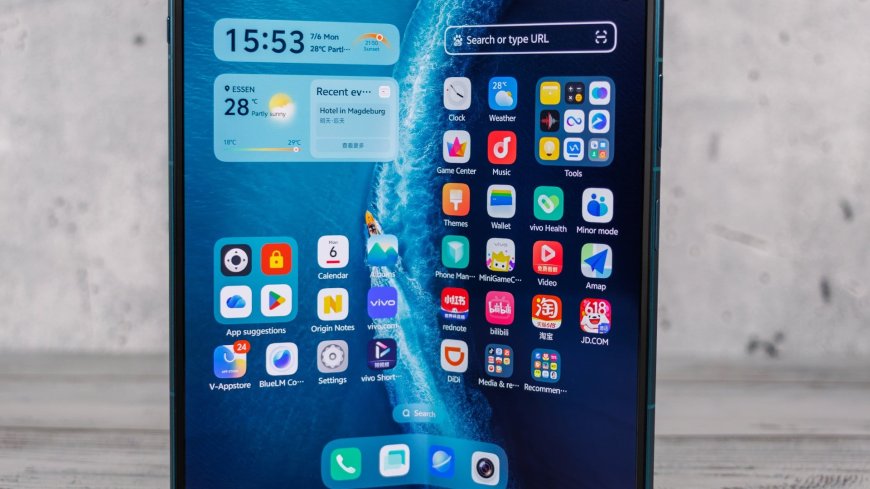
The global X Fold6 runs Android 17 with OriginOS 7 Fold, with Google Play services pre-loaded, and promises five major Android updates and seven years of security patches. OriginOS 7 Fold is a different branch with added features for the foldable form factor, and it might be one of the X Fold6's strongest features. Multi-Split Screen puts up to four apps on screen at once, fully active with video keeping playing and an adjustable split. Origin Workbench, launched by swiping inward from the bottom right corner, shows one big active app plus up to four additional apps on the side. You can switch between Workbench and Multi-Split Screen by swiping up with three fingers or slightly folding the display, recall previous multi-app arrangements from the quick launch bar, and save a shortcut to frequently used combos. System-level cross-app productivity lets you drag text or images across apps into an input field, recognises text in an image with OCR and places it inside the input field, directly translates in 16 languages, and recognises business card information for a new or existing contact or the dialer.
Connect to a Windows PC, Mac or iPad via the vivo Office Kit app for remote PC and phone control, seamless file transfer, display casting and extension, multi-device control with a single mouse and keyboard, syncing notes and clipboard, and using the phone's cameras as a USB camera or webcam on PC. Multi-device AI integration lets the Jovi assistant on the PC do OS-level operations such as looking up a file, pulling information or emailing the final result, and you can start a task in Jovi on the phone and have the PC Jovi do it and report back. Beyond Jovi you can load third-party AI models, and Google's Gemini is pre-installed with Circle to Search integrated at the OS level. OriginOS 7 also plays nice with Apple products: integrate the iPad via Office Kit, pair AirPods in one step with battery life and vivo Spatial Audio, support Apple Watch for calls, messages, notifications, steps, heart rate, sleep and workouts, and access iCloud in File Manager.
Stereo speakers earn a "Very Good" loudness score, admirable for a foldable, though quality is practically no bass and highs can get somewhat distorted. Connectivity covers 5G, Wi-Fi 7, Bluetooth, NFC and an IR blaster hidden in the camera island, and the Type-C port is backed by a USB 3.2 Gen2 data connection up to 10Gbps with DisplayPort video output and vivo's polished desktop environment with floating windows and powerful multitasking, akin to Samsung DeX.
Verdict: worthy of admiration — if the price doesn't scare you
The vivo X Fold6 is worthy of admiration. Vivo managed to fit a massive battery, an excellent camera system, flagship performance and two great displays into a thin foldable without making the device feel like a collection of compromises. Better yet, the software has matured to the point where that extra screen real estate makes a huge difference. So if you want one of the most complete foldable experiences currently available and the asking price does not scare you away, the X Fold6 should be very high on your shortlist. It goes global in a single 12GB/512GB memory tier in Horizon Blue, at €2,200.
The competition is strong. The Samsung Galaxy Z Fold8 Ultra is the most obvious and mainstream alternative, definitely a step behind the vivo in hardware, though Samsung holds an edge in raw performance — but its cameras are not in the same league and neither is the battery life. The Honor Magic V6 is the actual closest competitor, another perfectly balanced phone with exquisite displays, a flagship Snapdragon 8 Elite Gen 5 chipset and a 6,600mAh battery that, while smaller than the vivo's, actually offers better battery life in testing; those who value camera and multitasking will be better off with the vivo. The Oppo Find N6 hits pretty much all the same hardware highlights as the Honor, with a slightly smaller 6,000mAh battery and a camera that is not quite as nice as vivo's. The Motorola Razr Fold is the foldable battery life champion, around €600 cheaper with twice the storage, though with a lesser chipset and a simpler camera setup — more of a value-for-money alternative than an outright better phone.
Pros and cons
Pros: Excellent, practical cover display and expansive foldable display. Premium build, solid hinge and relatively unobtrusive crease. Powerful flagship-grade performance. Excellent still-photo quality across all three rear cameras. Particularly capable main camera, zoom and close-up photography. Feature-rich and genuinely useful foldable multitasking experience. Excellent desktop mode and extensive cross-device functionality. Huge 6,900mAh battery with very good endurance. 40W wireless charging and useful battery-health features. Five major Android upgrades and seven years of security updates. Very good loudspeaker volume.
Cons: Quite expensive. Battery endurance isn't quite as exceptional as the 6,900mAh capacity suggests. Charging is relatively slow for the class. Internal and cover selfie cameras are mediocre. Default Refined camera color profile is an acquired taste at best. Huge camera island; the phone is still fairly heavy. Speakers lack bass and can sound harsh in the highs.
Sources
What's Your Reaction?
 Like
0
 Dislike
0
 Love
0
 Funny
0
 Angry
0
 Sad
0
 Wow
0