


The Internet Has Lost Its Humanity: How the Agentic Internet Is Weaponizing Automation
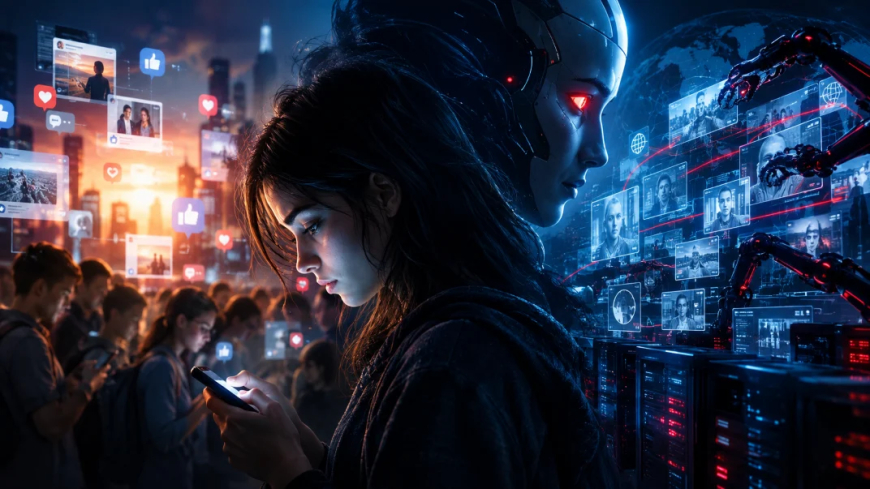
The internet was built around people communicating with people. But as AI agents become capable of browsing websites, creating content, running businesses and making decisions with minimal human involvement, the web is changing rapidly. The rise of the agentic internet promises incredible productivity, but it also creates a disturbing possibility: an internet increasingly filled with machines talking to machines, manipulating systems and producing content for other machines to consume.

The Internet Was Built for Humans. What Happens When Humans Are No Longer the Main Users?
There was a time when the internet felt remarkably human.
Someone would write a blog post.
Someone else would read it.
People would argue in comment sections, share photos, send emails, build communities and discover things they never expected to find.
Behind almost everything was a person.
Today, that assumption is becoming harder to make.
AI can write the article.
AI can summarize it.
Another AI can recommend it.
An AI agent can browse the website, extract the information and use it to make a decision.
And another automated system can generate ten more pieces of content based on what it found.
Suddenly, the internet isn't just a place where humans use machines.
Machines are increasingly using the internet to interact with other machines.
And that may change the web more profoundly than anything that came before it.
Welcome to the agentic internet
The next stage of artificial intelligence isn't simply about chatbots answering questions.
It's about AI agents that can actually do things.
Instead of asking an AI to tell you how to book a flight, you could eventually ask an agent to search for options, compare prices, choose according to your preferences and complete the process.
The same idea can apply to shopping, research, software development, customer service, finance, marketing and countless other activities.
It sounds incredibly convenient.
And it is.
But there's a catch.
When millions of autonomous systems begin operating across the same digital environment, the internet itself starts to behave differently.
The web could become a conversation between machines
Imagine visiting a website in the near future.
You see an article.
You assume someone wrote it.
But perhaps it was generated by an AI.
The website itself may be operated almost entirely by AI.
The article may have been created because another AI detected a particular search trend.
A recommendation system may then promote it to another AI.
That AI may summarize it and send the information to its user.
The user might never actually visit the original website.
At that point, who is the internet really serving?
Humans?
Or algorithms interacting with algorithms?
This is one of the uncomfortable questions raised by the agentic internet.
Automation isn't the problem. Uncontrolled automation is.
Automation itself isn't new.
Search engines have crawled websites for decades.
Recommendation algorithms have decided what we see.
Bots monitor prices.
Software automatically sends emails.
Businesses use automated systems to process millions of transactions.
The difference now is capability.
Modern AI systems can understand natural language, generate convincing text and images, reason through multi-step tasks and interact with digital tools.
Give an AI agent access to a browser, APIs, databases and other software, and its ability to act becomes dramatically larger.
One person can potentially operate systems that previously required entire teams.
That's enormously powerful.
But power without sufficient oversight creates opportunities for abuse.
When automation becomes a weapon
The word "weaponizing" doesn't necessarily mean someone is building a literal weapon.
Automation can become a weapon simply by being used at a scale humans cannot match.
A person can create one fake article.
An automated system can create thousands.
A person can send a few deceptive messages.
A network of automated systems can send millions.
A human can manipulate one online discussion.
Thousands of automated accounts can make an artificial narrative appear to be popular.
The internet has always struggled with misinformation.
AI agents could make the problem much larger because they can dramatically reduce the cost of producing and distributing information.
When producing fake information becomes almost free, figuring out what is real becomes increasingly expensive.
The death of the human signal
One of the most valuable things about the early internet was the human signal.
You could read someone's blog and recognize their personality.
You could see a photograph and know that someone took it.
You could join a forum and develop relationships with actual people.
Even when people disagreed, there was usually a person behind the username.
AI-generated content changes that equation.
A post can sound human without being written by a human.
A photograph can look real without ever having existed.
A customer review can appear personal without representing a genuine experience.
And increasingly, an AI agent may be able to create all of it automatically.
The result could be an internet where humanity becomes harder to detect.
The attention economy could become even stranger
The internet already rewards attention.
More clicks mean more advertising.
More engagement means more visibility.
More visibility means more money.
AI automation could supercharge that system.
If an AI can generate thousands of headlines, test them, analyze engagement and automatically produce more of whatever gets clicks, content production becomes an optimization problem.
The goal is no longer necessarily:
“What is useful for people?”
It can become:
“What gets the strongest response from the system?”
And those aren't always the same thing.
Anger can outperform nuance.
Sensationalism can outperform accuracy.
Fear can outperform context.
If autonomous systems are optimized primarily for engagement, they could unintentionally create an internet that becomes increasingly noisy, extreme and exhausting.
Then comes the AI-to-AI economy
Perhaps the most fascinating possibility is that humans won't be the only customers anymore.
Imagine your AI agent shopping for you.
It talks to a retailer's AI.
The retailer's AI negotiates with a supplier's AI.
The supplier's AI manages inventory.
Another AI handles payment and logistics.
Humans may simply define the goal.
The machines handle everything else.
That could make the digital economy dramatically more efficient.
But it also raises difficult questions.
What happens when two AI systems negotiate?
Who is responsible when an agent makes a mistake?
What happens if an AI optimizes for its owner's interests at the expense of everyone else?
And perhaps most importantly:
How much decision-making are humans willing to give away?
The internet may need a new kind of trust
For decades, we relied on relatively simple signals to determine whether something was trustworthy.
A recognizable publication.
A verified account.
A real photograph.
A person's reputation.
A recommendation from someone we know.
Those signals are becoming weaker.
As AI becomes better at imitating human communication, we may need new ways to establish authenticity.
We may need to know not only what information we're looking at, but also where it came from, who created it and whether an autonomous system modified it along the way.
Provenance, identity and transparency could become as important to the future internet as search engines and social networks were to the previous one.
There is still a huge opportunity
None of this means the agentic internet is inherently bad.
Quite the opposite.
It could be one of the most useful technological shifts we've ever experienced.
Imagine an AI agent handling repetitive paperwork.
Another helping a small business manage customers.
A developer delegating routine coding tasks.
A researcher having an agent search thousands of documents.
A student using AI to understand difficult concepts.
A business operating services around the clock without requiring humans to manually monitor every process.
The potential is enormous.
The problem isn't giving machines more abilities.
The problem is giving them abilities without deciding where the boundaries should be.
Maybe the internet hasn't lost its humanity—yet
Perhaps the headline is too pessimistic.
The internet hasn't completely lost its humanity.
Millions of people still write, create, communicate and build genuine communities online every day.
But the balance is changing.
For the first time, we are approaching an internet where autonomous systems could become active participants rather than passive tools.
And that means we have an opportunity to decide what kind of internet we want before the transition becomes irreversible.
Do we want a web optimized entirely for machines?
A web flooded with automated content, automated interactions and automated persuasion?
Or do we want technology that handles the boring work while preserving the parts of the internet that make it valuable to humans?
The answer won't be determined by AI alone.
It will be determined by the choices made by developers, companies, governments—and ordinary people using these systems.
Because the most important question about the agentic internet isn't what AI can do.
It's this:
What do we want the internet to remain?
If we forget that the web was ultimately built for people, we may wake up one day to discover that the machines didn't take the internet away from us.
We simply automated ourselves out of it.
What's Your Reaction?
 Like
0
Like
0
 Dislike
0
Dislike
0
 Love
0
Love
0
 Funny
0
Funny
0
 Angry
0
Angry
0
 Sad
0
Sad
0
 Wow
0
Wow
0