































Claude Sonnet 5.5 Arrives With a Faster, Cheaper Approach to Everyday AI Work
Anthropic has launched Claude Sonnet 5.5, a new mid-range AI model designed to handle everyday coding, document creation and other professional tasks faster and at a lower effective cost. The company says Sonnet 5.5 is more than 30% faster than its predecessor and can cost up to 30% less per task because it uses fewer tokens.

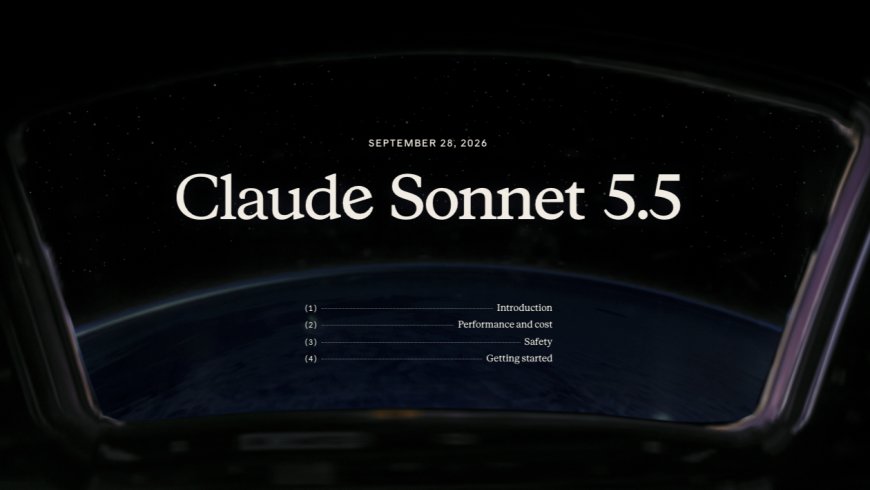
Anthropic's New Sonnet Is All About Speed and Efficiency
Anthropic has released Claude Sonnet 5.5, the second model in its new Claude 5.5 family, positioning it as a faster and more efficient AI work partner for everyday professional tasks. Unlike the recently launched Opus 5.5, which is aimed at complex work requiring deeper judgment, Sonnet 5.5 is designed for tasks such as coding, fixing software bugs, creating documents, building presentations and working with spreadsheets. Anthropic says the new model generates responses more than 30% faster than Sonnet 5 and can reduce the effective cost of completing a task by up to 30%.
The Price Hasn't Actually Dropped Per Token
Interestingly, Anthropic has not reduced Sonnet's headline API prices. Sonnet 5.5 still costs $2 per million input tokens and $10 per million output tokens, with cache reads priced at $0.20 per million tokens. The savings come from efficiency: Anthropic says Sonnet 5.5 generally needs far fewer tokens and tool calls to complete the same work, meaning customers can spend less overall even though the price per token remains unchanged.
A Big Jump in Coding Performance
Coding is one of the areas where Anthropic says Sonnet 5.5 has made particularly significant progress. On Terminal-Bench 4.0, an evaluation of agentic coding ability, Sonnet 5.5 scored 70.6%, compared with 10.3% for Sonnet 5 in Anthropic's reported testing. It also reached 55.5% on CursorBench 4.0 and 46.2% on FrontierCode at the company's Max effort setting. Anthropic says the model is better at understanding codebases and can complete work using fewer steps, making it more suitable for developers who want quick iteration without constantly relying on the company's more expensive Opus tier.
More Than Just a Coding Model
Anthropic is also targeting Sonnet 5.5 at broader knowledge work. The company says it performs strongly on long-horizon tasks, image understanding and computer use, while also producing more polished documents, slides and spreadsheets. Anthropic's internal testing showed Sonnet 5.5 coming close to Opus 5.5 on some knowledge-work evaluations, although the company still says Opus remains stronger for complex, open-ended tasks requiring sustained judgment.
What Makes Sonnet 5.5 Different?
The strategy behind Sonnet 5.5 is fairly straightforward: make capable AI cheaper to run by making it more efficient rather than simply cutting the price per token. Anthropic says users can adjust the model's effort level depending on the job. Lower settings prioritize speed and cost for routine work, while higher settings allow the model to spend more time reasoning and checking its results. That flexibility could make Sonnet 5.5 particularly useful for developers and businesses running AI agents repeatedly throughout the day.
Anthropic's Claude 5.5 Family Is Expanding
Sonnet 5.5 follows the release of Claude Opus 5.5 earlier in September. Anthropic has also announced that Claude Haiku 5.5, aimed at high-volume and cost-sensitive applications, is coming in the following weeks. That gives Anthropic a clearer three-tier lineup: Opus for demanding work, Sonnet for the balance between capability and efficiency, and Haiku for speed and high-volume workloads.
For developers and businesses, Sonnet 5.5 may ultimately be more important than simply being another new AI model. Its main pitch is efficiency: more work completed in fewer steps, faster responses and lower overall task costs. If Anthropic's claims hold up across real-world workloads, the model could make sophisticated AI agents more practical for everyday software development and business operations without requiring users to pay for the company's most expensive model on every task.
What's Your Reaction?
 Like
0
Like
0
 Dislike
0
Dislike
0
 Love
0
Love
0
 Funny
0
Funny
0
 Angry
0
Angry
0
 Sad
0
Sad
0
 Wow
0
Wow
0