





























































Samsung Galaxy A18 4G Review: A Sensible Budget Phone at a Not-So-Sensible Price
The Samsung Galaxy A18 4G is a pretty well-rounded budget Galaxy phone: solid build with IP64 protection, a pleasant 90Hz Super AMOLED display, dependable battery life, a decent 50MP main camera and a feature-rich One UI 9 with six generations of OS updates promised. Its problem is the €280 launch price and just 4GB of RAM across the range, which already feels limiting in 2026. GSMArena rated it 3.4 out of 5.
Samsung Galaxy A18 4G Review: A Sensible Budget Phone at a Not-So-Sensible Price
There is not anything fundamentally wrong with the Galaxy A18 4G. It is a pretty well-rounded budget Galaxy phone: solidly built, now with IP64 ingress protection, its 90Hz Super AMOLED display is pleasant to use, battery life is dependable, and the main camera can produce some perfectly decent photos. The new Exynos 1610 is not exactly a powerhouse, but it gets the job done, runs cool and represents a small performance step forward compared with the Helio G99. Unfortunately, every Galaxy A18 4G variant comes with just 4GB of RAM, which is already pretty limiting in 2026, and at around €280 for the 128GB/4GB version, the A18 4G is launching into a very awkward market. Samsung produced a perfectly sensible Galaxy A18 4G for rather less sensible money. GSMArena gave it 3.4 out of 5 in its full review, published on 30 September 2026. Here is the phone in detail.
Design: solid plastic, a big camera island, and a headphone jack
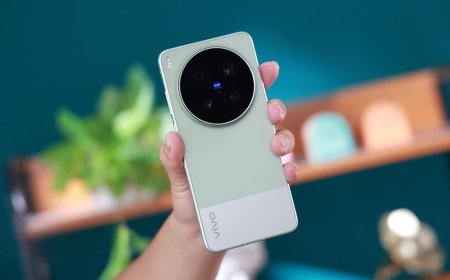
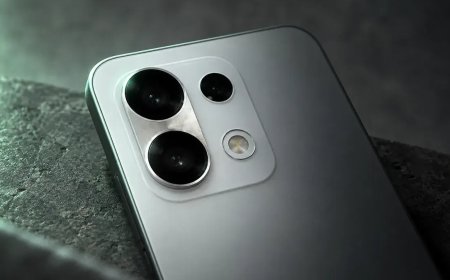
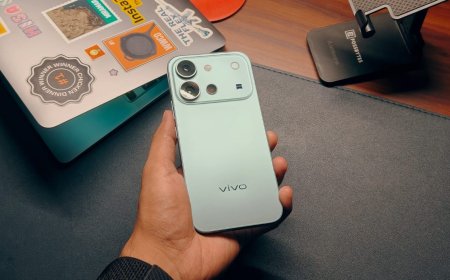
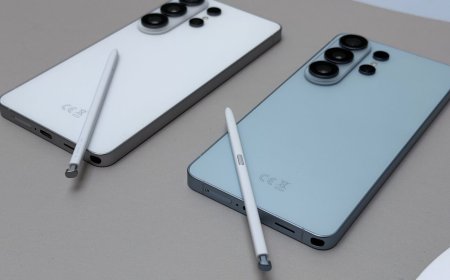
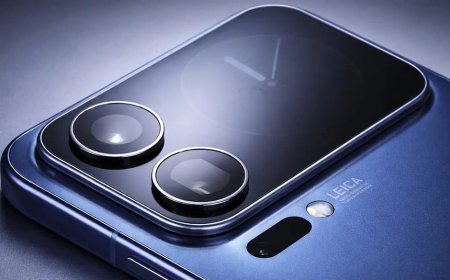
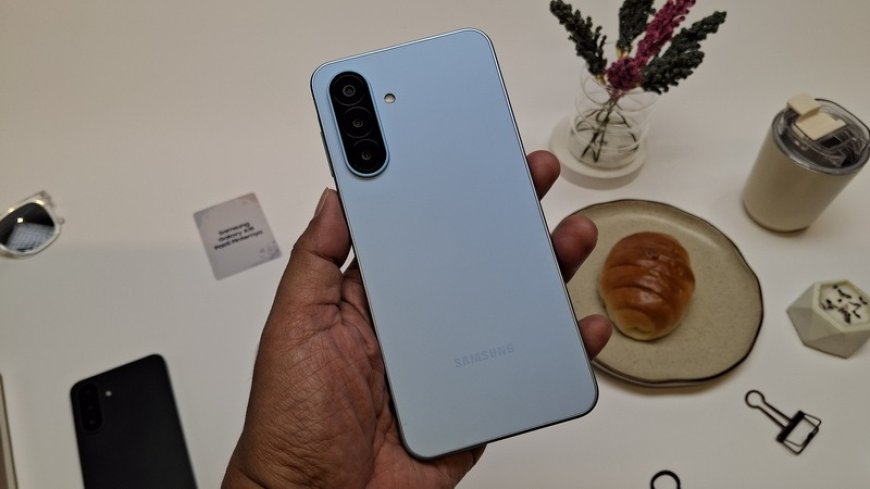
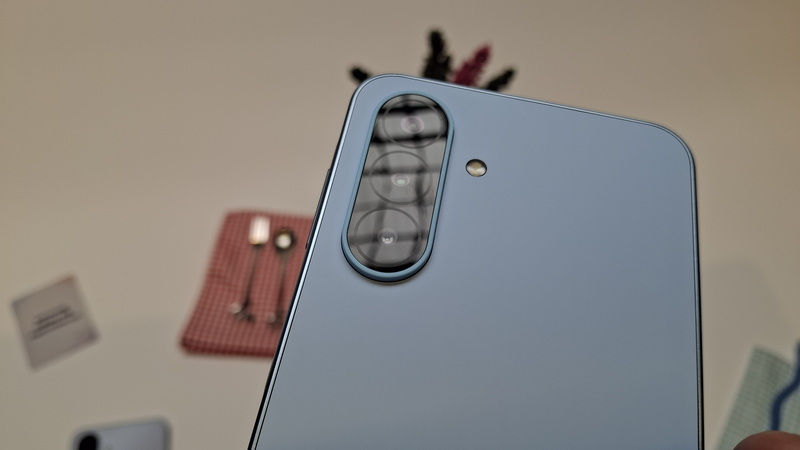
The design is a halved version of the A17's: a large rounded-rectangular camera island on the left of the rear houses all three cameras in a single pill-shaped black housing, with the LED flash to the side. The back is matte plastic with a subtle bulge in the middle, a smooth matte texture and a bevelled edge between the back and the frame that visually makes the phone appear thinner. The polycarbonate body is solid and well-made. The power button and volume rocker sit on the right-hand side, with the fingerprint sensor embedded in the power key, the top edge holds the SIM tray and a microphone, and the bottom edge has a USB-C port, a 3.5mm headphone jack, a microphone and a single loudspeaker.
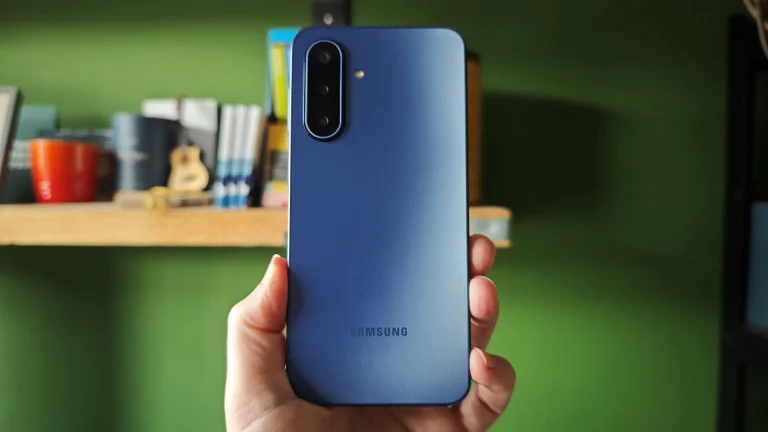
At 166.5 x 77 x 7.9 mm and 197 grams it is comfortable in the hand, with dimensions like a Galaxy A17, and the flat screen and back give a solid, good-feeling edges-and-corners design. The front is protected by Gorilla Glass 3 — a downgrade from the A17's Gorilla Glass Victus+ — with a plastic frame and plastic back, and IP64 ingress protection. Colours include Black, Gray, Blue and Green, and the review unit was a really pleasant Light Blue. There is no charger in the box, and no wireless charging.
Display: pleasant 90Hz Super AMOLED, but not the brightest in its class
The 6.7-inch Super AMOLED display packs 1080 x 2340 pixels at around 386 ppi, runs at up to 90Hz, and supports HDR10 and HDR10+ playback through the Netflix and YouTube apps, plus Widevine L1, which means Netflix at the highest quality. Image sharpness is fine, contrast is good and colours are nice and vibrant. It is not the brightest display in the segment, but the review says it is very nice for its class in real life. Colour accuracy with the Vivid default measured an average Delta E of 2.0 against the BT.709 target.
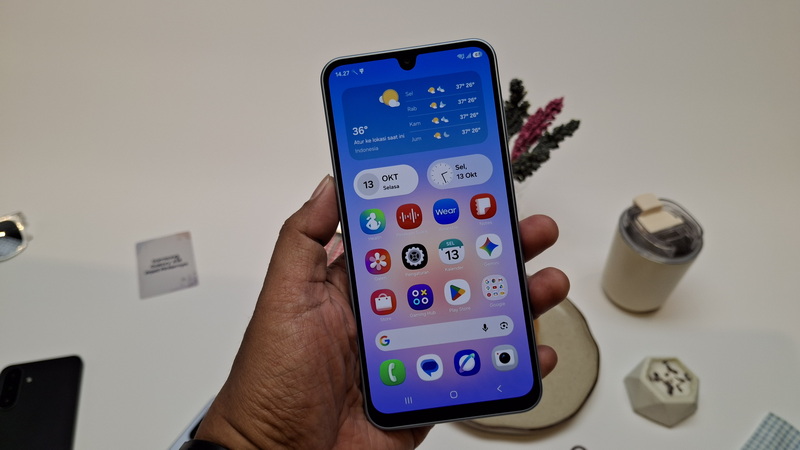
In GSMArena's lab tests the display measured 775 nits in auto mode with a 75% white patch — just shy of 800 nits — with a peak of about 1,100 nits at a 10% patch, and minimum brightness of 1.8 nits. That is notably dimmer than the Galaxy A17 4G at 1,167 nits and the Galaxy A27 4G at 1,392 nits in the same test, though it is still perfectly usable outdoors.
Battery life: dependable, and charging is not particularly fast
The 5,000mAh battery gives dependable battery life, though the Exynos 1610 is not especially efficient. In GSMArena's tests it scored an Active Use Score of 13 hours 10 minutes: 36 hours 4 minutes of calls, 10 hours 38 minutes of web browsing, 17 hours 29 minutes of video playback and 7 hours 59 minutes of gaming.
Charging is 25W wired PD 3.0, tested with a 25W Samsung charger from 1%: 29% in 15 minutes, 48% in 30 minutes and a full charge in 1 hour 29 minutes — almost 1.5 hours. The review notes charging is not particularly fast, and the phone does not support 45W charging like the A37. There is no wireless or reverse wireless charging.
Performance: the new chip gets the job done, but 4GB of RAM is already limiting
Inside is the Exynos 1610, a 5nm chip with one Cortex-A75 core, four Cortex-A74 cores and two Cortex-A55 cores up to 2.0GHz, plus an IMG BXE-2-32 GPU. It comes with 4GB of RAM across the range and 128GB or 256GB of storage, with microSDXC expansion possible at the cost of the second SIM. The benchmark results are modest: AnTuTu v11 scored 483,061, Geekbench 6 single-core scored 953, and 3DMark Wild Life Extreme came in at 384 — the GPU is not a powerhouse, and this is not a gaming phone.
In real-world use the phone already feels somewhat slow, with apps taking a while to open and multitasking limited. In the 60-minute CPU throttling test the Exynos 1610's performance dropped to around 54% of its peak, though the review notes the chip does not throttle aggressively and the phone stays cool, with cool and stable sustained performance listed as a pro. The new chip represents a small performance step forward compared with the Helio G99, but the 4GB of RAM is already pretty limiting in 2026.
Cameras: a decent main camera, and two cameras that are mostly filler
The rear camera system is a 50MP main camera with an f/1.8 aperture, a Samsung JN5 sensor, optical image stabilisation and autofocus, a 5MP ultrawide with an f/2.2 aperture, and a 2MP macro camera, with an LED flash. The front camera is a 13MP sensor with an f/2.0 aperture. Video recording tops out at a basic 1080p at 30fps, with no 4K.
In daylight the main camera takes good, decent photos, with good detail, good dynamic range, natural colours, pleasantly saturated colours and good contrast — the review says the main camera can produce some perfectly decent photos and is good for the class. Night mode works well and produces good low-light photos with the main camera. The 5MP ultrawide is modest, with low resolution, soft detail and pretty poor low-light performance. The 2MP macro camera is largely useless, largely there to fill out the spec sheet. The 2x zoom is poor and not particularly useful — 2x photos are cropped from the main sensor and look soft. Selfies are good for the class, with good detail, natural skin tones and good dynamic range. Video quality is decent and average for the class, with good colours and detail in daylight, but stabilisation is not particularly effective on the main camera.
Software, speakers and extras
The A18 4G runs Android 16 with One UI 9.0, and Samsung promises six major Android OS updates and six years of security patches — the review calls One UI 9 one of the phone's strongest selling points and the six-generation update promise difficult to argue with on a budget handset. One UI 9 is feature-rich, with Samsung's usual apps such as the Galaxy Store, Samsung Internet and Samsung Notes, plus Good Lock.
There is a single bottom-firing loudspeaker — mono, with no stereo speakers — though it gets plenty loud, measuring -24.5 LUFS, and the review lists "Loud speaker" as a pro. Connectivity covers dual SIM, Wi-Fi 802.11 a/b/g/n/ac dual-band, Bluetooth 5.3, NFC and GPS, plus USB-C and the 3.5mm headphone jack. There is no 5G — 4G LTE only — no Wi-Fi 6 or 7, and no eSIM mentioned.
Verdict: perfectly sensible, for rather less sensible money
At around €280 for the 128GB/4GB version, the A18 4G is simply launching into a very awkward market. The 256GB/4GB version is listed for €450 in most places. For comparison, the Galaxy A17 4G launched at €290 for 8GB/256GB, the Galaxy A27 sits at around €230 with a 6GB base, and the Galaxy A37 is about €270 with a brighter 120Hz display, better camera, 4K video, stereo speakers and 45W charging. Other rivals at similar money include the Xiaomi Redmi Note 17, the Redmi Note 15 at around €290 for 8GB/256GB, the Honor 600 at around €220, and the Motorola Edge 70 Fusion at €280 with 256GB/8GB, a 144Hz HDR10+ display, stereo speakers and a large battery with fast charging.
There is not anything fundamentally wrong with the Galaxy A18 4G — it is a pretty well-rounded budget Galaxy phone, solidly built, with IP64 protection, a pleasant display, dependable battery life and a decent main camera. But with just 4GB of RAM, no 5G, no stereo speakers and 1080p-only video, at its current launch price it is a tough sell. Samsung produced a perfectly sensible Galaxy A18 4G for rather less sensible money.
Pros and cons
Pros: Solid build quality, IP64 rating. Good 90Hz Super AMOLED display for the class. Dependable battery life. Expandable storage. Feature-rich One UI 9 and excellent six-generation OS update promise. Main camera produces good daylight photos; decent Night mode. Good selfies for the class. Loud speaker. Cool and stable sustained performance.
Cons: Too expensive at launch, with much stronger alternatives available for similar money. Only 4GB of RAM across the range; already feels somewhat slow. No stereo speakers. Video recording limited to 1080p30; stabilization isn't particularly effective on the main camera. Poor 2x zoom quality; low-resolution ultrawide and largely useless 2MP macro.
Sources
What's Your Reaction?
 Like
0
 Dislike
0
 Love
0
 Funny
0
 Angry
0
 Sad
0
 Wow
0