


































Xiaomi Power Bank 20000 165W Review
Xiaomi’s Power Bank 20000 165W is built for people who carry more than just a smartphone. With 120W single-port charging, 165W combined output, 90W self-charging, a built-in USB-C cable and a useful colour display, it can power a laptop, phone and other devices from one battery pack. But its 486-gram weight means this is a portable charging hub rather than an everyday pocket power bank.
Xiaomi Power Bank 20000 165W Review: The Portable Charger That Wants to Replace Your Charging Kit
A power bank used to be a fairly simple accessory. You bought one with a large battery, plugged in your phone when the battery indicator turned red, and put it back in your bag. Xiaomi’s new Power Bank 20000 165W is built around a very different idea.
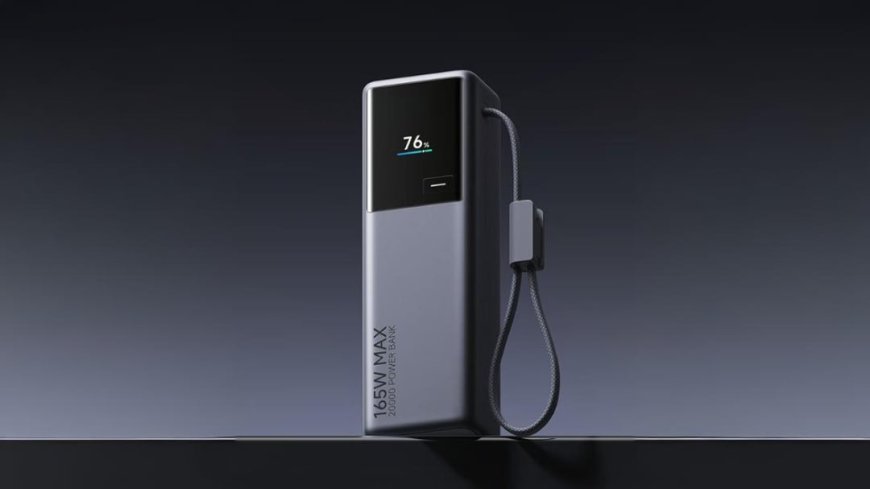
This is less of an emergency phone battery and more of a portable charging hub. It combines a 20,000mAh battery, up to 120W output from its built-in USB-C cable, another 45W USB-C output, a 22.5W USB-A port, 90W self-charging and a colour digital display. Xiaomi says the two USB-C outputs can deliver up to 165W combined, allowing compatible devices to be charged simultaneously.
That immediately makes the Xiaomi Power Bank 20000 165W interesting for a very specific type of user: someone carrying a laptop, smartphone, tablet, gaming handheld or several other USB-powered devices and who would rather carry one serious battery than a collection of chargers and smaller power banks.
The 165W Number Needs a Little Explanation
The headline figure sounds enormous, but there is an important detail behind it. 165W is the maximum combined output, not 165W from a single port.
The integrated USB-C cable can deliver up to 120W, while the second USB-C port can provide up to 45W at the same time. In other words, you could theoretically connect a compatible laptop to the 120W connection and a smartphone or tablet to the 45W port simultaneously. Xiaomi also includes a USB-A port capable of up to 22.5W for older cables and accessories.
That configuration is probably the smartest part of the product. Instead of asking whether a power bank can charge your phone, Xiaomi is effectively asking whether it can handle your entire mobile setup.
Of course, the actual charging speed always depends on the device. A laptop that accepts only 65W will not suddenly charge at 120W simply because the power bank can supply it. The same applies to smartphones. The advertised maximum is the capability of the power bank; the connected device and charging protocol determine what it actually receives.
20,000mAh, but It Is More Than a Big Battery
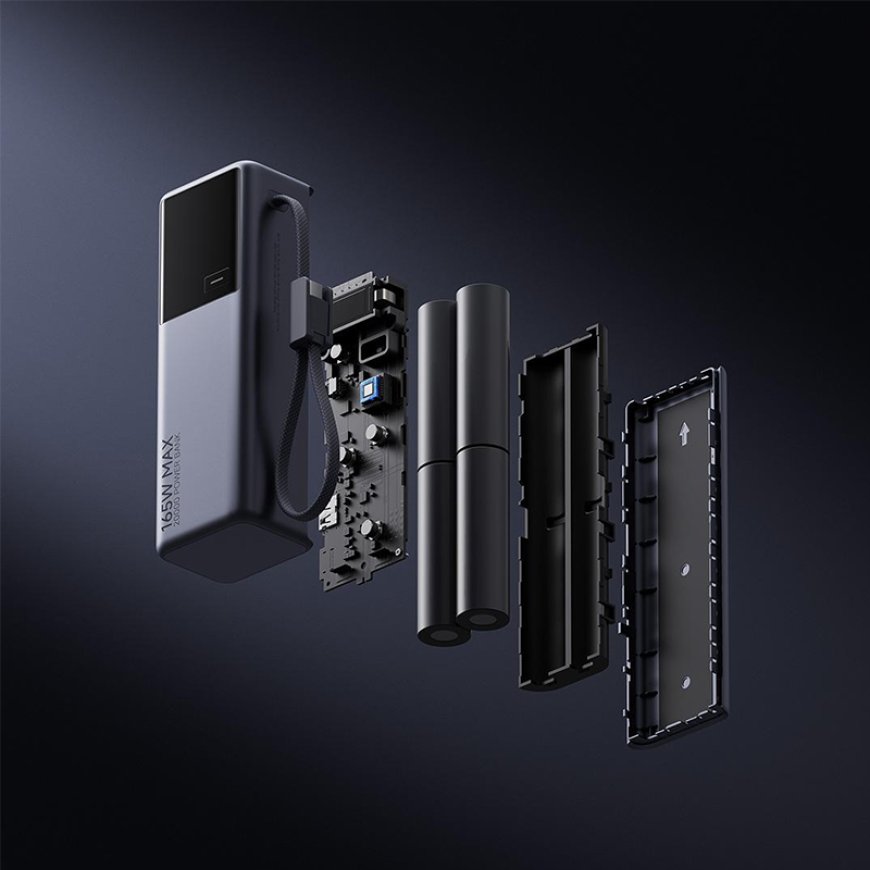
Inside the power bank are four 5,000mAh cells, giving the product its advertised 20,000mAh capacity. Xiaomi lists a rated capacity of 11,000mAh at 5V/7A and rated energy of approximately 70.65Wh.
That difference can initially look confusing. A 20,000mAh power bank does not mean that a phone will receive 20,000mAh directly from the pack. Voltage conversion and charging losses mean the usable output capacity is measured differently from the nominal capacity of the internal cells.
The roughly 70.65Wh energy rating is also significant for travellers. Xiaomi notes that the power bank is below the commonly used 100Wh threshold for portable batteries under international aviation standards, although individual airline rules still apply.
For everyday users, the simpler takeaway is this: 20,000mAh gives the power bank enough capacity to move beyond emergency phone charging and into multi-device territory.
Built-In USB-C Cable Is More Useful Than It Sounds
One of the details that makes the Xiaomi Power Bank 20000 165W different from many large power banks is the integrated braided USB-C cable.
It supports up to 120W output and can also be used to recharge the power bank itself. Xiaomi has designed the cable to double as a carrying loop, so there is no need to keep a separate USB-C cable attached to the power bank every time you take it out.
It is a small design decision, but it solves an everyday annoyance. High-capacity power banks are often used while travelling, and the last thing you want is to discover that the battery is fully charged but the charging cable is sitting at home.
There is also a second USB-C port, giving the power bank more flexibility when several devices need power at once.
The Colour Display Is Actually Useful
The front-mounted colour display is another feature that initially looks like a gimmick but becomes more useful the more you use the device.
Instead of relying on four tiny LEDs, the display provides information about the remaining battery level, charging and discharging status and estimated charging or discharging time. It can also indicate low-current conditions and malfunctions.
That matters more on a high-power power bank because you're likely to use it with several devices. If you're charging a laptop and phone simultaneously, knowing how much time and battery remain is considerably more useful than simply seeing three illuminated dots.
90W Self-Charging Solves a Big Problem
A powerful power bank has one obvious weakness: you eventually have to recharge the power bank itself.
Xiaomi addresses that with support for up to 90W input through the integrated USB-C cable. The company says a compatible 90W-or-higher charger can bring the power bank to around 27 percent in 15 minutes under its laboratory testing conditions. Xiaomi also advertises charging the power bank to full in under an hour under its specified test conditions.
That is important because a 20,000mAh battery charged at ordinary speeds can become a frustratingly slow accessory. Here, Xiaomi has tried to make both sides of the equation fast: the power bank charges other devices quickly, and it can itself be replenished quickly.
The catch is that the wall charger is not included in the package, so anyone wanting the maximum 90W recharge speed needs a compatible charger already available. The official package contents list the power bank and user manual.
Can It Really Charge a Laptop?
Yes—provided the laptop supports compatible USB-C Power Delivery charging and its power requirements fall within what the power bank can deliver.
The 120W USB-C output gives the Xiaomi Power Bank considerably more headroom than conventional 20,000mAh phone-focused models. Xiaomi specifically positions it for smartphones, tablets, laptops, gaming devices and other high-power electronics.
This is where the product starts making much more sense. A traveller with a USB-C laptop and smartphone could potentially leave the laptop's charger and a separate phone power bank behind and use this single battery for both.
It does not mean every laptop will charge at maximum speed, and it should not be treated as a universal replacement for every laptop's original power adapter. But for compatible USB-C laptops, the output is substantial enough to make the power bank genuinely useful rather than merely technically compatible.
Design: Powerful, but You Will Feel the Weight
There is no way around the physical consequence of putting this much battery and charging hardware into one device.
The Xiaomi Power Bank 20000 165W weighs 486 grams and measures 157.8 × 54 × 43.5mm.
Nearly half a kilogram is considerable for something intended to be carried around. It is not the sort of power bank most people would want in their pocket all day just to provide an occasional smartphone top-up.
But the weight makes more sense when the intended use is considered. In a backpack beside a laptop, tablet and other accessories, the extra weight may be easier to justify because one battery is potentially replacing several charging accessories.
This is therefore a product where the question is not really whether it is heavy. It is. The real question is whether the amount of power it provides makes that weight worthwhile.
Charging Standards Make It More Flexible
Xiaomi supports several charging standards, including USB Power Delivery 3.0 with PPS and Qualcomm Quick Charge 3.5, along with QC 3.0, QC 2.0, BC1.2 and Apple 2.4A compatibility.
That broad support is important because the power bank is intended to work across more than just Xiaomi hardware.
Still, the best-case charging speeds depend heavily on the individual device. Xiaomi's own compatible phones and tablets are positioned to take particularly strong advantage of the company's high-speed charging ecosystem, while other brands may negotiate lower power levels.
In practical terms, this is a high-output USB-C power bank first, rather than a guarantee that every device connected to it will suddenly charge at flagship speeds.
Xiaomi Power Bank 20000 165W Price
In India, Xiaomi lists the Power Bank 20000 165W at ₹5,499, with the product launched at an introductory price of ₹4,999. Recent reporting also lists ₹5,499 as the regular selling price.
For Bangladesh buyers, the Indian price should not be treated as an official Bangladesh retail price. Local pricing can differ because of taxes, import costs, distributor margins, warranty arrangements and availability.
That distinction is particularly important with accessories such as power banks, where unofficial imports can sometimes be sold at substantially different prices from official-channel products.
Xiaomi Power Bank 20000 165W Review: Who Should Buy It?
The Xiaomi Power Bank 20000 165W is not a product I would recommend simply because it has a huge number printed on the box. Its appeal becomes clear when you look at the entire package.
The 120W single-device output is the star feature, especially for compatible laptops and high-speed smartphones. The ability to add another 45W device simultaneously makes the 165W rating genuinely useful rather than just marketing language. The built-in USB-C cable removes one more item from the travel bag, while the display gives you useful information that ordinary power banks simply do not provide.
The biggest compromise is still the 486-gram weight. If your main requirement is simply charging a phone once or twice during the day, a smaller power bank will be easier to carry and probably cheaper.
But for people who regularly carry a laptop + smartphone + tablet + accessories, the equation changes. Carrying one powerful battery can be more convenient than managing several smaller charging solutions.
Final Verdict: A Power Bank Designed Like a Charging Hub
The Xiaomi Power Bank 20000 165W is an unusually capable portable charger because Xiaomi has treated it less like a backup battery and more like a mobile power station for personal electronics.
Its 20,000mAh battery, 120W single-port output, 165W combined charging, 90W self-charging, built-in USB-C cable, three output connections and colour display give it a compelling feature set.
But the product is not for everyone. It is relatively heavy, the fastest charging depends on device compatibility, and the maximum 90W self-charging speed requires a suitable charger that is not included.
For someone who only needs emergency power for a phone, it is probably excessive. For someone carrying several USB-C devices and wanting one battery to charge them all, however, the Xiaomi Power Bank 20000 165W makes a surprisingly strong case for leaving the pile of individual chargers behind.
Overall verdict: A powerful, practical and unusually versatile power bank—best suited to laptop users, frequent travellers and multi-device setups rather than casual smartphone charging.
What's Your Reaction?
 Like
0
Like
0
 Dislike
0
Dislike
0
 Love
0
Love
0
 Funny
0
Funny
0
 Angry
0
Angry
0
 Sad
0
Sad
0
 Wow
0
Wow
0