



















How Much Do the World’s 20 Richest Billionaires Have Every Second? The Numbers Are Almost Impossible to Imagine
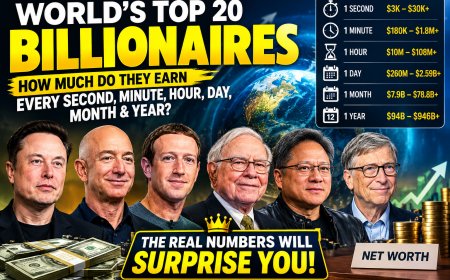
The world's richest people now control fortunes measured in tens and hundreds of billions of dollars, with Elon Musk far ahead of the rest of the field. But what would those fortunes look like if they were spread out like an ordinary income? From thousands of dollars every second to billions of dollars every day, this calculation puts the extraordinary scale of billionaire wealth into perspective. The figures are hypothetical wealth-equivalent calculations, not the billionaires' actual salaries or income.

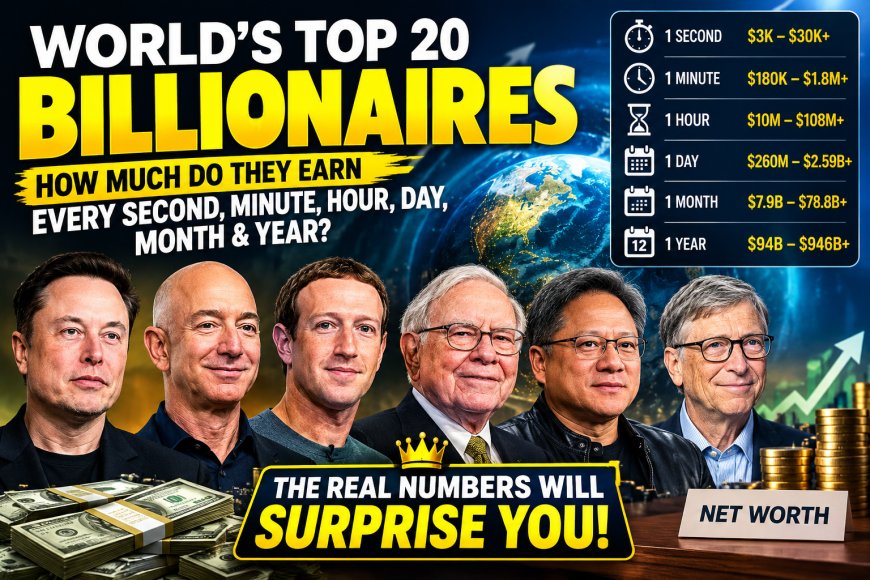
The World's Richest People Are Living in a Different Financial Universe
When most people hear that someone is worth $100 billion, the number can almost stop making sense. A million dollars is already a life-changing amount of money. A billion dollars is 1,000 million. But once fortunes reach hundreds of billions of dollars, ordinary comparisons start to break down.
As of September 20, 2026, Elon Musk sits at the top of the current billionaire ranking with an estimated fortune of about $946.48 billion, according to a current billionaire wealth listing. Jeff Bezos follows at about $373.13 billion, while Google's Larry Page is around $285.75 billion. Michael Dell, Sergey Brin and Mark Zuckerberg are also among the world's richest people, while Nvidia CEO Jensen Huang has joined the upper ranks of the global wealth list.
But there is an important distinction before looking at the numbers: a billionaire's net worth is not the same thing as their income. Most of their wealth is tied to ownership of companies, shares and other assets. Their fortunes can rise or fall dramatically when stock prices or private-company valuations change. Forbes, for example, updates public holdings frequently during market hours and adjusts private-company valuations according to its methodology.
So, rather than pretending these people literally earn the following amounts every second, we can perform a simple thought experiment: What if their entire current fortune were treated as money earned evenly over one year?
Top 20 Billionaires: The Fortune-per-Second Breakdown
| Rank | Billionaire | Main source of wealth | Net worth | 1 second | 1 minute | 1 hour | 24 hours | 1 month* | 12 months* |
|---|---|---|---|---|---|---|---|---|---|
| 1 | Elon Musk | Tesla, SpaceX, xAI | $946.48B | $30.0K | $1.80M | $108.05M | $2.59B | $78.87B | $946.48B |
| 2 | Jeff Bezos | Amazon, Blue Origin | $373.13B | $11.8K | $709.9K | $42.60M | $1.02B | $31.09B | $373.13B |
| 3 | Larry Page | Google/Alphabet | $285.75B | $9.1K | $543.7K | $32.62M | $782.88M | $23.81B | $285.75B |
| 4 | Michael Dell | Dell Technologies, investments | $275.99B | $8.8K | $525.1K | $31.51M | $756.14M | $23.00B | $275.99B |
| 5 | Sergey Brin | Google/Alphabet | $262.97B | $8.3K | $500.3K | $30.02M | $720.47M | $21.91B | $262.97B |
| 6 | Mark Zuckerberg | Meta | $228.56B | $7.2K | $434.9K | $26.09M | $626.19M | $19.05B | $228.56B |
| 7 | Jensen Huang | Nvidia | $192.51B | $6.1K | $366.3K | $21.98M | $527.43M | $16.04B | $192.51B |
| 8 | Larry Ellison | Oracle | $192.33B | $6.1K | $365.9K | $21.96M | $526.93M | $16.03B | $192.33B |
| 9 | Steve Ballmer | Microsoft, investments | $154.58B | $4.9K | $294.1K | $17.65M | $423.51M | $12.88B | $154.58B |
| 10 | Warren Buffett | Berkshire Hathaway | $144.63B | $4.6K | $275.2K | $16.51M | $396.25M | $12.05B | $144.63B |
| 11 | Amancio Ortega | Zara/Inditex | $132.92B | $4.2K | $252.9K | $15.17M | $364.16M | $11.08B | $132.92B |
| 12 | Rob Walton & family | Walmart | $131.21B | $4.2K | $249.6K | $14.98M | $359.48M | $10.93B | $131.21B |
| 13 | Jim Walton & family | Walmart | $128.02B | $4.1K | $243.6K | $14.61M | $350.74M | $10.67B | $128.02B |
| 14 | Bernard Arnault & family | LVMH | $124.97B | $4.0K | $237.8K | $14.27M | $342.38M | $10.41B | $124.97B |
| 15 | Carlos Slim Helú & family | Telecom, investments | $118.89B | $3.8K | $226.2K | $13.57M | $325.73M | $9.91B | $118.89B |
| 16 | Alice Walton | Walmart | $117.85B | $3.7K | $224.2K | $13.45M | $322.88M | $9.82B | $117.85B |
| 17 | Changpeng Zhao | Cryptocurrency exchange | $114.61B | $3.6K | $218.1K | $13.08M | $314.00M | $9.55B | $114.61B |
| 18 | Bill Gates | Microsoft, investments | $114.33B | $3.6K | $217.5K | $13.05M | $313.23M | $9.53B | $114.33B |
| 19 | Thomas Peterffy | Interactive Brokers | $105.03B | $3.3K | $199.8K | $11.99M | $287.75M | $8.75B | $105.03B |
| 20 | Michael Bloomberg | Bloomberg LP | $94.92B | $3.0K | $180.6K | $10.84M | $260.06M | $7.91B | $94.92B |
*The “1 month” and other time-period figures are hypothetical calculations based on dividing the current net worth evenly across 12 months. They are not actual monthly or hourly earnings.
Elon Musk's Numbers Are in a Category of Their Own
The most eye-catching number belongs to Elon Musk. With an estimated fortune of approximately $946.48 billion, the calculation produces a hypothetical wealth-equivalent rate of roughly $30,000 every second.
That means the mathematical equivalent of one minute would be around $1.8 million, one hour around $108 million, and one 24-hour period around $2.59 billion. Again, Musk is not actually receiving $2.59 billion in cash every day. His wealth is overwhelmingly connected to his ownership stakes in companies and can move dramatically with market valuations. Forbes' profile identifies Tesla and SpaceX as the primary sources of his fortune, with additional interests including xAI, Neuralink and The Boring Company.
Musk's extraordinary position at the top of the list is also relatively unusual because his wealth is heavily concentrated in companies whose valuations can change rapidly. Forbes reported that SpaceX became publicly traded in 2026 and that Musk owns a substantial stake, while Tesla remains another major component of his fortune.
Jeff Bezos: The Amazon Fortune Still Generates a Huge Number
Jeff Bezos' estimated $373.13 billion fortune produces another eye-opening hypothetical figure. Spread evenly over a year, it would work out to nearly $11,800 every second, or about $1.02 billion every 24 hours.
But Bezos' story demonstrates why net worth should not be confused with a paycheck. The majority of his wealth comes from ownership and investments rather than a traditional salary. Amazon transformed his personal fortune through decades of company growth, while his Blue Origin space company represents another major part of his business empire.
A rise or fall in Amazon's share price can therefore change his net worth by billions without Bezos receiving billions of dollars in income that day.
The Technology Industry Dominates the Top
One of the clearest patterns in the table is the extraordinary presence of technology entrepreneurs. Larry Page and Sergey Brin built their fortunes through Google, Mark Zuckerberg through Meta, Jensen Huang through Nvidia, Larry Ellison through Oracle and Michael Dell through Dell Technologies.
The pattern tells a much bigger story about the modern economy. The world's largest technology companies have created enormous amounts of shareholder value, and founders who retained significant ownership stakes have benefited from that growth.
Jensen Huang is a particularly interesting example. Nvidia became one of the central companies behind the global artificial-intelligence boom as demand for advanced processors and AI infrastructure exploded. His fortune has consequently become closely connected to the market's expectations for the future of AI.
Walmart Shows That Technology Isn't the Only Road to Extreme Wealth
The list isn't entirely dominated by Silicon Valley. Several of the world's richest people built or inherited fortunes connected to retail.
Rob Walton, Jim Walton and Alice Walton are all members of the Walton family, whose wealth comes primarily from Walmart. Together, the three positions in this top-20 table represent hundreds of billions of dollars in estimated wealth.
Amancio Ortega represents another completely different business story. The Spanish billionaire built his fortune around Inditex, the parent company of Zara, demonstrating that global retail can create fortunes comparable to those generated by some of the world's largest technology businesses.
Bernard Arnault and his family occupy another major non-tech position through LVMH, the luxury-goods empire behind brands across fashion, jewelry, cosmetics and other premium markets.
Warren Buffett's Fortune Came From a Very Different Strategy
Warren Buffett's position is particularly interesting because Berkshire Hathaway's rise wasn't built around a single technology product. Buffett became famous for long-term investing, capital allocation and acquiring stakes in businesses through Berkshire Hathaway.
His estimated fortune of about $144.63 billion would translate, in our hypothetical calculation, to roughly $4,600 every second or almost $396 million per day if the entire fortune were evenly converted into yearly income.
But Buffett himself has long demonstrated why such calculations can be misleading. A large fortune can remain invested for decades without becoming ordinary spending money. Wealth is often about ownership of productive assets rather than cash sitting in a bank account.
The $100 Billion Club Is Getting Less Ordinary
Perhaps the most remarkable part of the list is not simply the person at number one. It is how high the wealth threshold has become.
Every person in this top 20 has a fortune of more than $94 billion based on the September 20 figures. Even Michael Bloomberg, at number 20, would have a hypothetical wealth-equivalent rate of roughly $3,000 every second under the calculation used here.
That doesn't mean these people are literally generating thousands of dollars every second. It means that if their entire accumulated wealth were divided into equal pieces across one year, the resulting number would be thousands of dollars per second.
And that distinction matters.
Billionaire Wealth Can Rise Without Anyone Writing Them a Check
A billionaire's net worth can increase by billions of dollars on a strong stock-market day. That does not mean the person received billions of dollars in salary.
Imagine someone owns 10% of a company worth $1 trillion. If that company's market value rises by $100 billion, the person's stake could theoretically become $10 billion more valuable. Nothing necessarily changed in their bank account that afternoon.
This is why billionaire wealth can sometimes appear to move at an almost unbelievable speed.
Forbes' real-time methodology tracks public holdings during market hours and can update those values frequently, while private-company holdings are treated differently. As a result, a billionaire's reported net worth is best understood as an estimate of the current market value of their assets, not a conventional income statement.
So Who Is Actually "Earning" the Most?
That question is much harder to answer than the table makes it appear.
Someone could have a huge net worth but relatively little traditional annual income. Another billionaire could sell shares or receive dividends worth billions in a particular year. Someone else could see their fortune increase by tens of billions without selling anything.
That is why net-worth rankings and income rankings are two completely different things.
The table is therefore best viewed as a way of making enormous fortunes understandable. It asks a deliberately simple question: If today's estimated fortunes were converted into money and divided evenly over one year, how much would each billionaire's wealth represent every second?
The answer is extraordinary.
A Fortune Measured in Seconds
For most people, a second is almost nothing financially. A minute is ordinary. An hour passes quickly. A month can disappear before we notice it.
For the world's richest people, however, dividing their accumulated fortunes into these same units produces numbers that are difficult to comprehend.
Elon Musk's estimated fortune alone is close to one trillion dollars. Jeff Bezos is above $370 billion. Larry Page, Michael Dell and Sergey Brin are each above $260 billion. Mark Zuckerberg is above $220 billion, while several others are approaching or exceeding $100 billion.
The bigger story isn't really about how much money any one person supposedly "makes per second." It is about how ownership of technology companies, retail empires, financial businesses, luxury brands and other global assets has created fortunes on a scale rarely seen in human history.
And as AI, space technology, semiconductors and global digital businesses continue expanding, the list of the world's richest people is likely to remain a fascinating snapshot of where economic power is accumulating.
One final reminder: these figures are estimates of net worth as of September 20, 2026, not verified personal incomes. Markets move every day, so rankings and fortunes can change quickly.
What's Your Reaction?
 Like
0
Like
0
 Dislike
0
Dislike
0
 Love
0
Love
0
 Funny
0
Funny
0
 Angry
0
Angry
0
 Sad
0
Sad
0
 Wow
0
Wow
0