





























Title: Sony Brings AI Upscaling to Standard PS5, With Wolverine and Ghost of Yōtei Leading the Upgrade
Sony has introduced Quick Spectral Super Resolution (QSSR), a new AI-powered upscaling technology designed specifically for the standard PlayStation 5. Marvel’s Wolverine and Ghost of Yōtei are the first games to receive QSSR support, bringing improved image detail and temporal stability to the base console.
Sony Gives the Standard PS5 an AI Graphics Upgrade With QSSR
Sony has found a way to bring one of the PlayStation 5 Pro’s most interesting graphics ideas to the much larger audience using the standard PS5. The company has introduced Quick Spectral Super Resolution, or QSSR, a new AI-powered upscaling technology designed to improve image quality on the original PS5 hardware.
The technology is arriving first in two major PlayStation titles: Marvel’s Wolverine from Insomniac Games and Ghost of Yōtei from Sucker Punch Productions. Both games have received updates adding QSSR as an additional graphics option on the standard PS5.
This is a significant development for PS5 owners because Sony previously kept its more advanced PlayStation Spectral Super Resolution (PSSR) technology associated with the PS5 Pro. QSSR is not simply PSSR moved over to the older console, however. Sony describes it as a new performance tier of AI upscaling, redesigned to work within the considerably tighter hardware constraints of the standard PS5.
What Exactly Is Sony QSSR?
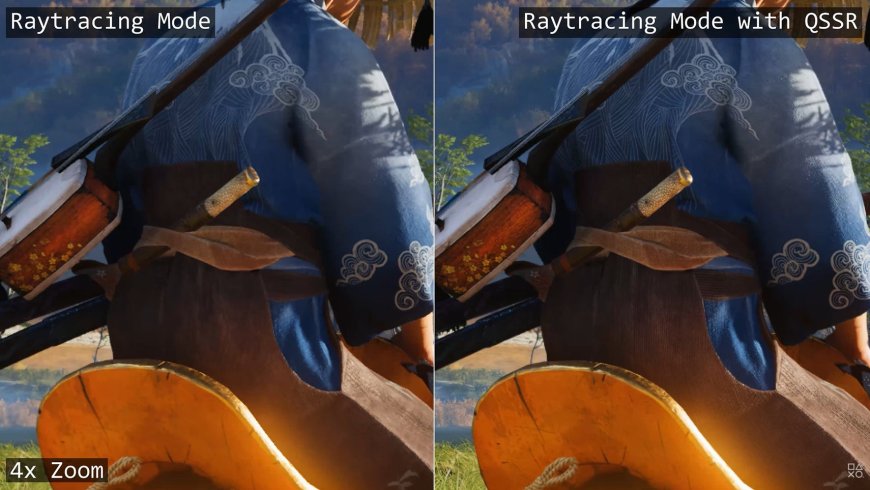
At its simplest, QSSR is designed to reconstruct a sharper final image from a lower-resolution game render using AI-assisted processing.
Traditional upscaling methods can increase the apparent resolution of an image, but they can also struggle with fine details, movement and objects that change from frame to frame. Sony's approach uses a neural network to improve those areas, helping preserve small details and make the resulting image more stable.
Sony says QSSR was developed through Project Amethyst, its graphics and AI collaboration with AMD. The technology uses a streamlined neural-network architecture combined with a hand-tuned implementation designed specifically around the performance characteristics of the standard PS5.
That distinction matters. The regular PS5 does not have the dedicated machine-learning hardware available in the PS5 Pro, so Sony had to approach the problem differently rather than simply porting PSSR to the base machine.
Wolverine and Ghost of Yōtei Are First
Sony has chosen two particularly high-profile games to introduce QSSR.
Marvel’s Wolverine, developed by Insomniac Games, is one of the first titles to demonstrate the technology. According to Insomniac, QSSR improves pixel-level clarity and image stability, helping reveal more detail in environments throughout Wolverine's journey.
Ghost of Yōtei, developed by Sucker Punch Productions, is the other launch title. The studio says QSSR is particularly useful for resolving fine details in characters and environments while improving temporal stability.
Both games received updates that make QSSR available as an additional graphics option on PS5. That means the technology is not replacing every existing rendering mode; developers can give players a choice over how the game presents its visuals.
QSSR Is Not the Same as PS5 Pro's PSSR
It would be easy to describe QSSR as “PSSR for the PS5,” but Sony itself makes an important distinction.
PSSR remains the company's higher-end solution for PS5 Pro, while QSSR is designed around the performance limitations of the standard PS5. The Pro has hardware advantages that allow PSSR to operate at a higher performance level.
Sony's goal with QSSR is therefore not to make a standard PS5 perform exactly like a PS5 Pro. Instead, it is trying to extract more image quality from hardware that has already been in millions of homes.
That makes the technology arguably more important from a platform perspective than its name suggests. A visual improvement available to the standard PS5 potentially reaches a much larger installed user base than an enhancement exclusive to the Pro.
Early Testing Shows a Noticeable Difference
Early technical analysis suggests that QSSR can produce a meaningful improvement, although the results vary from game to game.
Digital Foundry's early testing highlighted particularly strong improvements in Marvel's Wolverine, including better temporal stability, increased fine detail and fewer visible artifacts in moving elements. Ghost of Yōtei reportedly showed a less dramatic difference because its existing image quality was already strong.
There can also be a performance trade-off depending on the graphics mode. Early analysis reported frame-rate differences in some Wolverine testing, while the actual frame-time cost was relatively small. That illustrates an important point about AI upscaling: better reconstruction does not automatically mean the game becomes faster. The value comes from finding a better balance between rendering resolution, image quality and performance.
Why This Matters for PS5 Owners
For a standard PS5 owner, the most interesting part of QSSR is that the console is receiving a meaningful graphics improvement several years into its life.
Modern games increasingly rely on reconstruction techniques because rendering every frame natively at very high resolutions can consume enormous amounts of GPU resources. Developers can instead render internally at a lower resolution and use sophisticated reconstruction to produce a cleaner final image.
If QSSR becomes widely adopted, developers could have another tool for achieving that balance on PS5. Instead of choosing between a softer image and a heavier rendering workload, studios may be able to use AI-assisted reconstruction to make performance-oriented graphics modes look substantially cleaner.
That could be especially useful in demanding games where developers are trying to maintain higher frame rates while still preserving visual detail.
Sony Wants More Games to Use QSSR
Perhaps the biggest announcement is not the two launch games themselves. Sony says QSSR will be offered broadly to PlayStation developers.
That means Wolverine and Ghost of Yōtei are effectively the starting point rather than the end of the technology's rollout.
Sony's Daniel Craig has explained that QSSR can serve as a relatively straightforward replacement for titles already supporting PSSR, although developers still need to tune their games for the base PS5's different performance characteristics.
If that process remains practical for studios, QSSR could eventually become a more common part of PS5 graphics options rather than a feature limited to a handful of first-party games.
A Bigger Change Than Another Graphics Setting
The interesting story here is not simply that Sony has added another graphics toggle.
QSSR shows that Sony is continuing to invest in improving the capabilities of the standard PS5 instead of treating the original console as technologically frozen after the launch of the PS5 Pro. The company can now use AI-assisted reconstruction to squeeze additional visual quality from hardware that was never designed around dedicated machine-learning acceleration.
For gamers, that could mean sharper foliage, cleaner distant objects, more stable fine details and fewer reconstruction artifacts in future games. The improvement will not look identical in every title, and QSSR will not magically turn the standard PS5 into a PS5 Pro, but it gives developers another tool to work with.
And because the first two implementations are arriving in major first-party releases, Sony has a strong showcase for what the technology can actually accomplish.
The Road Ahead for PS5 Graphics
The arrival of QSSR also says something about where console graphics are heading. AI-assisted reconstruction is increasingly becoming part of the rendering pipeline rather than a feature reserved for experimental PC technology.
Sony has already established PSSR on PS5 Pro. Now QSSR brings a lighter version of the same broader idea to the standard PS5. AMD's involvement through Project Amethyst further underlines how important machine learning has become to modern graphics development.
For PS5 owners, the immediate result is simple: Marvel’s Wolverine and Ghost of Yōtei now provide an early look at what AI upscaling can do on the base console. The more important question is what happens next. If developers embrace QSSR and Sony continues refining it, the technology could become one of the more valuable late-generation improvements to the standard PS5.
Sources
- PlayStation Blog — Sony Interactive Entertainment: “AI upscaling is coming to PS5”
- Sony Interactive Entertainment — QSSR and Project Amethyst information
- The Verge — Sony's QSSR announcement and technical context
- TechRadar — Early QSSR analysis and image-quality testing
- TechSpot — Base PS5 QSSR testing and performance analysis
What's Your Reaction?
 Like
0
Like
0
 Dislike
0
Dislike
0
 Love
0
Love
0
 Funny
0
Funny
0
 Angry
0
Angry
0
 Sad
0
Sad
0
 Wow
0
Wow
0