















































Our Next Energy to Go Public in $1 Billion SPAC Deal After Near Collapse
Our Next Energy, the Michigan battery startup that nearly collapsed in late 2023, is going public through a SPAC merger with Wen Acquisition Corp. The deal values the company at $600 million before the merger and is expected to bring in up to $400 million, with the combined company trading on Nasdaq under the ticker ONEE in the first half of 2027.
Our Next Energy to Go Public in $1 Billion SPAC Deal After Near Collapse
Our Next Energy (ONE), the Michigan battery startup that came close to shutting down in late 2023, is heading for the public markets. The company announced on November 16 that it has signed a definitive agreement to merge with Wen Acquisition Corp, a Nasdaq-listed special purpose acquisition company, in a deal that gives the combined business a pro forma equity value of about $1 billion.
Under the terms, ONE is valued at $600 million before the merger. The combined company expects to raise up to $400 million in gross proceeds, assuming no shareholders of the SPAC redeem their shares, and to trade on the Nasdaq under the ticker symbol "ONEE". Closing is expected in the first half of 2027, subject to approval by the shareholders of both companies and other customary conditions.
The deal at a glance
The $400 million in expected proceeds is made up of $300 million of cash held in Wen's trust account, assuming no redemptions, plus a $100 million private investment in public equity, or PIPE. Of that PIPE, $30 million has already been committed by two global strategic investors in the steel and defence industries. Cantor Fitzgerald is serving as exclusive capital markets adviser and sole placement agent to Wen.
The merger still needs to clear several hurdles before it closes. Wen's registration statement on Form S-4 must be declared effective by the US Securities and Exchange Commission, the waiting period under the Hart-Scott-Rodino antitrust law must expire, and a minimum cash condition must be met. Both companies' boards have approved the transaction.
The deal also comes as Washington tightens the rules around batteries. An executive order signed in August 2026 restricts battery energy storage systems and other grid equipment linked to foreign adversaries, a backdrop that ONE is leaning into as it pitches itself as an American battery maker.
From near collapse to a public listing
ONE's path to this point has been anything but smooth. The company was founded by Mujeeb Ijaz, a former Ford and Apple engineer, around a dual-chemistry battery system that let an electric vehicle draw power from two different types of cells. In its first setup, it paired lithium-iron-phosphate (LFP) cells for everyday driving with a manganese-rich chemistry reserved for long, infrequent road trips. An early prototype travelled more than 600 miles on a single charge.
But the electric vehicle market did not grow as fast as expected, and automakers wanted batteries at lower prices, usually from China. Those two pressures helped sink ONE's first attempt at a Series C funding round in late 2023. The startup laid off a large part of its staff and eventually gave up the lease on a planned $1.6 billion factory in Michigan. Ijaz was removed as chief executive in December 2023, only to return to the role in March 2025 after a new funding round closed. His brother's investment firm co-led that round.
According to PitchBook data, ONE has raised $483 million over its lifetime and was once valued at $1.3 billion, more than double its current $600 million pre-money valuation. It has also received tens of millions of dollars in incentives tied to investment and job creation in Michigan.
A new focus: defence, rail and grid
When Ijaz returned, he said ONE would leave the automotive market and focus on grid-scale batteries. The logic was straightforward: LFP batteries are safer and cheaper than the cells used in most US electric vehicles, and the grid was starting to strain under the power demands of AI data centres. Ford and General Motors have since announced their own energy storage products for the same reason.
But grid customers proved to be much like carmakers, willing to buy from China as long as the price was low enough. Ijaz told TechCrunch that the company therefore looked for customers who valued an American battery supplier, and found them in defence and rail.
That shift is now the core of ONE's pitch to investors. The US government cannot buy batteries made in China, or made using minerals from China-controlled supply chains, under so-called foreign entity of concern restrictions. Defence and rail customers, by contrast, will pay a premium for a domestic supply chain shielded from Chinese competition, even though those markets are smaller than the EV sector.
ONE says it has $200 million in binding, multi-year contracts with railroads and defence contractors. It has built a hybrid locomotive powered by a 2.8 megawatt-hour battery, and a smaller micro-hybrid system that starts a diesel engine faster, similar to a stop-start system in a car. Ijaz said customers are seeing about a 50 percent improvement in diesel fuel consumption. In its investor pitch, which TechCrunch reviewed, ONE puts the defence market, including drones, submarines and defence data centres, at $16.2 billion, and the rail market at $28.2 billion. By comparison, the EV sector is worth about $73 billion today and could grow to $200 billion by the end of the decade, according to Grand View Research.
Today ONE operates a battery pack assembly plant in Novi, Michigan, which can assemble packs at a rate of 3 gigawatt-hours per year. The plant uses cells from Chinese and non-Chinese suppliers, as well as ONE's own cells from a smaller nearby factory that is being upgraded to produce 50 megawatt-hours of batteries a year. The company expects revenue of $30 million in 2026 and hopes to double that in 2027.
What happens next
The merger still leaves ONE with plenty to prove. Its pitch depends on investors believing the company has moved past the unfocused, product-heavy culture that contributed to its 2023 collapse, and that defence and rail contracts can carry a business that once aimed at the far larger car market. The $400 million in expected proceeds also rests on the assumption that SPAC shareholders do not redeem their shares, a condition that has tripped up other deals.
If the transaction closes as planned, ONE will arrive on the Nasdaq as a very different company from the EV battery hopeful that nearly died three years ago: smaller, focused on American industrial customers, and betting that domestic supply chains are worth a premium. Whether that bet pays off will become clear once the combined company starts reporting as a public business in 2027.
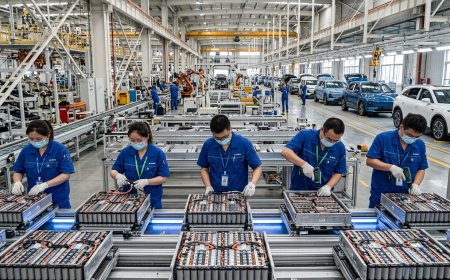
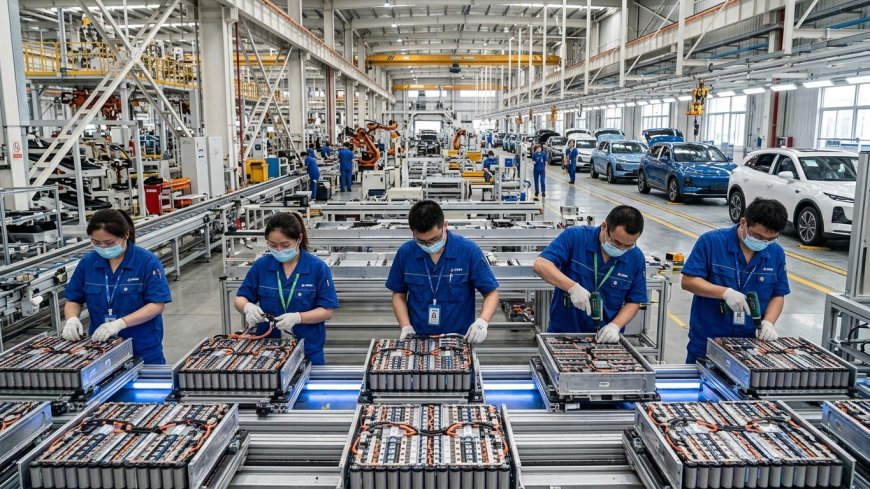
Note: The featured image shows a generic electric-vehicle battery assembly line, not ONE's plant in Novi, Michigan.
Sources
- TechCrunch — After dodging death, battery startup Our Next Energy is now going public (November 16, 2026)
- GlobeNewswire via The Manila Times — Our Next Energy to go public via business combination with Wen Acquisition Corp (November 16, 2026)
- The EV Report — Our Next Energy to Go Public in $1 Billion Wen SPAC Deal (November 16, 2026)
What's Your Reaction?
 Like
0
 Dislike
0
 Love
0
 Funny
0
 Angry
0
 Sad
0
 Wow
0