














































Europe Races to Build Its Own Military AI as Reliance on Palantir Comes Under Scrutiny
European defence ministries are pushing to reduce their dependence on Palantir's military software, with Germany's Helsing, France's Arcadia project and other homegrown systems vying to fill the gap — though officials admit no European rival yet matches Palantir's scale and battlefield experience.
Europe Races to Build Its Own Military AI as Reliance on Palantir Comes Under Scrutiny
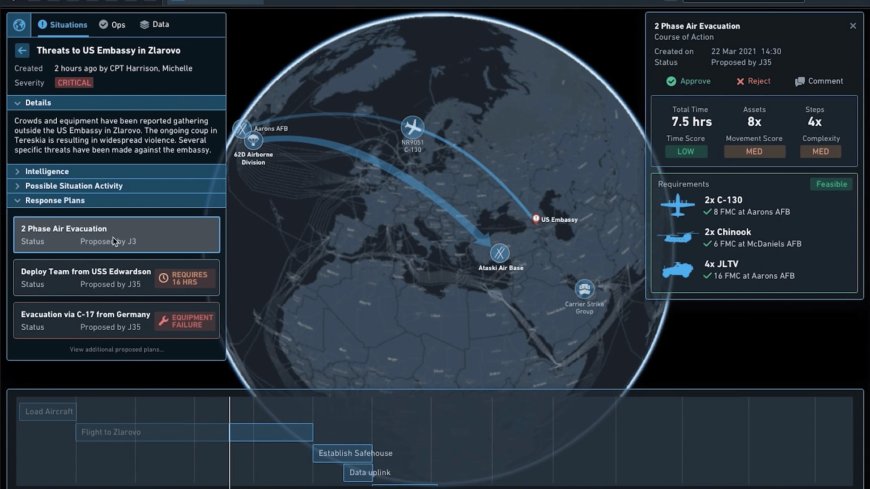
European defence ministries are moving to limit their reliance on American technology — and on Palantir Technologies in particular — for some of the most sensitive functions in modern warfare. Across the continent, a growing field of homegrown firms is now competing to supply the AI-powered software that helps commanders sift through vast amounts of battlefield data, identify threats and recommend action, including targeting.
The push reflects a wider reckoning in European capitals. The Trump administration has pressed Europe to take far greater responsibility for its own security as Washington scales back its military presence in the region, putting new strain on the NATO alliance. For defence officials, that raises an uncomfortable question: how much of the software that runs a war should depend on a single American company?
Yet the shift is far from straightforward. Europe currently has no exact equivalent that matches Palantir's scale, deployment footprint and operational experience, government and military officials told Reuters. That leaves European militaries with a dilemma — pursue homegrown systems that promise greater autonomy but may be less mature, or keep relying on a proven platform despite worries about long-term strategic dependence.
Helsing's Clarity leads the European charge
The most prominent European challenger emerged last week, when Germany's Helsing unveiled Clarity, a military intelligence software platform. It is part of a broader market for AI systems designed to accelerate military decision-making by processing enormous volumes of sensor, satellite and battlefield data far faster than human analysts could manage alone.
Helsing says it could supply an initial version of Clarity within a matter of months to the German military's Lithuania brigade — the Bundeswehr unit widely seen as most likely to face frontline combat in the event of a conflict with Russia. The company is already one of Europe's best-known defence technology firms, and its backers include the venture firm Plural, which recently closed a €1 billion fund aimed at Europe's next generation of deep-tech companies.
Clarity is not the only European contender. Denmark's Systematic makes SitaWare, a command-and-control product already used by the Bundeswehr and parts of NATO. Traditional defence groups such as France's Thales and Safran are in the field too, alongside startups including Paris-based Comand AI.
France's Arcadia and Germany's shortlist
France, the most vocal advocate of European strategic autonomy, is developing its own sovereign AI-enabled military platform, called Arcadia. Alexandre Lahousse, deputy head of France's defence procurement agency, told Reuters the system would draw on multiple suppliers, with at least some contracts awarded by the end of the year and an operational version ready for field deployment by mid-2027.
Germany, meanwhile, is aiming to deploy an AI-based military data integration platform from next year and is weighing domestic and other European options. It has narrowed the field to a shortlist of a handful of solutions — one that does not include Palantir, according to a person familiar with the matter. The same person said the options under consideration would not match Palantir's capabilities, but would be good enough, would guarantee national data sovereignty and should be able to deliver about 80 percent of what is needed within a year.
The Netherlands is on a similar path. The Dutch military currently uses some Palantir software but says it wants a European alternative within two years. It is meeting potential suppliers and will likely require a combination of Dutch and other European providers, Dutch arms procurement minister Derk Boswijk told Reuters.
"We have a lot of knowledge in Europe when it comes to AI and decision-making. But it's very fragmented, and that is the problem," Boswijk said.
Why Palantir is so hard to replace
The scale of the challenge becomes clear when looking at what Palantir's software already does. Its Maven Smart System has been widely used by Ukraine in its fight against Russia, while the Pentagon has adopted it as its core military software. NATO's military headquarters adopted the system last year and said in June that it was ready for routine alliance-wide operational use.
NATO's top commander, US Air Force General Alexus Grynkewich, praised the platform's flexibility earlier this year. "I've yet to find anything that can pull together as much of a diverse set of data and allow us the ability to make sense of that data as flexibly," he told Reuters this summer.
The trade-off between autonomy and capability runs through other military technologies too. Satellite communications, for example, is dominated by Elon Musk's SpaceX — and Ukraine last week reported further significant disruptions to its access to the company's Starlink service, affecting the entire front line and Russian-occupied parts of the country.
The interoperability problem
Militaries are also wrestling with questions that go beyond any single supplier: data security, who trains the AI systems, and making sure different platforms work seamlessly together. Lieutenant General Christian Freuding, Germany's army chief, raised the issue at a conference in Berlin on Friday.
"There's the issue of interoperability when we fight in alliances — and we always fight in alliances," he said.
The urgency is sharpened by NATO warnings that Russia could potentially mount a large-scale assault on allied territory as early as 2029. Moscow denies any aggressive intentions.
Palantir pushes back
For its part, Palantir has sought to reassure Europeans that its military AI system used by NATO has no "kill switch". Louis Mosley, the company's international chief, told Reuters there remains demand in Europe for its products, including in the UK, where the defence ministry last year signed a three-year enterprise agreement with the US company.
Mosley added that he still hopes to persuade Germany to adopt Palantir's software, pitching battlefield-tested capability that works today rather than a system still being built. For European governments, that is precisely the tension: the proven tool is American, and the European alternatives are still catching up.
Whether the continent's defence ministries can close that gap — and how quickly — will shape not only who supplies Europe's military software, but how much control Europe ultimately has over the systems its own armed forces depend on.
Sources
What's Your Reaction?
 Like
0
 Dislike
0
 Love
0
 Funny
0
 Angry
0
 Sad
0
 Wow
0