






































Alibaba Qwen Launches Qwen-Image-2.1-Turbo for Faster AI Image Generation
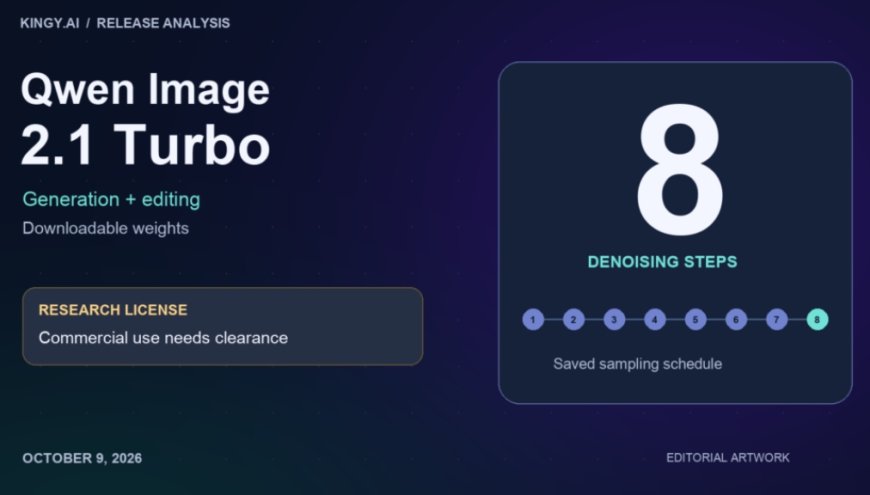
Alibaba's Qwen team has released Qwen-Image-2.1-Turbo, an accelerated 7-billion-parameter AI image model designed to generate and edit images in just eight denoising steps. Built on the Qwen-Image-2.1 architecture, the model combines text-to-image generation, image editing, transparent image creation, and reference-based composition. Its reduced sampling steps could make AI-powered creative workflows faster and more efficient, although actual performance depends on hardware, image complexity, and the inference environment. The model weights are available through Hugging Face under the Qwen Research License Agreement.
Alibaba Qwen Launches Qwen-Image-2.1-Turbo for Faster AI Image Generation
Alibaba's Qwen team has introduced Qwen-Image-2.1-Turbo, an accelerated version of its Qwen-Image-2.1 image-generation model that reduces the standard generation process from 40 denoising steps to just eight. The release targets developers, designers, and AI creators looking for faster image generation and editing without switching to an entirely different model architecture.
The model became available through Hugging Face in October 2026. It retains the base model's 7-billion-parameter visual generation architecture while introducing a sampling configuration designed for substantially fewer inference steps. The result is a more speed-oriented option within Qwen's image-generation lineup, although the actual time saved will depend on the hardware and software used.
Unlike tools focused exclusively on creating pictures from written descriptions, Qwen-Image-2.1-Turbo supports both text-to-image generation and image editing. Its broader capabilities include working with reference images, producing transparent RGBA images, and following detailed instructions for visual changes.
What Is Qwen-Image-2.1-Turbo?
Qwen-Image-2.1-Turbo is an accelerated checkpoint built on Alibaba's Qwen-Image-2.1 model. A checkpoint is a saved set of trained model parameters and associated configuration that can be loaded to perform inference.
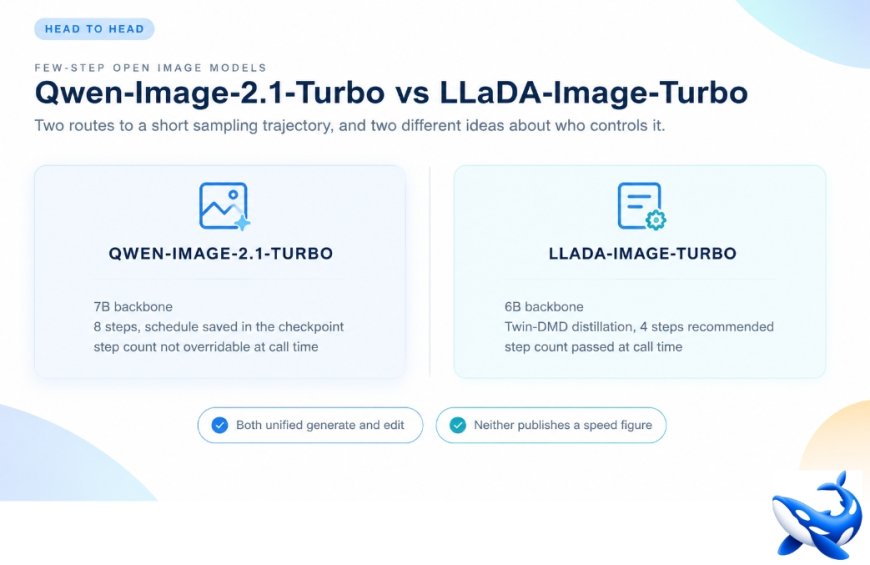
The underlying visual generator contains approximately seven billion parameters and uses a 32-layer, single-stream diffusion transformer architecture. Rather than introducing a completely new image-generation system, the Turbo release focuses on making the existing architecture more efficient during image creation and editing.
The original Qwen-Image-2.1 model was released on September 20, 2026. Its feature set includes high-resolution image generation, detailed text rendering, transparent image support, and advanced editing capabilities. Turbo brings an accelerated inference configuration to this foundation.
The official model card on Hugging Face identifies the Turbo checkpoint as an eight-step model and provides instructions for running it through the Diffusers library. This gives developers a direct route to experimenting with the model instead of relying exclusively on a hosted image-generation service.
How Eight-Step Image Generation Works
Diffusion-based image generators typically refine an image through a sequence of denoising operations. Starting from a noisy representation, the model progressively transforms that representation into an image that follows the user's prompt.
The number of denoising steps can affect generation speed and image quality. More steps generally mean more iterative computation, although the relationship between step count and final quality varies by model and sampling method.
Qwen-Image-2.1 uses a 40-step configuration in its documented standard workflow, while the Turbo checkpoint is configured to run in eight steps. That represents an 80% reduction in the number of denoising iterations.
The reduction is meaningful because denoising is a central part of the image-generation workload. Fewer steps can reduce inference latency and computational requirements, making the model more practical for interactive creative applications or systems that generate images repeatedly.
However, eight steps do not automatically translate into images being five times faster in every environment. Text encoding, image decoding, memory transfers, hardware utilization, and other operations also contribute to total generation time. The available official model documentation establishes the eight-step configuration, but a universal fivefold speed improvement should not be assumed without controlled benchmark results.

Key Features of Qwen-Image-2.1-Turbo
Text-to-Image Generation
The model can create images from natural-language prompts, allowing users to describe subjects, environments, lighting, composition, and visual styles.
This capability is useful for generating concept art, marketing visuals, illustrations, product scenes, posters, and other creative assets. More detailed prompts can communicate how different elements should appear and relate to one another.
As with other generative image systems, results depend on the clarity of the prompt and the complexity of the requested composition. Users may still need multiple attempts to obtain a suitable image.
Image Editing With Natural-Language Instructions
Qwen-Image-2.1-Turbo also supports image editing. Instead of generating a new image from scratch, users can provide an existing image and describe the changes they want.
The underlying Qwen-Image-2.1 capabilities include reference-based editing and localized modifications. Depending on the task, these features can help users change specific visual elements, adjust a scene, or create variations while preserving important details from the source image.
This combined generation-and-editing approach is particularly relevant to designers who need to revise existing assets rather than repeatedly recreate them.
Transparent Images and RGBA Output
One of the more practical capabilities inherited from Qwen-Image-2.1 is support for transparent image generation.
Transparent RGBA images contain an alpha channel that represents transparency. This allows a generated subject to be separated from its background without requiring every asset to have a solid white or colored backdrop.
The feature can be useful for stickers, product cutouts, game assets, design elements, and graphics intended for websites. It may also reduce some manual background-removal work, although the quality of edges and fine details will still need to be checked.
Reference Images and More Controlled Composition
The underlying Qwen-Image-2.1 model supports workflows involving multiple reference images, with documentation describing support for up to 10 references.
Reference-based generation can help users guide the appearance of a subject or the composition of a scene using existing visual material. It is especially useful when a creative project requires continuity across related images.
For example, a designer may want to preserve a product's visual identity while changing the background or creating alternative promotional scenes. The Turbo checkpoint is intended to bring the model's generation and editing capabilities into a faster inference workflow.
Typography and Detailed Visuals
Qwen-Image-2.1 also emphasizes improved typography, realistic textures, portrait lighting, and detailed visual composition.
Text rendering is particularly important for posters, infographics, advertisements, and interface mock-ups. Many image generators have historically struggled with long or precisely arranged text, making typography-focused improvements valuable for practical design work.
Nevertheless, generated text should be reviewed before publication. Exact wording, spelling, layout, and fine details may still require correction in a conventional design application.
Performance and Hardware Considerations
The Turbo checkpoint is designed to work with the Diffusers pipeline provided for Qwen-Image-2.1. Its official model card includes a loading example using bfloat16 precision and a CUDA device.
The official repository also documents the model's integration with the relevant image-generation pipeline. Developers should check the current software requirements before installation, as support for newer pipelines and sampling configurations can depend on the versions of Diffusers and Transformers being used.
Although the model has seven billion visual-generation parameters, that number alone does not determine the complete hardware requirements. The text encoder, image decoder, intermediate tensors, image resolution, precision, and memory-management strategy all influence how much GPU memory an inference session needs.
The model's official documentation does not establish a single minimum GPU memory requirement that will work for every configuration. Users should therefore test their intended resolution and workflow rather than assume the model will run comfortably on any graphics card.
The eight-step configuration may be particularly useful for applications where users generate several alternatives in succession. Even a modest reduction in latency can improve the experience of an interactive editor, provided that image quality remains appropriate for the intended use.
How Developers Can Access the Model
Qwen-Image-2.1-Turbo is available through its official Hugging Face repository. Developers can use the model with Python-based AI workflows and the Diffusers library.
The basic loading process involves installing compatible dependencies, importing the Diffusers pipeline, and loading the model checkpoint. The official model card provides the current example and should be treated as the reference for installation and inference instructions.
Developers interested in hosted inference can also investigate Alibaba Cloud Model Studio. The service provides a managed environment for supported Qwen image-generation models, which can reduce the need to maintain local GPU infrastructure.
Local inference and hosted inference serve different needs. Running the model locally offers more control over the environment and data flow, but requires suitable hardware and technical setup. A hosted service shifts much of the infrastructure burden to the provider, although usage limits, regional availability, and pricing must be considered.
The model's availability on Hugging Face should not be confused with unrestricted commercial licensing. Its published weights are distributed under the Qwen Research License Agreement, so anyone planning a commercial deployment should review the complete license and obtain any additional permission required.
Licensing: An Important Detail for Commercial Users
Open-weight AI models can be downloaded and run in supported environments, but their licenses do not necessarily grant unrestricted commercial rights.
Qwen-Image-2.1-Turbo's official model card identifies the Qwen Research License Agreement. Businesses, agencies, independent developers, and design studios should read the agreement carefully before incorporating the model into a paid service or commercial production pipeline.
This distinction matters for organizations planning to host the model themselves, build image-generation applications, or offer AI-generated design assets to customers. Technical accessibility and permission to use a model commercially are separate questions.
For users who only want to experiment with image generation or evaluate the technology, the published checkpoint provides an opportunity to test its capabilities. Commercial users should make licensing verification part of their deployment planning rather than treating the availability of downloadable weights as blanket permission.
What Qwen-Image-2.1-Turbo Means for AI Creators
The release reflects a broader direction in generative AI: improving the efficiency of existing models rather than focusing exclusively on increasing parameter counts.
For graphic designers, shorter inference workflows could make it easier to explore several visual directions, revise existing compositions, and produce draft assets. For developers, the reduced step count could help when integrating image generation into applications where response time matters.
Businesses creating product imagery, promotional graphics, or visual prototypes may also find a combined generation-and-editing model useful. A single workflow that supports both tasks can reduce the need to maintain separate tools for different stages of the creative process.
Still, speed is only one part of the equation. Final image quality, typography accuracy, consistency across generations, hardware costs, and licensing restrictions all influence whether the model is suitable for a particular project.
The most useful comparison will come from testing Turbo against the standard Qwen-Image-2.1 checkpoint on the same prompts, resolutions, and hardware. Such testing can reveal whether the faster configuration preserves the details and composition required for professional work.
Qwen-Image-2.1-Turbo: Availability and Outlook
As of October 10, 2026, the Turbo checkpoint is available through Hugging Face, with technical documentation and implementation resources published by the Qwen team. Developers can also consult Alibaba Cloud's Model Studio documentation for information about supported hosted services.
The release gives users a faster-inference alternative built on Qwen's existing 7B visual-generation architecture. Its eight-step workflow, combined image generation and editing, and transparent-image capabilities make it relevant to developers and creative professionals exploring locally runnable image models.
The main questions for prospective users are how much time the model saves on their particular hardware, whether the resulting images meet their quality requirements, and whether the license fits their intended use.
Qwen-Image-2.1-Turbo is therefore best understood as an efficiency-focused addition to the Qwen image-generation family. Its reduced denoising step count is a concrete technical change, while its real-world advantages will depend on workload-specific testing.
Sources
- Hugging Face — Official Qwen-Image-2.1-Turbo model card: Qwen-Image-2.1-Turbo Model Card
- QwenLM — Official Qwen-Image-2.1 GitHub repository: Qwen-Image-2.1 Repository
- Alibaba Cloud Model Studio — Qwen-Image-2.1-Turbo documentation: Qwen-Image-2.1-Turbo Documentation
- MarkTechPost — Coverage of the Turbo model's eight-step release: MarkTechPost Report
What's Your Reaction?
 Like
0
Like
0
 Dislike
0
Dislike
0
 Love
0
Love
0
 Funny
0
Funny
0
 Angry
0
Angry
0
 Sad
0
Sad
0
 Wow
0
Wow
0