
















Nubia NaviX Ultra Arrives With AI That Can Actually Do Things for You
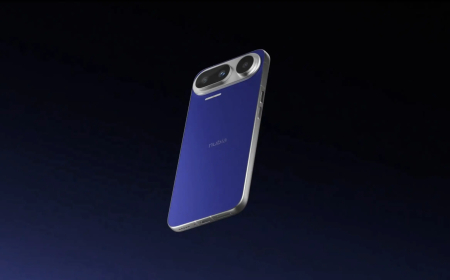
Nubia has officially launched the NaviX Ultra in China, introducing a flagship smartphone built around agentic AI rather than simply adding another chatbot to the phone. Powered by Qualcomm’s Snapdragon 8 Elite Gen 5 and ByteDance’s Doubao Mobile Assistant, the device can understand complex instructions, plan multi-step tasks and interact with different apps on the user's behalf.

This Isn't Just Another Phone With an AI Button
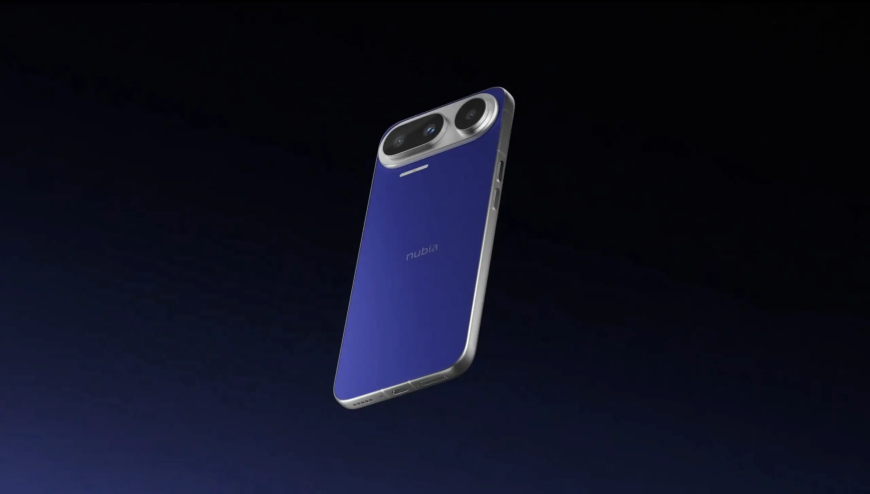
Nubia has officially launched the NaviX Ultra, and the company is positioning it as something more ambitious than a conventional flagship smartphone with a few AI features added on top. The device is built around the idea of an AI agent that can actually perform tasks, rather than simply answering questions. Nubia says its new phone can understand natural-language instructions, break complicated requests into steps, interact with multiple applications and continue working through longer tasks with limited input from the user. The phone is now available in China, with the 12GB RAM and 512GB storage model starting at CNY 5,999, or CNY 5,499 after the applicable government subsidy.
That makes the NaviX Ultra part of a much bigger change happening in smartphones. For years, smartphone AI mostly meant asking an assistant a question, removing something from a photo or generating a short piece of text. Agentic AI takes the idea further: instead of simply telling you what to do, the AI is designed to do part of the work itself. On the NaviX Ultra, Nubia says users can give instructions such as sending messages, arranging meetings, summarizing group conversations, checking tasks and forwarding documents. The assistant can also work across services such as maps, music and travel applications.
The Phone Can Plan Before It Acts
The most interesting part of the NaviX Ultra is the way Nubia describes its AI system. The phone uses the consumer version of ByteDance's Doubao Mobile Assistant, integrated at the system level. Rather than treating every request as an isolated command, the assistant is designed to understand context, divide complicated instructions into smaller actions and execute them across applications. Nubia says the system can handle long chains of operations involving potentially hundreds of steps, while allowing the user to interrupt and provide another instruction along the way.
There's also a memory component. With user permission, the phone can remember information that the user deliberately asks it to save and later retrieve that information using natural-language searches. Nubia describes the system around four ideas: understanding, execution, memory and security. That is an important distinction from simply putting a chatbot into a phone, because the company's goal is for the AI to become a layer that sits between the user and the apps they normally operate manually.
Snapdragon 8 Elite Gen 5 Does the Heavy Lifting
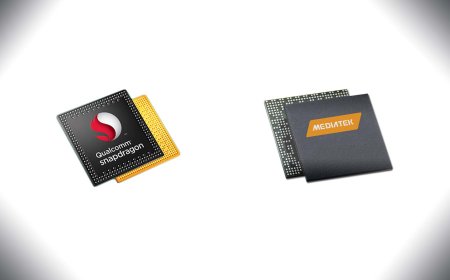
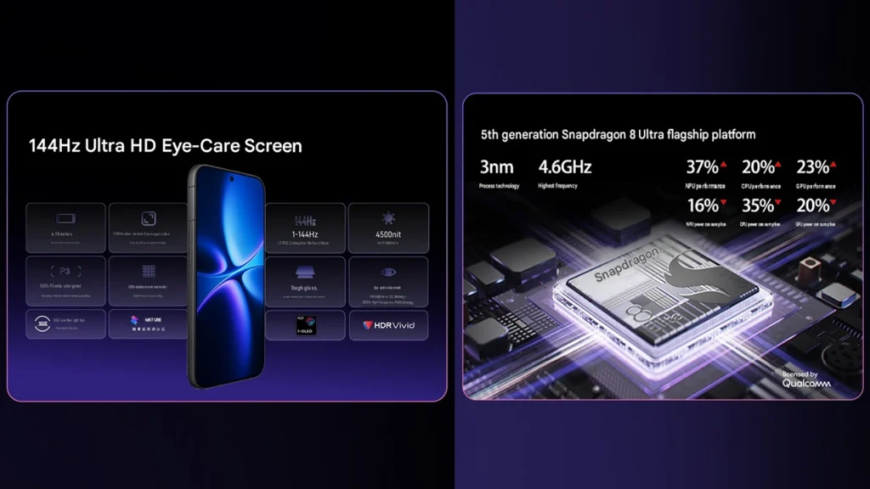
Behind all of this is Qualcomm's Snapdragon 8 Elite Gen 5, one of the latest flagship mobile platforms. The chipset is designed with on-device AI processing in mind, including a newer Hexagon NPU and Qualcomm's third-generation Oryon CPU. Qualcomm says the platform delivers improvements in CPU, GPU and NPU performance compared with the previous Snapdragon 8 Elite, while also being designed for personalized agentic AI experiences.
Nubia pairs the processor with LPDDR5X memory reaching speeds of up to 10,667Mbps, with configurations going as high as 16GB RAM and 1TB storage. That combination is particularly relevant for a phone that is expected to keep several applications and AI processes active at the same time. Instead of treating AI as something that always happens in the cloud, the industry is increasingly trying to push more intelligence closer to the device itself.
A 7,100mAh Battery for an AI-Heavy Phone
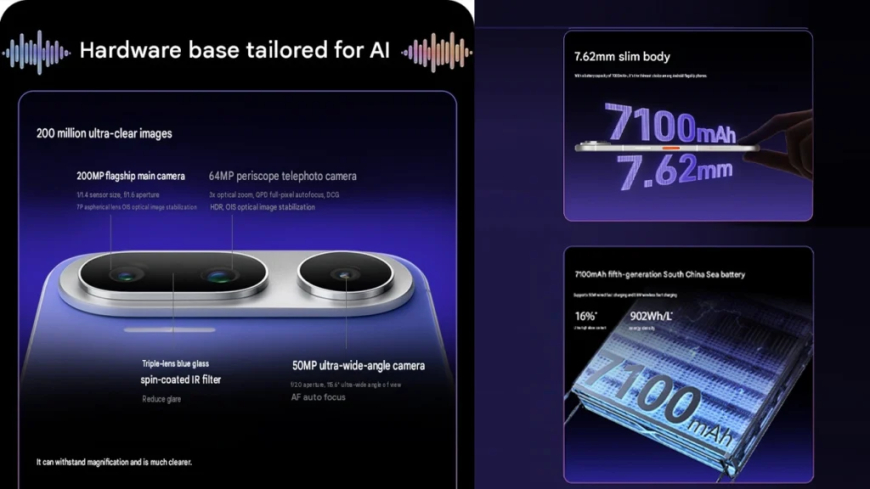
All that intelligence needs power, and Nubia has given the NaviX Ultra a remarkably large 7,100mAh battery. The phone supports 90W wired charging and 50W wireless charging, while the silicon-carbon battery technology is designed to provide high capacity without turning the device into an enormous brick. Nubia lists the phone at around 7.62mm thick, making the combination of a large battery and relatively slim body one of the more notable hardware decisions.
The battery matters beyond normal screen-on time. If Nubia really wants users to treat the phone as an always-available AI assistant, battery life becomes part of the experience itself. An AI agent that can continuously listen, process requests, communicate with apps and maintain context isn't particularly useful if users constantly have to worry about charging the device.
The Display and Cameras Are Flagship-Level Too
The NaviX Ultra doesn't appear to be sacrificing traditional flagship hardware to make room for AI. It comes with a 6.78-inch LTPO OLED display supporting an adaptive refresh rate from 1Hz to 144Hz, with up to 4,500 nits of peak brightness. The rear camera system includes a 200MP main camera with optical image stabilization, a 64MP periscope telephoto camera with 3x zoom and a 50MP ultrawide camera, while the front camera is 32MP according to launch specifications.
The phone also supports Wi-Fi 7, Bluetooth 6.0, NFC and 5G, while running Android 16 with Nubia's Nebula AIOS 2. Storage options range from 512GB to 1TB, meaning this is very much positioned as a high-end flagship rather than an experimental AI device with mid-range hardware.
The Real Story Is the Smartphone Becoming an Agent
The NaviX Ultra may ultimately be remembered less for its 200MP camera or huge battery and more for what it represents. Smartphone companies are beginning to move away from the idea that AI should simply answer questions. The next step is an AI system that understands what the user wants and then navigates the phone to accomplish it.
Imagine telling your phone to find a suitable meeting time, check your calendar, send the invitation, notify the people involved and prepare the necessary document. Today, that can mean jumping between several applications and performing a long sequence of taps. An agentic phone is supposed to turn much of that into a conversation. Nubia says the NaviX Ultra can already perform this kind of cross-app workflow, although real-world reliability will ultimately matter more than the demonstrations.
And that is where the bigger smartphone battle could be heading. The competition may no longer be just about who has the fastest processor, brightest display or most megapixels. The more interesting question could become how much of the phone can the AI operate for you — and how safely can it do it?
Price and Availability
The Nubia NaviX Ultra is currently officially available in China. The 12GB + 512GB version is priced at CNY 5,999, while the 16GB + 512GB model costs CNY 6,499 and the top 16GB + 1TB version costs CNY 7,499. With the applicable Chinese government subsidy, the starting price is CNY 5,499. Nubia has not indicated in the launch information whether the NaviX Ultra will receive the same configuration and AI experience in other international markets.
For now, the NaviX Ultra is an interesting glimpse at where smartphones could be heading next. The hardware is certainly powerful, but the bigger experiment is happening in the software: what happens when your phone stops waiting for you to open an app and starts trying to complete the task for you? If Nubia and its AI partners can make that experience reliable, useful and safe, the NaviX Ultra could be an early sign that the next generation of smartphones will be defined less by screens and cameras — and more by what their AI can actually get done.
What's Your Reaction?
 Like
0
Like
0
 Dislike
0
Dislike
0
 Love
0
Love
0
 Funny
0
Funny
0
 Angry
0
Angry
0
 Sad
0
Sad
0
 Wow
0
Wow
0