






















































Microsoft Ignite 2026: MAI Code 2 Brings Cheaper In-House Coding Models to GitHub Copilot
Microsoft opened Ignite 2026 with its own MAI Code 2 and Code 2 Flash coding models, now generally available in GitHub Copilot and Copilot Fusion, alongside Copilot Autopilot, a new security model and licensed access to its model weights.
Microsoft Ignite 2026: MAI Code 2 Brings Cheaper In-House Coding Models to GitHub Copilot
Microsoft opened its Ignite 2026 conference in San Francisco on Tuesday, November 17, with a keynote built around a single pitch: smaller, cheaper, specialised models that do everyday work at a fraction of the cost of the frontier systems they sit beside. Chief executive Satya Nadella called it a "frontier ecosystem" — Copilot as the new operating system for work, backed by Microsoft's own family of MAI models, its agent-governance platform and new silicon underneath it all.
The headline for developers was MAI Code 2. Microsoft's new flagship family of agentic coding models is generally available from launch day in GitHub Copilot, both in the model picker and inside Copilot Fusion, and in Microsoft Foundry. It is the first time Microsoft's own coding models have shipped inside Copilot, a product that has so far relied on models from OpenAI and Anthropic.
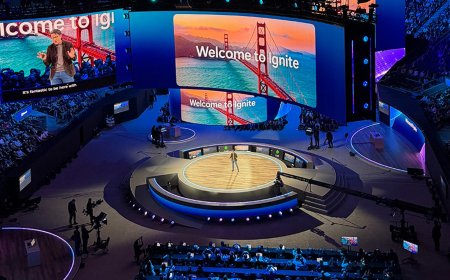
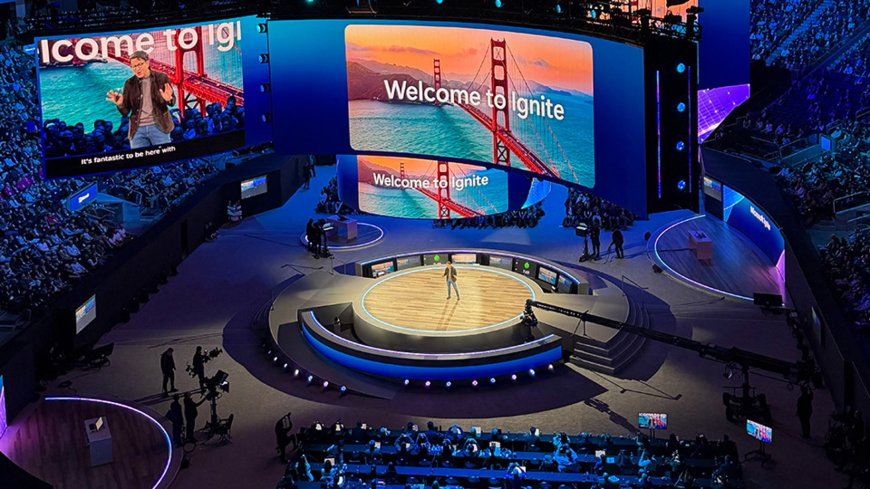
The photo above shows a Microsoft Ignite keynote at Chase Center in San Francisco, where this year's event is being held.
What MAI Code 2 and Code 2 Flash actually do
Code 2 is aimed at the heavy end of everyday coding. Microsoft positions it for taking code to production, deep debugging, implementation across multiple files, reasoning across an entire repository and building user interfaces. Code 2 Flash is the lighter sibling, built for fast, high-volume work such as explaining code, making targeted edits, fixing routine errors and iterating quickly. Microsoft lists a total context length of 1.05 million tokens for the family, including 922,000 tokens of input and 128,000 of output.
Both models are available to eligible Copilot Pro, Pro+, Max, Business and Enterprise subscribers, while Code 2 Flash is also available on Copilot Free and Student plans. They appear in the model picker across VS Code, Visual Studio, JetBrains, Xcode, Eclipse, the Copilot command-line tool, github.com and GitHub Mobile.
The performance numbers Microsoft attached to the launch are striking — and they are Microsoft's own. The company says Code 2 delivers 96 percent of the coding quality of Claude Opus 5.5 at 5 percent of the price, and 98 percent of the performance of OpenAI's GPT-6.1 Sol across four coding benchmarks at about 40 percent of the cost. Two caveats matter: the comparisons come from Microsoft's evaluations on specific coding tasks, and the cost figures are calculated using a 50 percent promotional price, with no end date given for the promotion. Microsoft also acknowledges the models are not yet optimised for particularly complex scientific research or very long-running agentic tasks. Teams should test them on their own workloads before switching defaults.
Copilot Fusion picks the model so developers do not have to
The other half of the coding story is Copilot Fusion, the system that selects and coordinates models for a task. Fusion became generally available on October 28 at GitHub Universe, and Ignite extends it to Visual Studio, github.com and GitHub Mobile betas, with Standard, High and Max effort tiers. It can send work to one model, have a model check a draft before escalating to a stronger one, or get several models to critique a response before it is revised.
According to GitHub's changelog, Fusion Max scored 71.2 percent on Terminal-Bench 4.1, beating Claude Opus 5.5 and Fable 5.2 by 5.4 percentage points while running at 57 percent lower cost than Opus 5.5 and 88 percent lower than Fable 5.2. On the Artificial Analysis Coding Agent Index, Fusion Max landed within two points of Claude Code running Opus 5.5 Max, at roughly half the average API cost per task and about 40 percent less time. The message is consistent: Microsoft is selling cost-performance, not raw capability, and it is betting that routing between models — including its own — is where the savings are.
Autopilot, Copilot Code and a Copilot that organises itself by role
Beyond coding, Nadella presented Copilot as one connected system built around Chat, Cowork, Code and Autopilot, with the full Office suite — Word, Excel and PowerPoint — now built into Copilot. Copilot Home, where Chat and Cowork come together, is generally available, as is Office in Copilot.
Autopilot is the most ambitious piece. It is a persistent, proactive agent with its own identity, memory and tool access inside a customer's tenant, designed to keep work moving around the clock — following up on email, managing multi-step projects and acting in the places where a team collaborates. Colleagues can mention a person's Autopilot in Teams, and its actions are tied to its own agent ID so administrators can see what it did. It is rolling out through Microsoft's Frontier program rather than as a general release.
Copilot Code, which turns plain-language descriptions into working dashboards, trackers and apps, is in the Frontier program on Windows, web, iOS and Android, with general availability planned for December. Copilot Workspaces gives a team, its work and Copilot one shared space, described by Microsoft as the evolution of Copilot Notebooks, also through the Frontier program. Microsoft is also organising Copilot by job role, with skills, connectors and plugins for sales, legal, finance and service teams, and it announced new business-application plugins starting with Dynamics 365, plus a Salesforce plugin in preview with more than 38 prebuilt sales skills.
A security model, licensed weights and new silicon
Microsoft applied the same in-house approach to security. MAI Cyber 2 Flash is its most capable security model yet, which Microsoft says performs ahead of frontier models at a fraction of the cost per task — in its own security evaluation, matching the quality of GPT-6 Astra at under 2 percent of the cost per task. But the keynote's tone ran ahead of the product's status: Cyber 2 Flash is available in preview only, inside a system codenamed MDASH, and Microsoft is integrating it with Perception, its agentic security system of red, blue and green agent teams, which is now generally available.
The wider model news included Microsoft-Decision-1.1, now generally available for enterprise deployment, which Microsoft says more than 4,000 customers have already used. MAI Licensed Weights will give trusted customers access to Microsoft AI model weights through its Frontier Co. Foundry is also adding OpenAI's GPT 6.2 and Meta's latest models, so Microsoft's own models will sit alongside the frontier systems they are priced against. Agent 365, the control plane that extends governance, identity and security to agents, now covers more than 50 million agents, and Microsoft announced Agent 365 Business Analytics to track what AI spending actually returns.
Underneath it all, Microsoft announced Maia 300, its own AI chip, which the company says will deliver 40 percent more tokens per watt than leading GPU-based systems, and general availability of its next-generation Cobalt 200 virtual machines on Azure. It also launched the Microsoft AI Transparency Initiative, working with 40 organisations and with NIST's Agent Standards Initiative on open standards for AI transparency, security and governance.
Why it matters
Ignite 2026 is Microsoft's clearest statement yet that it no longer wants to rent all of its intelligence. By putting its own coding models into Copilot and pricing them aggressively against Claude and GPT, it is testing whether developers will trade a little frontier capability for a much smaller bill — and whether a router like Fusion can hide that trade-off entirely. The rival model makers are not standing still: Google launched its own Gemini 4 family days earlier, and OpenAI's GPT-6.2 is landing on Foundry at the same time. But the direction of travel is now unmistakable, and the numbers Microsoft quoted will be tested in public within weeks, on real codebases, by the developers it is trying to win over.
Ignite 2026 runs through Friday, November 20.
Sources
- Official Microsoft Blog — "Ignite 2026: Building the frontier ecosystem" (November 17, 2026)
- Digital Trends — "Microsoft's new AI coder is gunning for Claude and ChatGPT. It's coming with a price advantage" (November 19, 2026)
- The Neuron — "Microsoft Ignite 2026: Copilot Autopilot, Today and Fusion" (November 17, 2026)
- Windows Forum — "Microsoft Ignite 2026 Keynote: Copilot Agents, AI Security and Azure Launches Explained" (November 18, 2026)
- EPC Group — "Microsoft Ignite 2026 Day 1 Announcements" (November 18, 2026)
- GitHub Changelog — MAI Code 2 and MAI Code 2 Flash in GitHub Copilot (November 17, 2026), as reported in coverage
Read also: Google launches Gemini 4 Hydrogen, a faster AI model for coding and agentic workflows
What's Your Reaction?
 Like
0
 Dislike
0
 Love
0
 Funny
0
 Angry
0
 Sad
0
 Wow
0