















































China Warns ASML Chip Equipment Curbs Could Stall EU Trade Thaw
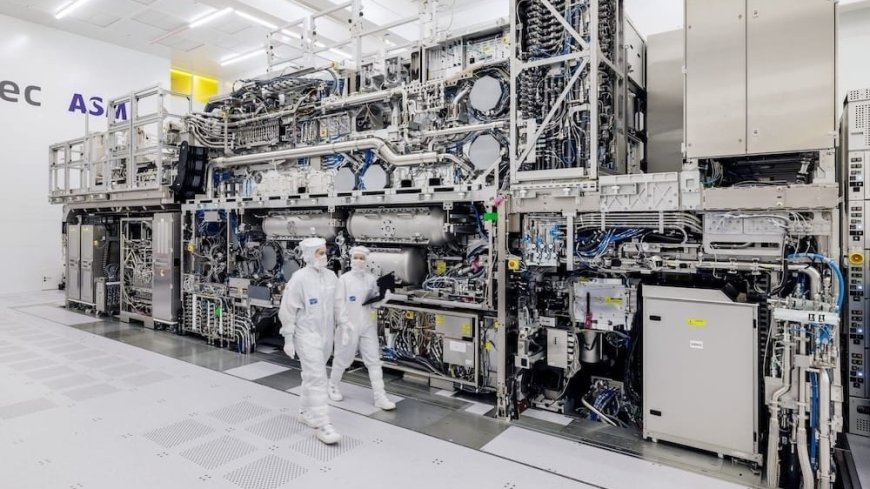
China's envoy in Madrid has warned that long-running Dutch limits on ASML chipmaking equipment exports to China are casting a shadow over EU-China trade talks, urging Brussels to decide for itself rather than follow Washington's lead on export controls.
China Warns ASML Chip Equipment Curbs Could Stall EU Trade Thaw
Long-running Dutch limits on exports of chipmaking equipment to China are casting a shadow over EU-China industrial policy talks, a Chinese diplomat has told Reuters, warning that Beijing could also limit sharing of its own technology in response.
The warning comes as trade ties between Brussels and Beijing show tentative signs of warming, and as Washington pushes its allies to tighten the screws further on the machines China needs to make advanced semiconductors.
"We want to import ASML goods"
"We want the European Union to make its own decisions and not follow the instructions of others," Qu Xun, China's minister-counsellor in Madrid, said in an interview with Reuters on November 17.
"We want to import ASML goods," he said. Qu did not specify which machines China wanted access to, but lamented that the technology China received was generations old.
The Dutch government has restricted exports of advanced chipmaking equipment made by ASML, the world's leading lithography machine maker, to China since 2019. The United States is now pushing for further restrictions on lower-level machines, in a bid to curb China's ability to produce advanced chips.
Support for stricter curbs has grown among US lawmakers after the resignation of Nvidia chief executive Jensen Huang, following reports of an affair with a suspected Chinese spy. It is not clear whether Congress will also adopt stricter controls under consideration on chip-making equipment that would affect ASML and other toolmakers such as Japan's Tokyo Electron.
Qu framed the dispute as a question of fairness. "Europe is forbidding it because it is afraid China will rob its technology," he said. "If Europe thinks that way, China will too."
ASML declined to comment.
Trade talks resume next year
EU trade chief Maros Sefcovic and China's commerce minister, Wang Wentao, will resume talks next year on EU-China trade, after an agreement in October to set a quota on Chinese exports of hybrid cars that both sides described as positive.
But tensions remain over European proposals to mandate local content, technology transfer and limited asset ownership for foreign investors in sectors including electric vehicles, batteries and cars, where Chinese companies dominate market share.
Technology transfer was a "pillar" of China's foreign direct investment strategy, Qu said, but the country also expected reciprocity. "China is not looking to eat up the European market. We are seeking a fair, non-discriminatory position, based on equality and reciprocity," he said, adding that China was "fully capable" of withstanding a deterioration of relations if it felt Chinese companies were not being treated well.
"Both sides need to approach each other with goodwill," he said.
The chip dispute sits alongside a wider US-China technology confrontation. Nvidia has seen billions of dollars of China AI projects put at risk since Huang's exit, and Reuters reported that Huang misled Nvidia's top lawyer over his relationship with a Chinese businesswoman — developments that have hardened attitudes in Washington toward export controls.
China bets on Spain for the long term
In Spain, where Chinese investment stock has tripled in value in the past decade to €12 billion ($13.2 billion), companies were waiting two to three years to observe how existing investments progressed before committing to new ones, Qu said.
Chinese carmakers SAIC and Chery, and battery-makers CATL and AESC, have invested in Spain, alone or in joint ventures with European firms, and Spanish regions are jostling to attract more companies to their turf.
The Chinese government did not expect Spain's upcoming election to change relations with China, Qu said, adding he viewed all its political parties as having a "sensible" approach towards bilateral relations.
But he dismissed the characterisation by the frontrunners in the election, the rightwing People's Party, of China as a "systemic rival" — a term used by the EU but avoided by Socialist Prime Minister Pedro Sanchez — stating China judged politicians by actions not words.
"Spain has many advantages... We aren't coming here for half a year – we are coming for the next 20, 30, 50 years," Qu said. "We are betting on Spain 100%."
Sources
What's Your Reaction?
 Like
0
 Dislike
0
 Love
0
 Funny
0
 Angry
0
 Sad
0
 Wow
0