



































































Genesis AI Raises $500 Million to Scale Its Eno Robot After a $3.5 Billion Valuation
Genesis AI has raised a $500 million Series A at a $3.5 billion post-money valuation to scale production of its general-purpose Eno robot. The Paris-based startup trains its robots using sensor gloves worn by more than 100 real workers, and says the funding will expand data collection, AI training and manufacturing — though its dexterous robot hands currently last only a few weeks of regular work.
Genesis AI Raises $500 Million to Scale Its Eno Robot After a $3.5 Billion Valuation
Genesis AI has raised $500 million in Series A funding at a $3.5 billion post-money valuation, one of the largest funding rounds Europe's robotics sector has seen, as investors bet that the startup's unusual approach to teaching robots to handle objects can finally make general-purpose machines useful on factory floors and in warehouses.
The Paris-based company announced the round on Tuesday, November 17, 2026. Premji Invest, Khosla Ventures and Eclipse co-led the financing, which brings Genesis AI's total disclosed funding to $605 million since it was founded in 2024. The company previously raised $105 million in a seed round announced in July 2025.
Other participants in the new round include Nvidia, AMD Ventures, Samsung Next and Ericsson, along with former Google chief executive Eric Schmidt, French tech entrepreneur Xavier Niel, Bpifrance, T. Rowe Price, Durable Capital Partners and HSG, according to Crunchbase News and Reuters.
What the money is for
Genesis AI plans to use the capital to increase production of Eno, its flagship general-purpose robot, expand its data collection and AI training, and hire more employees, chief executive Zhou Xian told Crunchbase News. The company also plans to grow its computing infrastructure as it prepares for a wider customer rollout in 2027.
That rollout is the real test. Genesis says it has built between 30 and 40 Eno robots so far and is piloting the machine with a small number of undisclosed customers. A US contract manufacturer has been chosen to begin mass-production work next year, and the company says the design of the mass-produced version has been finalised. The first customer deployments are targeted for the end of 2026.
Gloves, not teleoperators
What sets Genesis apart from humanoid rivals such as Figure and Agility is how it gathers training data. Instead of relying on people remotely operating robots, the company puts sensor-enabled gloves and headset cameras on more than 100 real workers around the world as they do ordinary tasks. The recorded hand movements, including force data, feed into the company's GENE foundation model.
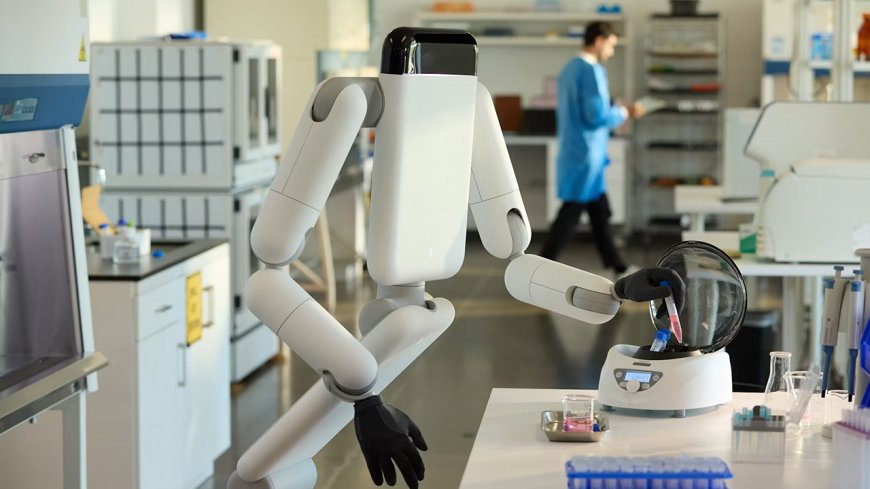
The robots wear the same sensor-equipped gloves, and their hands are designed to mimic the proportions of human hands. That fidelity, Xian says, is what enables Eno to sort objects and manipulate wires — the kind of dexterous work that has long been the hardest part of building a useful general-purpose robot.
The company has also invested heavily in simulation. One of its advisers, Minchen Li, co-authored an influential physics algorithm Genesis uses to create millions of high-fidelity simulated models of the robot's experience, which supplements the real-world glove data.
A wheeled robot built for human workplaces
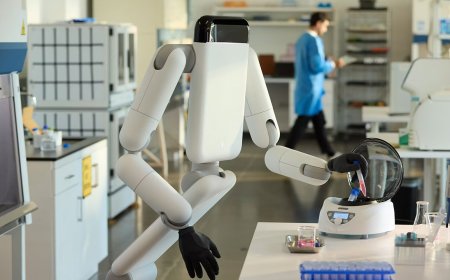
Eno itself looks different from the two-legged humanoids that dominate the field. It moves on a wheeled base, has an adjustable body with three segments, two articulated arms and dexterous hands, and is designed to work with equipment built for people. TechCrunch described the machine as more of an "iMac on wheels" than a Terminator-style metal skeleton, reflecting the friendly feeling the company wants to deliver to customers.
Genesis is initially targeting manufacturing, logistics and laboratories with Eno, followed by hotels and hospitals, with home and outdoor applications further down the road. In June 2026 the company also announced a partnership with LG CNS to evaluate and validate the robots for manufacturing and logistics at LG operations in the United States and within LG CNS's industrial customer base.
The hard part: making hands that last
For all the momentum, Genesis is candid about the gap between a lab demonstration and reliable automation — and so is the reporting around it. When TechCrunch visited the company's Silicon Valley facility, the demonstration used a pair of off-the-shelf robotic arms rather than Eno itself, which was not ready to show its abilities. The arms picked up small cardboard boxes, scanned them, packed them into a larger box, folded it shut, taped it and applied a label — and on a second run the robot fumbled a box and struggled to peel the label off the tape.
The bigger bottleneck, Xian says, is hardware. The company's dexterous hands can currently operate for only a few weeks of regular industrial work before mechanical wear means they need to be replaced. Until that durability problem is solved, replacement parts and downtime will be a real cost for any buyer.
Xian is nevertheless confident about the software side. He estimates that model architecture contributes only around 10 percent of the final result, with the training infrastructure, data infrastructure and data quality mattering far more. "I don't think we expect or we need another fundamental scientific leap," he told TechCrunch. "No, we have all the recipes. It's just about execution."
Why this round matters
The size of the round — and the $3.5 billion valuation for a company founded in 2024 with no disclosed revenue — shows how much capital is now chasing physical AI, the idea that the next leap for artificial intelligence is not a smarter chatbot but a machine that can do physical work. Investors are betting that dexterity, not just intelligence, is the unlock.
Whether that bet pays off will be decided not in funding announcements but in factories and warehouses: whether Eno's hands can survive a working shift, whether the glove-trained model can handle the messiness of real workflows, and whether customers who pilot the robot in 2026 come back to buy more in 2027. Genesis now has the money to find out. The hard part is making the hardware keep up with the ambition.
Sources
- TechCrunch — "Genesis AI raises $500M to deploy glove-wearing robots" (November 17, 2026)
- Crunchbase News — "Genesis AI Raises $500M At $3.5B Valuation To Bring Its Robots To Factories And Warehouses" (November 17, 2026)
- Reuters — "French robot maker Genesis raises $500 million at $3.5 billion valuation" (November 17, 2026)
- SiliconANGLE — "General-purpose robot maker Genesis AI reels in $500M at $3.5B valuation" (November 17, 2026)
- Unite.AI — "Genesis AI Raises $500M Series A to Accelerate Robot Deployment" (November 17, 2026)
What's Your Reaction?
 Like
0
 Dislike
0
 Love
0
 Funny
0
 Angry
0
 Sad
0
 Wow
0