








































































Apple Opens 200,000-Person Health AI Study With OpenEvidence to Learn How People Trust AI Health Answers
Apple has launched the Apple Health AI Usage Study in the United States, a virtual research project run with clinical AI company OpenEvidence that will enrol up to 200,000 iPhone users. The study will examine how people understand, evaluate and trust AI-generated answers to everyday health questions, and whether those answers help them prepare for visits to their doctors.
Apple Opens 200,000-Person Health AI Study With OpenEvidence to Learn How People Trust AI Health Answers
Apple has launched a large research study to find out how people actually use and judge artificial intelligence when it comes to their health. Announced on Sunday, November 15, the Apple Health AI Usage Study is a virtual, United States-only project run through a dedicated iPhone app, and it is open to up to 200,000 participants.
The study is being conducted in collaboration with OpenEvidence, a clinical AI platform widely used by healthcare professionals. Rather than rushing a health chatbot into the Health app or Siri, Apple says it wants to study the experience first: what makes people trust an AI answer, whether they understand it, and whether it changes what they do about their health.
What the study app does
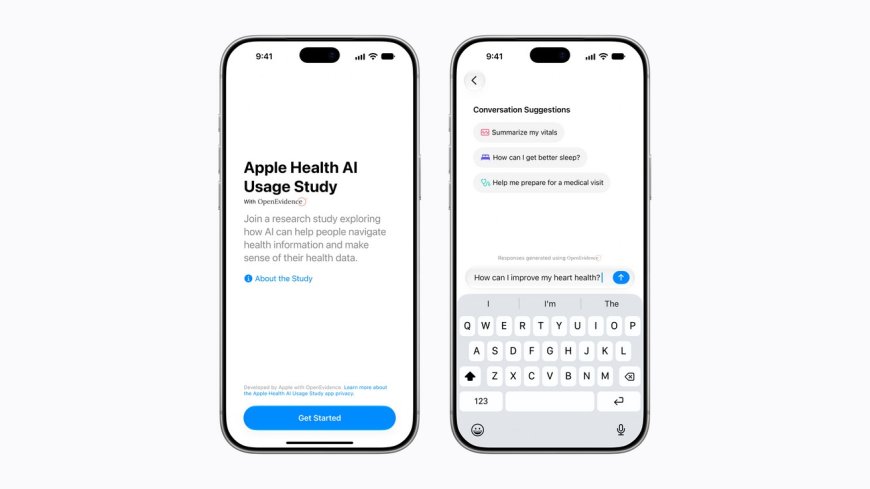
Participants use a dedicated Apple Health AI Study App, separate from the Health app, to ask everyday health questions and get plain-language answers with links to peer-reviewed clinical sources. The answers are generated by OpenEvidence technology, drawing on medical information from established publications such as The New England Journal of Medicine, the Journal of the American Medical Association and Nature.
The app also lets participants explore complex medical information in approachable language, and it will test whether health AI can help people better prepare for clinical visits with their own doctors. Participants can choose to share HealthKit data, such as resting heart rate, activity, sleep or lab results, to explore how personal data affects the relevance of the answers. Sharing is optional, and participants control what they share.
Apple is clear about the limits. The study app is not meant to diagnose or treat any condition, and it is not a replacement for advice from medical professionals. The app includes safety guardrails designed to detect certain concerning questions and suggest that the participant follow up with a provider or other resources.
Who can take part
The study is open to up to 200,000 eligible participants aged 21 and older across the United States. To join, participants need an Apple Intelligence-enabled iPhone, an iPhone 15 Pro or later, running iOS 26 or later. They can enrol through the study app, which is available on the App Store in the US. Participants may remain in the study for up to 12 months.
Apple has not said when results from the study will be published, or whether the work will lead to AI health features in the Health app or Siri. For now, the study is a research project, not a product launch.
Privacy is built into the design
Apple says the study was designed from the ground up with privacy protections, transparency and clinical guardrails. Study data will not be used to train AI models, and participants retain control over whether to share any HealthKit metrics or survey responses. Apple says it has implemented security measures to protect the study data it maintains and the confidentiality of participants.
TechCrunch reports that OpenEvidence deletes participants' questions and answers within 24 hours, a further limit on how long personal health queries are retained.
Why Apple is studying before building
Health chatbots powered by large language models can sometimes give incomplete or unclear answers, and Apple argues that research is critical to presenting health information with greater clarity. The study aims to inform the responsible design of health AI experiences for Apple and the wider industry.
"At Apple, we believe responsible innovation starts with scientific rigor and clinical grounding. Health is deeply personal, and conducting a dedicated research study is the most thoughtful way to understand how people engage with, comprehend, and evaluate health AI in everyday life," said Sumbul Desai, M.D., Apple's vice president of Health and Fitness. "Insights from this study will help advance the broader scientific conversation and ensure that as technology evolves, we continue building trusted tools that genuinely support people wherever they are on their health journey."
Robert M. Wachter, M.D., professor and chair of the Department of Medicine at the University of California, San Francisco, welcomed the approach. "Patients and clinicians are both turning to AI, but the tools they use are being built and tested in separate worlds," he said. "When patients and doctors draw on versions of the same trustworthy tools, patients arrive prepared, conversations improve, and next steps happen seamlessly."
The study also fits into Apple's broader health push. The company recently redesigned the Health app in a developer beta, as reported in our coverage of the first iOS 27.3 developer beta, and it has been adding AI features to the Apple Watch, covered in our report on the Apple Watch Series 12 and Ultra 4. The new study suggests Apple is taking a deliberately careful route into AI health advice, testing trust and comprehension at scale before deciding what, if anything, ships to hundreds of millions of iPhone owners.
Sources
What's Your Reaction?
 Like
0
 Dislike
0
 Love
0
 Funny
0
 Angry
0
 Sad
0
 Wow
0