

































































Voyager 1 Is About to Cross One Light-Day From Earth — a First in Human History
NASA's Voyager 1 spacecraft will become the first human-made object ever to travel one light-day from Earth on Wednesday, November 18, 2026 — about 25.9 billion kilometres away, so far that a radio signal from Earth will take a full 24 hours to reach it.
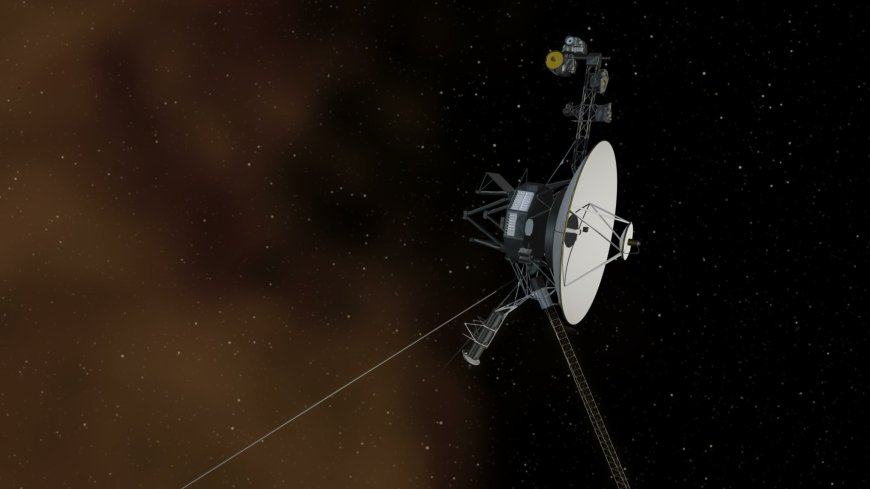
Voyager 1 Is About to Cross One Light-Day From Earth — a First in Human History
Nearly half a century after it left Cape Canaveral, NASA's Voyager 1 spacecraft is about to put another first next to its name. On Wednesday, November 18, 2026, the probe will become the first human-made object ever to travel one light-day from Earth — a distance so great that light itself, the fastest thing in the universe, needs a full 24 hours to cover it.
According to NASA, Voyager 1 will cross the mark at 5:16 a.m. Eastern Time (10:16 a.m. UTC, 4:16 p.m. in Dhaka). At that moment it will be roughly 25.9 billion kilometres — about 16.1 billion miles, or 173 astronomical units — from our planet. No spacecraft has ever been that far from home.
What one light-day actually means
A light-day is not a measure of time. It is a measure of distance: how far light travels in 24 hours. Light moves at 299,792 kilometres per second, so a single light-day works out to about 25.9 billion kilometres. Voyager 1 will have needed 49 years, two months and 11 days of continuous flight to cover it, travelling at roughly 61,000 kilometres per hour.
The practical consequence is just as striking. Once Voyager 1 passes the mark, any command sent from Earth will take a full day to reach the spacecraft, and confirmation that it arrived will take another full day to come back. A simple two-way exchange with the probe will take 48 hours. NASA's Deep Space Network, the giant antennas that still talk to the Voyagers, will keep listening into the 2030s.
For scale, a light-year — the distance light covers in a year — is about 9.5 trillion kilometres, and the nearest stars beyond our solar system, the Alpha Centauri system, sit about 4.24 light-years away. Voyager 1 has covered one light-day. The road ahead is, quite literally, astronomical.
The exact moment, and how NASA is marking it
NASA has named the crossing to the second: 5:16:07 a.m. Eastern Time on November 18. The agency is inviting people around the world to mark the occasion the night before, on Tuesday, November 17, in an event it calls "Shine Bright for Voyager's Light-Day." Participants are asked to shine a light into the sky after sunset — a flashlight, a glow stick or a smartphone — and flash out "V-G-R," Voyager's call sign, in Morse code. NASA has also built an automated signal player on its Voyager Light-Day website that flashes the code for you.
The gesture is symbolic rather than practical. Only an unimaginably tiny fraction of the photons from a flashlight on Earth could ever reach a spacecraft 25.9 billion kilometres away. NASA is clear about that — the point is a worldwide wave of light for a machine that has carried humanity's reach further than anything else we have ever built.
The Jet Propulsion Laboratory, which manages the mission, will host a public discussion about the milestone on Thursday, November 19, at noon Eastern Time in its von Karman Auditorium — the same hall that hosted Voyager briefings during the planetary flybys of the late 1970s.
A 49-year journey that was only supposed to last five
Voyager 1 launched on September 5, 1977, from Cape Canaveral in Florida, carried into space by a Titan IIIE-Centaur rocket. It left Earth 16 days after its twin, Voyager 2, but overtook it within months. The original mission was a five-year tour of Jupiter and Saturn. It delivered, and then some: Voyager 1 returned a wealth of information about both giant planets and their moons, discovering a thin ring around Jupiter, two previously unknown Jovian moons — Thebe and Metis — and five new moons around Saturn, along with a ring called the G-ring.
After the planetary encounters, the spacecraft kept going. In 2012 it crossed the outer edge of the heliosphere, the protective bubble of particles and magnetic fields blown out by the Sun, and entered interstellar space — the region between the stars. It was the first spacecraft to report the energy spectra of galactic cosmic rays at low energies, particles that cannot be observed inside the heliosphere because the solar wind pushes them back. Voyager 2 followed into interstellar space in 2018, taking a different path that carried it past Uranus and Neptune first.
Alan Cummings, an astrophysicist at Caltech who has worked on the Voyager programme since 1973, described the coming milestone as an engineering achievement as much as a distance record. "I view it as an engineering milestone, marking the amazing longevity of Voyager 1 — and also an engineering achievement to be able to communicate with Voyager 1 at its distance," he told Reuters.
The twin still has nine years to go
Voyager 2, launched first but travelling a slower, longer route, will not reach one light-day from Earth until November 2035, according to NASA. When it does, it will become only the second human-made object to get there.
Voyager 1 is now heading toward a faint star more than 17 light-years away, known as AC +79 3888, or Gliese 445, in the constellation Ursa Minor. NASA estimates it will pass within about 1.7 light-years of that star in roughly 40,000 years. The spacecraft itself will notice nothing when it crosses the one-light-day mark — no instrument will switch, and it will not enter a new kind of space at that minute. The milestone is a human one.
Both Voyagers carry a Golden Record, a 12-inch gold-plated copper disk intended to tell Earth's story to anything that might one day find the spacecraft. It holds music including Chuck Berry's "Johnny B. Goode" and Beethoven's Fifth Symphony, spoken greetings in 55 languages, images of life on Earth and instructions for locating our planet. Whether sending those directions was wise has been debated ever since. Cummings, for one, is unbothered: "I've heard that concern a little over the years but I never worried about it. It's pretty unlikely the aliens will find it."
For now, the probe keeps flying, kept alive on dwindling power and a shrinking set of instruments, still answering commands that take a day to arrive. On Wednesday it will cross a line no human-made object has ever crossed — one full day of light away from the planet that built it.
Sources
- Reuters — NASA's Voyager 1 probe poised to achieve mega-distance milestone
- The Hindu — NASA's Voyager 1 closes in on a light-day in interstellar space for new distance record
- IFLScience — NASA Wants The World To Send A Message To Voyager 1 As It Reaches One Light-Day From Earth On November 18
- IOL — NASA invites people worldwide to shine a light as Voyager 1 reaches historic milestone
What's Your Reaction?
 Like
0
 Dislike
0
 Love
0
 Funny
0
 Angry
0
 Sad
0
 Wow
0