




















MediaTek Dimensity 9600 Pro Review: The 2nm Chip That Wants to Redefine Flagship Phones
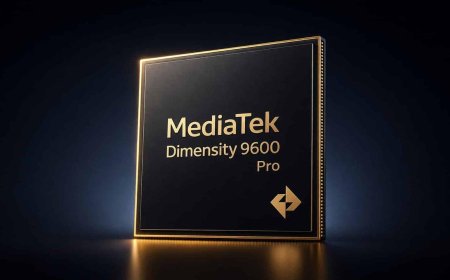
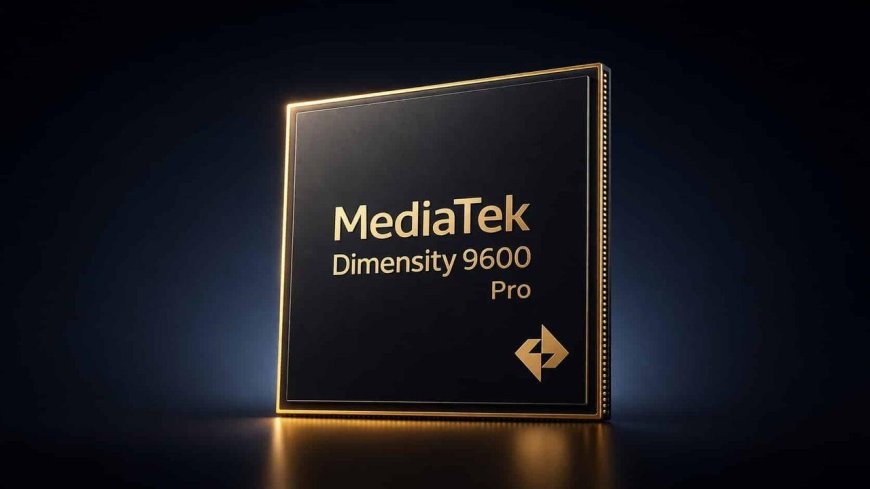
MediaTek has officially unveiled the Dimensity 9600 Pro, its first smartphone processor built on a 2nm process. With an all-big-core CPU, dual NPU architecture, LPDDR6 memory, UFS 5.0 storage, a new Mali-G2 Ultra NX GPU and major on-device AI upgrades, the 9600 Pro is designed to compete directly at the highest end of the smartphone market.

MediaTek Just Took Its Biggest Step Into the 2nm Era
For years, smartphone processor launches have followed a familiar pattern: a little more performance, a little better efficiency and another round of benchmark numbers. The Dimensity 9600 Pro feels more significant than that. MediaTek has officially introduced its new flagship processor as its first smartphone chip built using a 2nm process, marking a major manufacturing jump and putting the company directly into the next generation of flagship silicon. The chip is built using TSMC's advanced 2nm technology and is designed around a combination of performance, efficiency and on-device AI rather than focusing on raw CPU speed alone.
And that last part is important. Modern smartphones are no longer just trying to open apps faster. They are increasingly expected to translate conversations, edit photos with AI, summarize information, run generative AI models and perform tasks in the background without constantly sending everything to the cloud. MediaTek is clearly designing the Dimensity 9600 Pro for that world. Its new architecture combines CPU, GPU, NPU and ISP resources more closely, with the company calling the approach Native AI Architecture.
Dimensity 9600 Pro Specs at a Glance
| Specification | Dimensity 9600 Pro |
|---|---|
| Manufacturing process | TSMC 2nm |
| CPU | 8-core, 2+3+3 All Big Core |
| CPU cores | 2× Arm C2-Ultra + 6× Arm C2-Pro |
| Maximum clock speed | Up to 4.55GHz |
| GPU | Arm Mali-G2 Ultra NX |
| AI | MediaTek NPU 1090 + Super Efficient NPU 2.0 |
| RAM | LPDDR6 / LPDDR5X |
| Storage | UFS 5.0 |
| Cache | 16MB L3 + 10MB SLC |
| Camera support | Up to 200MP |
| Video | Up to 8K60; 4K240 slow motion |
| Display | Up to WQHD+ 180Hz |
| Cellular | 5G Advanced |
| Wi-Fi | Wi-Fi 7 |
| Bluetooth | Bluetooth 6.2 |
| AI model support | Up to 30B-parameter models on-device |
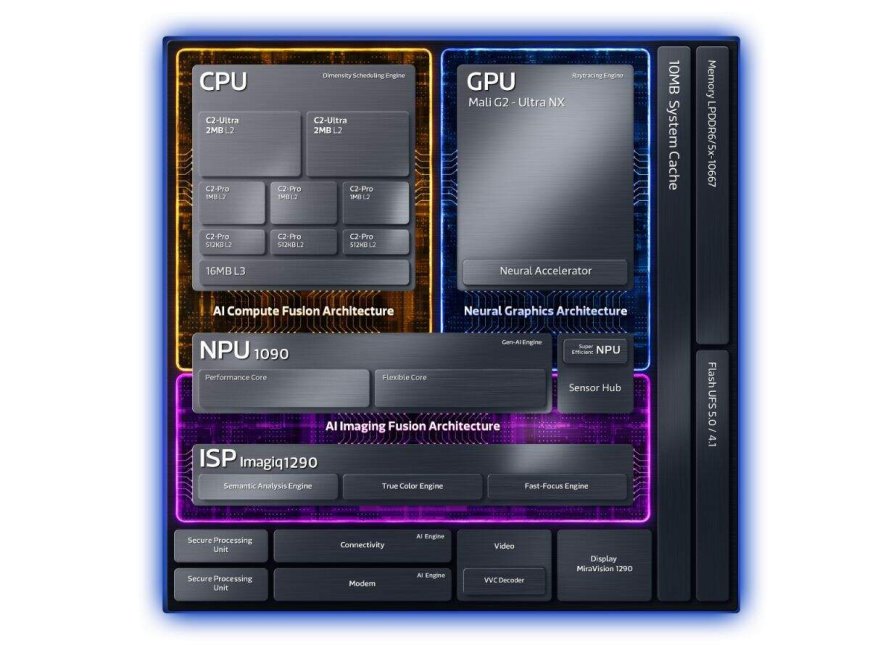
MediaTek's official specifications show just how aggressively the company is pushing the platform. The processor uses an 8-core 2+3+3 configuration: two Arm C2-Ultra cores can reach 4.55GHz, three C2-Pro cores run at up to 4.35GHz, and another three C2-Pro cores operate at up to 3.1GHz. Unlike older designs that combine large performance cores with smaller efficiency cores, this is an all-big-core architecture.
The 2nm Process Is About More Than a Smaller Number
The headline "2nm" sounds like a simple upgrade from 3nm, but the real story is what that smaller manufacturing process can potentially deliver. Smaller transistor technology can allow chip designers to pack more computing capability into a similar physical area while improving efficiency. MediaTek claims the Dimensity 9600 Pro delivers up to 17% higher single-core performance and 15% higher multi-core performance than its previous flagship, while claiming 37% better single-core power efficiency and a 61% reduction in multi-core power consumption. These are MediaTek's comparisons against the previous-generation flagship and should therefore be treated as company claims until independent testing across shipping phones provides a broader picture.
This is arguably more important than the benchmark headline. A faster processor is nice, but a processor that can deliver similar workloads while consuming substantially less power could have a much more noticeable effect on everyday phones. In theory, that could mean less heat, better sustained performance and more battery life when manufacturers take advantage of the efficiency gains rather than simply spending the extra power on higher performance.
AI Is Where MediaTek Really Wants to Win
The Dimensity 9600 Pro isn't being marketed simply as a faster CPU. MediaTek has built the chip around a dual-NPU architecture, combining the NPU 1090 for demanding generative and agentic AI workloads with a Super Efficient NPU 2.0 designed for lower-power, always-on AI tasks.
MediaTek claims the NPU 1090 delivers 51% faster LLM prefill performance and 55% greater token generation per watt, while supporting on-device models of up to 30 billion parameters. The company also says its second-generation efficient NPU can reduce power consumption for always-on AI workloads by 40%. In practical terms, the goal is to let more AI processing happen directly on the phone instead of constantly relying on a remote server.
That could become increasingly useful as smartphones move toward what MediaTek calls an "agentic" experience. Instead of simply answering a question when you ask it, an AI assistant could potentially understand context, work across apps and perform more complicated tasks. Of course, how impressive that actually feels will depend heavily on the software individual phone manufacturers build around the chip.
Gaming Gets a Serious Upgrade Too
Gamers haven't been forgotten. The Dimensity 9600 Pro introduces the Arm Mali-G2 Ultra NX GPU, supported by MediaTek's Neural Graphics Architecture and a third-generation ray-tracing engine. MediaTek claims up to 27% higher peak GPU performance, 24% better power efficiency at peak performance and up to 18% faster ray tracing compared with the previous generation.
The chip is also designed to support gaming at frame rates of up to 185fps, although actual frame rates will obviously depend on the game, resolution, thermal system and display used by the phone. MediaTek is combining GPU rendering with AI processing to improve graphics quality and performance, including neural rendering and ray-tracing features.
This is where the 2nm efficiency story could become particularly interesting. Smartphone gaming can push a processor hard for long periods, and peak benchmark performance doesn't tell the whole story. The real test will be whether phones using the 9600 Pro can maintain high performance without becoming uncomfortably hot or rapidly draining their batteries.
Camera and Video Capabilities Are Flagship-Level
MediaTek has also upgraded the imaging side of the platform with its Imagiq 1290 ISP and AI Imaging Fusion Architecture. The chip can support camera sensors up to 200MP, 8K60 video and 4K240 slow-motion recording. It also supports 4K120 video with electronic stabilization, 4K60 HDR processing and advanced computational photography features.
One particularly interesting capability is MediaTek's claim of 4K240 native direct-output ultra-slow-motion video, alongside AI-assisted subject tracking and professional-oriented video features such as 4K120 cinematic log. The chip also supports 17-stop HDR imaging features. Again, the hardware provides the foundation, but the final camera experience will depend on the phone's sensors, lenses and software tuning.
LPDDR6 and UFS 5.0 Make the Whole Phone Faster
The Dimensity 9600 Pro is also among the first smartphone platforms to support LPDDR6 memory and UFS 5.0 storage. MediaTek says LPDDR6 can provide a 33% increase in effective memory bandwidth at the same frequency, while UFS 5.0 is designed to provide roughly twice the read/write performance of the previous generation.
That matters because a flagship processor can only work as quickly as the rest of the system allows. Faster storage can make large files and applications move more quickly, while greater memory bandwidth can help feed demanding AI and graphics workloads. The result should be a more balanced platform rather than simply a faster CPU sitting next to slower supporting components.
Connectivity Is Ready for the Next Generation
On the networking side, the 9600 Pro includes an integrated 5G Advanced modem with support for up to 350MHz of sub-6GHz carrier aggregation and download speeds above 7.4Gbps under supported conditions. It also brings Wi-Fi 7, Bluetooth 6.2 and MediaTek's AI-based connectivity features for network optimization.
The company is also paying attention to security. The processor includes hardware-root-of-trust capabilities and post-quantum cryptography features, while MediaTek says its AI privacy architecture can isolate AI workloads to help protect user data. As phones become more dependent on local AI, keeping those AI processes secure is becoming just as important as making them fast.
So, Is the Dimensity 9600 Pro Actually a Big Deal?
On paper, yes — this is one of MediaTek's most ambitious smartphone chips yet. The combination of a 2nm manufacturing process, all-big-core CPU, dual NPUs, LPDDR6, UFS 5.0, powerful ray tracing and extensive on-device AI support makes the 9600 Pro look less like an incremental refresh and more like a platform built for the next phase of smartphones.
But there is one important thing to remember: a chipset specification sheet is not a phone review. MediaTek's performance and efficiency numbers are controlled company comparisons, and real-world results will depend on the handset, cooling system, software optimization, battery capacity and how aggressively each manufacturer configures the chip. Independent testing will ultimately tell us whether the 2nm efficiency advantage survives outside the laboratory.
The First Phones Are Coming Soon
MediaTek says the first smartphones using the Dimensity 9600 Pro and Dimensity 9600M are expected to launch during the third quarter of 2026. Reuters reports that manufacturers including Xiaomi, Oppo and Vivo are expected to use the new chips. Oppo has already confirmed that its Find X10 Pro Max will use the Dimensity 9600 Pro, with its China launch scheduled for September 22.
That makes the next few months particularly interesting for the Android flagship market. Qualcomm is also moving toward its own next-generation 2nm smartphone silicon, meaning MediaTek's head start may not remain uncontested for long. The real battle is therefore only beginning.
Final Verdict
The Dimensity 9600 Pro represents something bigger than another number in MediaTek's Dimensity lineup. It is the company's attempt to prove that it can compete at the absolute top of the smartphone processor market while the definition of a "smartphone" itself is changing.
The move to 2nm, the focus on power efficiency and the huge investment in local AI all point in the same direction: the next flagship phone isn't simply going to be faster. It is going to be expected to understand more, process more locally and perform more tasks without constantly depending on the cloud.
Whether MediaTek has actually delivered a new performance king will have to wait for independent reviews and real phones. But on paper, the Dimensity 9600 Pro has given the Android flagship market a very interesting new contender — and the 2nm smartphone race has officially begun.
What's Your Reaction?
 Like
0
Like
0
 Dislike
0
Dislike
0
 Love
0
Love
0
 Funny
0
Funny
0
 Angry
0
Angry
0
 Sad
0
Sad
0
 Wow
0
Wow
0