






































US Stock Market Today: Wall Street Heads Into October With Nasdaq Near Record as Fed Pressure Eases
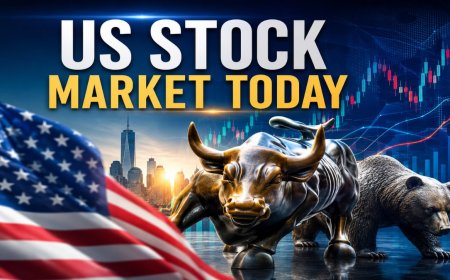
US stock futures edged higher on October 5, 2026, as investors entered a new trading week after a strong Friday rally driven by weaker-than-expected September jobs data. The Nasdaq remains close to record territory, while the S&P 500 is less than 1% below its all-time high. Investors are now weighing softer employment data, elevated Treasury yields, oil prices, AI-driven technology gains and the Federal Reserve's next move.
US Stock Market Today: Wall Street Heads Into October With Nasdaq Near Record as Fed Pressure Eases
Wall Street is entering the first full trading week of October with investors in a noticeably more optimistic mood, but the market is far from free of risks. US stock futures moved modestly higher Sunday evening into Monday, October 5, after a powerful rally at the end of last week pushed the Nasdaq Composite to a record close and brought the S&P 500 back within striking distance of its own all-time high. The immediate catalyst was not another blockbuster technology announcement, but a weaker US jobs report that changed the interest-rate conversation on Wall Street.
The latest futures trading showed a cautious start rather than another explosive rally. Dow Jones futures were up about 0.1%, S&P 500 futures gained roughly 0.1%, while Nasdaq-100 futures advanced around 0.25%. The moves suggest investors are willing to carry Friday's momentum into the new week, although the relatively small gains also show that traders are waiting for fresh economic and corporate signals before making bigger bets.
Nasdaq Leads the Market as Technology Stocks Stay in Focus
The technology-heavy Nasdaq remains the strongest major US index this year. Friday's session saw the Nasdaq Composite climb 1.2% to 27,190.86, while the S&P 500 gained 0.7% to 7,722.72 and the Dow Jones Industrial Average rose 0.5% to 51,176.96. The Russell 2000, which tracks smaller US companies, also gained 0.9%.
Those numbers tell an important story about the current market. Investors are still willing to pay for growth, particularly in companies connected to artificial intelligence, semiconductors and large-scale technology infrastructure. The Nasdaq is up about 17% for the year, compared with roughly 12.8% for the S&P 500 and 6.5% for the Dow through the end of last week.
That leadership is increasingly concentrated, however. AI-related companies have become an enormous part of both the equity and credit markets, and investors are beginning to pay closer attention to what could happen if expectations around AI spending or earnings growth cool. Recent analysis has highlighted how broadly AI exposure now runs through large US companies, making the technology trade both a major source of market strength and an increasingly important source of concentration risk.
Weak Jobs Data Changes the Federal Reserve Equation
The biggest market-moving development heading into October came from Friday's employment report. The US economy added only 29,000 nonfarm jobs in September, dramatically below the roughly 90,000 increase economists had expected. The unemployment rate also edged up to 4.2%, while August's payroll gain was revised lower.
For Wall Street, the significance goes beyond the headline jobs number. A cooling labor market reduces some of the pressure on the Federal Reserve to raise interest rates again immediately. Traders therefore reacted positively, pushing stocks higher and Treasury yields lower initially as expectations for an October rate increase faded.
The report does not necessarily mean the US economy is heading into a recession. The labor market is clearly softer, but the latest data did not point to a sudden wave of layoffs. Instead, the picture is becoming more complicated: employment growth is slowing while inflation, energy prices and borrowing costs remain elevated. That combination leaves the Federal Reserve with less room for an easy policy decision.
Treasury Yields Remain Wall Street's Biggest Headache
The stock market's enthusiasm has a major counterweight: government bond yields remain unusually high. The 10-year Treasury yield recently moved above 5.3%, while the longer-term bond market has experienced significant selling pressure. Higher yields matter because they raise borrowing costs across the economy and make future corporate earnings less valuable when investors calculate stock valuations.
That issue is particularly important for technology companies. Many of the biggest AI and software businesses trade at valuations that depend heavily on expectations for strong future growth. When Treasury yields rise sharply, investors can become less willing to pay premium prices for those future earnings.
This explains why Wall Street has been able to rally while still looking nervous underneath the surface. The Nasdaq can make new highs while bond investors are sending a much more cautious message. Recent trading has repeatedly shown how quickly rising yields can pressure technology and semiconductor shares.
AI Stocks Remain the Engine of Wall Street
Artificial intelligence continues to sit at the center of the US stock market story. Nvidia remains one of the most important companies to watch because the company's GPUs are central to the infrastructure behind today's AI boom. Investors are also watching semiconductor manufacturers, cloud companies, data-center operators and software businesses that could benefit from continued AI investment.
Nvidia recently returned to the spotlight after Morgan Stanley placed the company back at the top of its semiconductor picks, pointing to its broad customer base and the importance of its GPUs to the development of agentic AI systems. The renewed optimism around Nvidia reflects the broader belief that AI infrastructure spending still has significant room to grow.
But the market is becoming less willing to treat every AI-related company as an automatic winner. Investors are increasingly asking a more difficult question: how much revenue and profit growth will companies actually generate from the enormous amount of money being spent on AI infrastructure? That distinction could become increasingly important as third-quarter earnings season gets underway.
Corporate Earnings Could Give the Market Its Next Direction
October also brings the beginning of another major corporate earnings season. Investors will be looking beyond headline revenue and profit numbers and paying close attention to forward guidance, capital spending and comments about AI-related demand.
Corporate optimism remains unusually strong. A recent FactSet-based analysis found that 72 of 116 S&P 500 companies that had issued third-quarter earnings-per-share outlooks were above Wall Street expectations. That was the highest proportion recorded in the dataset's roughly two-decade history. Technology companies accounted for a large part of that optimism.
That creates an interesting setup for the market. Stock prices are already elevated, particularly in technology, so companies may need to deliver more than simply acceptable results. Strong earnings and confident guidance could reinforce the rally, while even a small disappointment could trigger sharp reactions in expensive stocks.
Oil Prices and Geopolitical Risks Still Matter
Oil remains another variable investors cannot ignore. Crude prices have stayed elevated amid continuing geopolitical tensions and concerns surrounding supply through key Middle Eastern routes. Brent crude settled around $102.25 a barrel at the end of last week, adding another layer of uncertainty to the inflation outlook.
Expensive oil can create a difficult chain reaction for markets. Higher fuel costs can increase transportation and production expenses, squeeze consumers and make it harder for inflation to fall. If inflation remains stubborn, the Federal Reserve could face pressure to maintain restrictive monetary policy for longer than investors currently expect.
That is why the stock market's reaction to economic data may remain unusually sensitive. A weak jobs report can boost stocks by reducing rate-hike expectations, but a sharp rise in oil prices could work in the opposite direction by reigniting inflation concerns.
What Investors Are Watching on October 5
The immediate focus is likely to remain on Treasury yields, US stock futures, technology shares and any new developments that could change expectations for Federal Reserve policy. Investors will also be watching the early stages of the third-quarter earnings season, where corporate guidance may determine whether the current AI-led rally has enough fundamental support to continue.
The market begins the week from a strong technical position, but the picture underneath is more complicated. The Nasdaq is at record levels, the S&P 500 is close to its peak and major technology stocks continue to attract money. At the same time, bond yields are high, market breadth remains less convincing than the index gains suggest, and investors are increasingly conscious of how heavily the market depends on AI-related companies.
US Stock Market Outlook: Strong Momentum, But Less Room for Mistakes
Wall Street's October story is therefore not simply about whether stocks will rise or fall. The more important question is whether earnings growth, AI investment and a still-resilient economy can justify today's elevated valuations while interest rates and oil prices remain uncomfortable.
Friday's jobs report gave investors a reason to breathe easier about an immediate Federal Reserve rate increase, and that helped push the major indexes higher. But one weak employment report does not settle the rate debate. The next moves in Treasury yields, inflation, corporate earnings and oil prices could quickly change the mood.
For now, the bulls still have the upper hand. The Nasdaq is leading, the S&P 500 is close to a record and US companies are entering earnings season with unusually optimistic profit expectations. Yet October could also become a test of how much further the market can climb when valuations are already stretched and investors have very little tolerance for disappointing news. That tension—between powerful AI-driven growth and rising macroeconomic risks—is likely to define Wall Street's next major move.
What's Your Reaction?
 Like
0
Like
0
 Dislike
0
Dislike
0
 Love
0
Love
0
 Funny
0
Funny
0
 Angry
0
Angry
0
 Sad
0
Sad
0
 Wow
0
Wow
0