





























AMD Joins the $1 Trillion Club as the AI Chip Race Enters a New Phase
Advanced Micro Devices has crossed the $1 trillion market-capitalization milestone for the first time, becoming the fourth U.S. chipmaker to reach that level. AMD shares surged nearly 10% on September 21, as investors returned aggressively to AI-related stocks and increasingly bet on AMD's growing role in AI infrastructure.

AMD Has Officially Entered the Trillion-Dollar Club
Advanced Micro Devices has just crossed a milestone that would have sounded almost unimaginable a few years ago. AMD's market capitalization moved above $1 trillion for the first time on September 21, after its shares jumped roughly 10% and reached a record high. The company later closed at about $615.52 per share, putting its market value around the trillion-dollar mark.
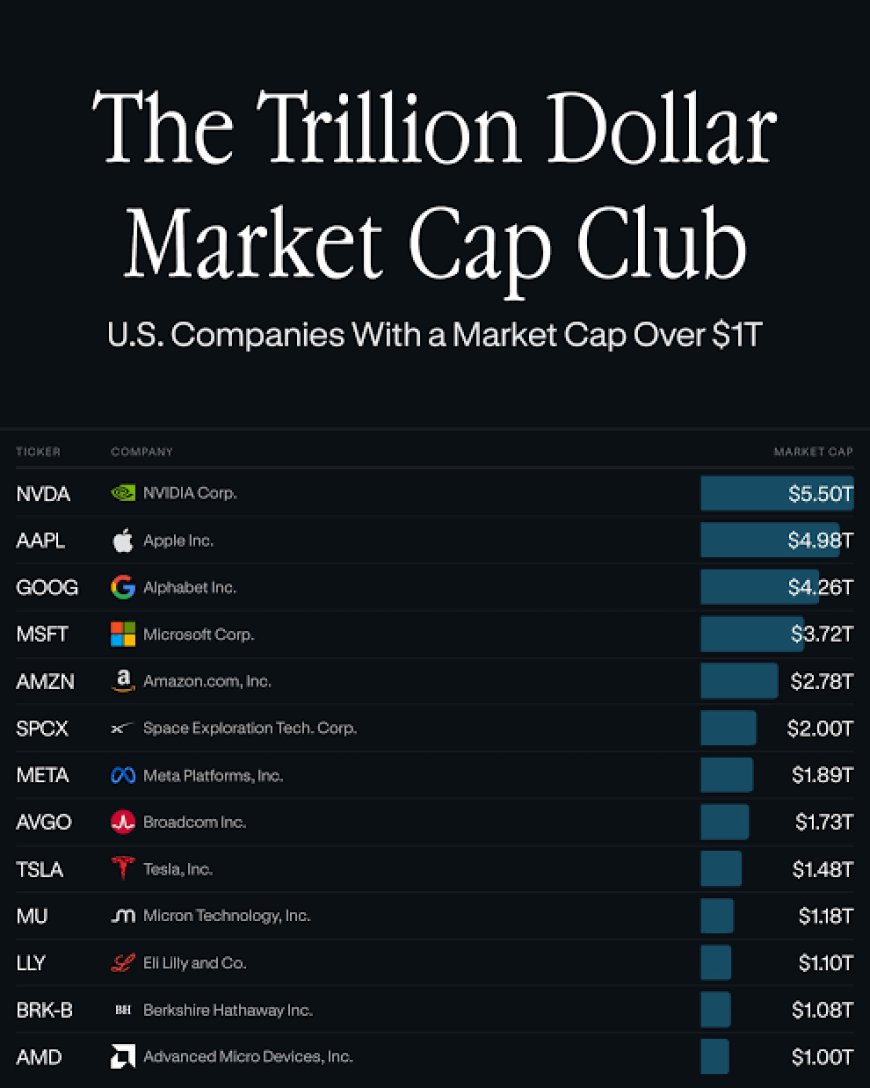
The milestone puts AMD in an extremely exclusive group of American semiconductor companies. It is now the fourth U.S. chipmaker to reach a $1 trillion valuation, joining Nvidia, Broadcom and Micron. Nvidia crossed the same threshold in 2023 and has since grown into a company worth more than $5 trillion. AMD is still far behind Nvidia in market value, but reaching $1 trillion represents a dramatic change in how investors view the company and its place in the AI economy.
The AI Boom Is Pulling AMD Higher
The obvious reason behind the excitement is artificial intelligence. The world's biggest technology companies are spending enormous amounts on data centers and computing infrastructure, and those systems require huge quantities of processors. Nvidia remains the dominant name in AI accelerators, but AMD has increasingly positioned itself as one of its most important competitors.
AMD's opportunity is also becoming broader than simply selling graphics processors. Its EPYC server CPUs are used alongside accelerators in AI data centers, while the company has been expanding its portfolio of AI chips, networking technology and complete computing systems. Investors are increasingly looking at AMD as a company that can benefit from several parts of the rapidly expanding AI infrastructure market.
The Numbers Behind the Rally Are Huge
AMD's recent stock performance makes the $1 trillion milestone even more remarkable. Reuters reported that AMD shares had nearly tripled during 2026 before the latest move, while the stock reached roughly $613.92 during Monday's trading session. By the close, shares were up about 10%.
The company's underlying business has also been growing rapidly. AMD reported $11.54 billion in second-quarter revenue, up 50% from the same period a year earlier, while its Data Center segment generated about $6.7 billion, more than doubling from the previous year. Those figures give investors something beyond the AI hype to watch: AMD is already seeing substantial growth from the infrastructure being built to support AI.
Investors Are Suddenly Buying the AI Story Again
AMD's breakthrough came during a powerful rally across the semiconductor industry. Intel jumped more than 12% on Monday, Arm Holdings also posted a double-digit gain, and the Philadelphia Semiconductor Index climbed about 4.3%. The Nasdaq itself closed at a record high, rising 2.26%.
The timing is interesting because enthusiasm around AI stocks had cooled in recent months. Investors had begun questioning whether the enormous spending by technology companies on AI infrastructure could continue indefinitely. Recent warnings from some AI leaders about safety and the pace of development had also contributed to uncertainty. Monday's market action suggested that, at least for the moment, investors were once again focusing heavily on the potential economic growth created by AI.
AI Agents Could Create Another Wave of Demand
There is another piece of the story that could become increasingly important: AI agents.
Traditional AI applications mostly respond to individual requests. Agentic AI is designed to perform multiple steps, interact with software and continue working toward a goal with less human intervention. If these systems become widely used, they could require large amounts of computing power because they may make repeated model calls and perform many tasks in the background.
Recent investor excitement around Meta's AI agent Muse has added to that conversation. Market reports have linked the growing interest in agentic AI with renewed enthusiasm for companies supplying the processors and infrastructure needed to run these workloads.
For AMD, that could be an important opportunity. The company's leadership has identified agentic AI as a potentially enormous market, while its CPUs and AI accelerators can play different roles inside the infrastructure needed to run these systems.
AMD vs. Nvidia Is Still the Bigger Story
Crossing $1 trillion does not suddenly make AMD equal to Nvidia. Nvidia remains vastly larger and has a commanding position in AI accelerators. But AMD's milestone makes one thing clear: investors see room for more than one giant chip company in the AI era.
The competition is becoming much broader than a simple battle over which company makes the fastest GPU. It now involves CPUs, AI accelerators, networking, memory, data-center systems and the enormous infrastructure required to connect all of them. AMD is trying to capture a larger share of that ecosystem while Nvidia continues to expand its own position.
From Underdog to Trillion-Dollar Chipmaker
Perhaps the most striking part of AMD's story is how quickly its market value has changed. MarketWatch reported that AMD was worth around $255 billion at the same point a year earlier. Reaching roughly $1 trillion in just twelve months shows how dramatically investor expectations around AI infrastructure have shifted.
Of course, a market capitalization is not the same thing as money sitting in AMD's bank account. It is calculated from the company's share price and outstanding shares and changes constantly as the stock moves. AMD even moved above and below the $1 trillion threshold during trading as its share price fluctuated.
But the symbolism is hard to miss. AMD has gone from being known primarily as Intel's longtime CPU rival and Nvidia's challenger in graphics to becoming a $1 trillion semiconductor company riding one of the biggest technology shifts in decades.
The AI race is no longer just about who builds the most impressive models. Behind every chatbot, AI agent and automated service is an enormous amount of computing hardware. And with AMD now officially inside the trillion-dollar club, the semiconductor industry is showing just how much money investors believe could be created by the machines powering the next generation of AI.
What's Your Reaction?
 Like
0
Like
0
 Dislike
0
Dislike
0
 Love
0
Love
0
 Funny
0
Funny
0
 Angry
0
Angry
0
 Sad
0
Sad
0
 Wow
0
Wow
0